Breast Surgery and Breastfeeding: What You Should Know
breast surgery and breastfeeding
breastfeeding after breast augmentation; breastfeeding after breast reduction; breastfeeding after breast lift; breast implants and breastfeeding; breast surgery before pregnancy; milk supply after breast surgery
Breast Surgery and Breastfeeding: What You Should Know
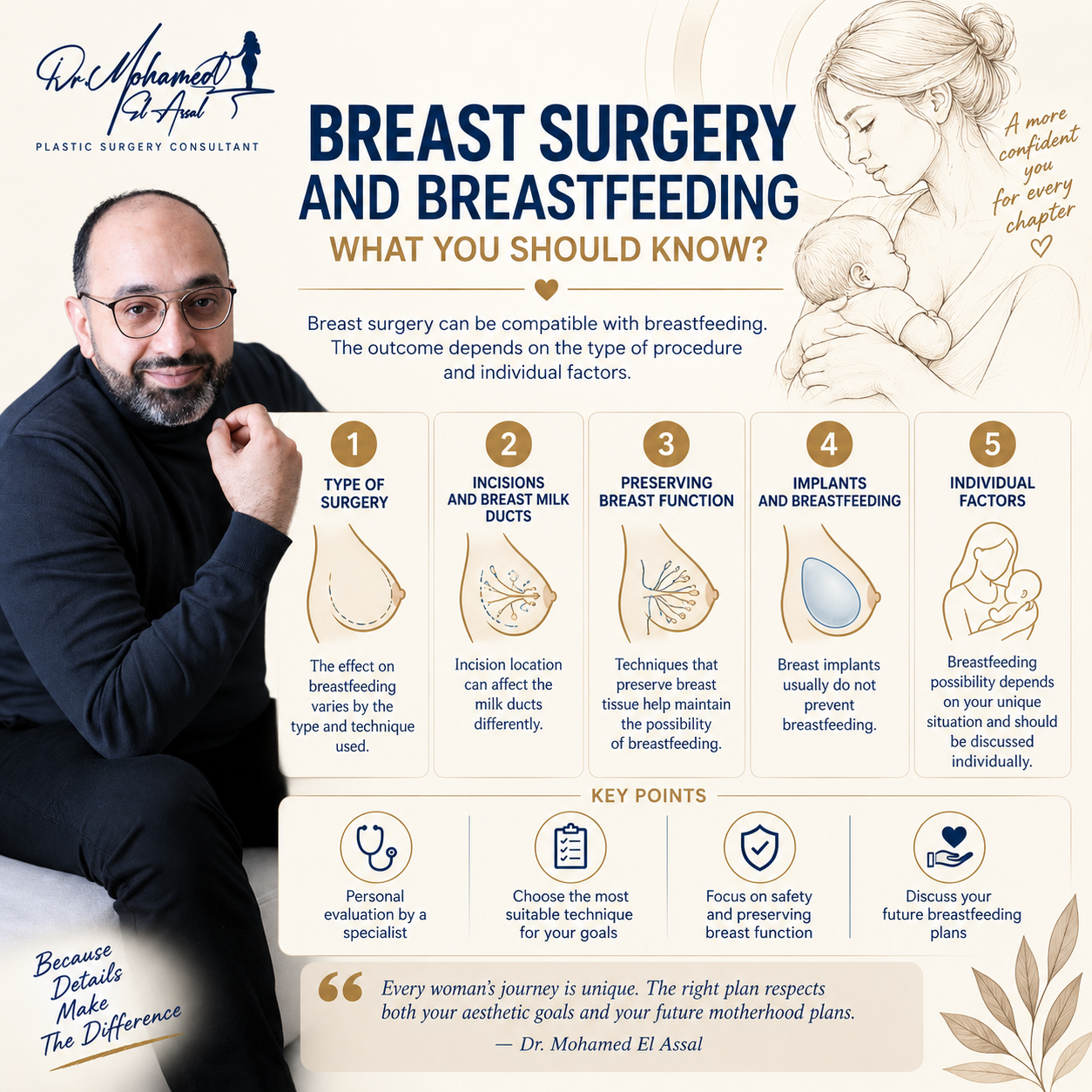
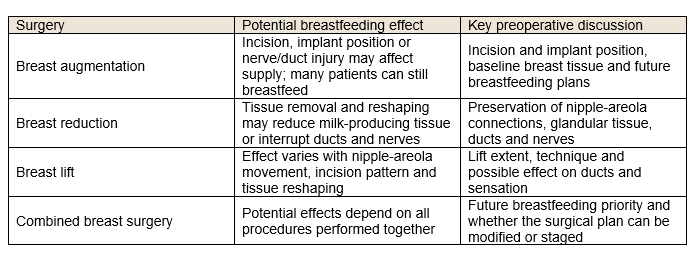
Breast surgery can affect future breastfeeding to different degrees, but previous surgery does not automatically mean breastfeeding will be impossible. The effect depends on the operation, incision placement, preservation of milk-producing tissue, ducts and nipple sensation, as well as factors unrelated to surgery that influence milk production after pregnancy and delivery.
If future pregnancy and breastfeeding matter to you, discuss them before breast augmentation, reduction or lift. The purpose is not to promise a particular breastfeeding outcome, but to understand how the proposed technique may affect lactation anatomy and to plan support after birth if milk production turns out to be partial rather than complete.
If future pregnancy and breastfeeding matter to you, discuss them before breast augmentation, reduction or lift. The purpose is not to promise a particular breastfeeding outcome, but to understand how the proposed technique may affect lactation anatomy and to plan support after birth if milk production turns out to be partial rather than complete.
Can you breastfeed after breast surgery?
Yes. Many people can produce at least some milk after breast surgery, but a full milk supply cannot be predicted. CDC states that augmentation, reduction and lift can affect breast nerves and ducts, and some mothers may need additional lactation support or supplementation if milk production does not fully meet the infant’s nutritional needs.
How can breast surgery affect milk production?
Milk production can be affected when surgery removes glandular tissue, interrupts milk ducts or injures nerves that contribute to the hormonal response to breastfeeding. CDC notes that severed ducts may reconnect or form new pathways and nerves may regain function over time, but the extent of recovery cannot be predicted reliably before lactation begins.
Can you breastfeed after breast augmentation?
Breastfeeding is possible after augmentation, although some patients may have reduced milk production. CDC and Cleveland Clinic note that implant position, incision location and effects on nerves or ducts can matter. Research findings are not completely consistent, so neither full breastfeeding nor insufficient supply can be predicted from the presence of an implant alone.
Are silicone breast implants unsafe for a breastfed baby?
CDC notes that research remains limited, but there are no recent reports of clinical problems in infants of mothers with silicone implants, and implants are not routinely considered a reason to avoid breastfeeding. Medical review is still appropriate if the mother has an implant complication, breast symptoms or concerns about milk production.
Does breast reduction affect breastfeeding more than augmentation?
Breast reduction can have a greater potential impact because it removes breast tissue, fat and skin and may interrupt ducts or nerves connected to the nipple. Mayo Clinic lists difficulty or inability to breastfeed as a risk, while systematic reviews suggest preservation of tissue connections beneath the nipple-areola complex may influence later lactation potential.
Why do breastfeeding outcomes vary between breast reduction techniques?
Reduction techniques preserve different amounts of the tissue, ducts and nerves connecting the nipple-areola complex to the breast. A systematic review found substantial variation across techniques and studies, while newer reviews emphasize that definitions of breastfeeding “success” are inconsistent. A single percentage therefore should not be applied to every reduction procedure.
Can you breastfeed after a breast lift?
A breast lift does not necessarily prevent breastfeeding, but lactation can be affected depending on the technique and how nipple, areola and surrounding tissues are moved. Mayo Clinic says breastfeeding is usually possible after mastopexy while acknowledging possible low supply, whereas Cleveland Clinic lists future inability to lactate among potential surgical complications.
Does incision placement matter for future breastfeeding?
Yes. Incisions and techniques that disrupt nerves or ducts around the nipple-areola complex may affect milk production or transfer. CDC states that incisions around the areola and procedures that completely detach the nipple and areola are more likely to reduce milk production, although a circular areolar scar alone does not prove complete detachment.
Does breast implant placement affect milk supply?
Implant position may matter, but it is not the only factor. CDC states that implants below the muscle usually affect milk production less than implants above the muscle. More recent reviews emphasize that breastfeeding outcomes also depend on surgical technique, pre-existing glandular tissue, complications and other maternal factors affecting lactation.
What should you tell your surgeon if future breastfeeding matters to you?
Tell your surgeon clearly that preserving future breastfeeding potential is important. Discuss the planned incision, implant position when relevant, nipple-areola handling and how much glandular tissue or ductal connection may be preserved. No technique can guarantee a full milk supply, but reproductive plans can meaningfully inform the surgical discussion before you decide.
What should you do after delivery if you have had breast surgery?
Tell your obstetric, pediatric and lactation teams about the previous operation and, if known, the technique used. CDC recommends close infant growth monitoring because some mothers produce only part of the required milk supply. An experienced lactation consultant can support milk stimulation, latch and supplementation decisions when additional nutrition is needed.
Does partial milk production mean breastfeeding has failed?
No. A mother may produce part of her infant’s milk needs and continue breastfeeding while using supplementation when medically necessary. CDC emphasizes support and infant growth monitoring rather than an all-or-nothing definition. Management depends on actual milk transfer, infant weight gain, feeding effectiveness and assessment by the maternity and pediatric care teams.
Should you postpone breast surgery if you plan pregnancy soon?
Postponement may be reasonable for some patients because pregnancy and breastfeeding can change breast volume, skin and shape, and future lactation goals may influence surgical technique. Mayo Clinic advises considering delay of breast lift or reduction when pregnancy is planned. The decision remains individual and balances current symptoms, goals and reproductive plans.
Can a surgeon predict who will have a full milk supply after surgery?
Not reliably. Lactation depends on more than the operation itself, including baseline glandular tissue, hormonal response, nerve function, duct continuity and effective milk removal after birth. Surgery-related risks can be discussed and sometimes reduced, but an individual future milk supply cannot be guaranteed before pregnancy and breastfeeding are actually established.
Dr. Mohamed El Assal – Expertise
Dr. Mohamed El Assal's surgical philosophy in breast surgery reflects a commitment to natural proportions, balanced contours, and results that harmonize with each patient's body. Every procedure is carefully tailored to the individual's anatomy, personal goals, and unique proportions, with particular emphasis on safety, symmetry, and preserving a natural appearance. His approach combines surgical precision with an appreciation for aesthetic balance, aiming to achieve refined, long-lasting results that enhance each patient's natural silhouette — without standardized approaches or one-size-fits-all solutions.
Frequently asked questions about breast surgery and breastfeeding
Can you breastfeed after breast augmentation?
Yes. Many patients can breastfeed after augmentation, although some may produce less milk. Implant position, incision location and preservation of nerves, ducts and glandular tissue can influence lactation. The implant itself does not determine the outcome, so future breastfeeding plans should be discussed before surgery and milk production should be assessed after delivery.
Can you breastfeed after breast reduction?
Breastfeeding can occur after reduction, but reduced milk production may be more likely because tissue is removed and ducts or nerves can be affected. Outcomes vary with technique, preserved tissue and nipple-areola connections. Evidence does not support one universal success rate, making preoperative counseling and postpartum lactation support particularly important.
Can you breastfeed after a breast lift?
reastfeeding may remain possible after mastopexy, but it cannot be guaranteed. The effect depends on incision pattern, tissue reshaping and whether nerves or ducts associated with the nipple-areola complex are disrupted. Mayo Clinic notes that breastfeeding is usually possible, while acknowledging that some patients may have difficulty producing enough milk.
Does a scar around the areola mean breastfeeding will be impossible?
No. CDC specifically notes that a scar around the entire areola does not necessarily mean the nipple and areola were completely detached from their blood supply, nerves and ducts. However, some periareolar procedures can affect milk production. Details of the previous operation help the lactation team interpret possible risks after delivery.
Should I see a lactation consultant after delivery?
It can be especially helpful after previous breast surgery or when infant weight gain or milk supply is uncertain. CDC recommends referral for lactation support when challenges occur after breast surgery. A qualified consultant can help with latch, stimulation and milk removal while the pediatric team determines whether supplementation is needed.
Should I wait until after having children to get breast surgery?
There is no single answer for everyone. If pregnancy is planned soon or preserving breastfeeding potential is a high priority, postponing surgery may be worth discussing. Other patients have symptoms or goals that justify earlier treatment. The decision depends on the operation, current need, reproductive plans and the trade-offs discussed with the surgeon.
How does Dr. Mohamed El Assal discuss breast surgery when future breastfeeding matters?
The consultation starts by defining the breast concern and proposed operation, then discussing pregnancy and breastfeeding plans before the technique is finalized. Incision placement, nipple-areola movement, tissue removal and potential effects on ducts and nerves are reviewed. Preserving these structures may reduce impact, but no surgical plan can guarantee a complete future milk supply.
For more information about increasing breast volume, read: Breast Augmentation. [Internal Link → Breast Augmentation]
For more information about reducing breast size, read: Breast Reduction. [Internal Link → Breast Reduction]
For more information about correcting breast sagging, read: Breast Lift. [Internal Link → Breast Lift]
CTA: If future breastfeeding is important to you, say so during the consultation before choosing breast surgery. Ask specifically which ducts, nerves and glandular tissues may be affected by the proposed technique, and keep details of your operation so you can share them later with your pediatric or lactation team if needed.
For more information about increasing breast volume, read: Breast Augmentation. [Internal Link → Breast Augmentation]
For more information about reducing breast size, read: Breast Reduction. [Internal Link → Breast Reduction]
For more information about correcting breast sagging, read: Breast Lift. [Internal Link → Breast Lift]
CTA: If future breastfeeding is important to you, say so during the consultation before choosing breast surgery. Ask specifically which ducts, nerves and glandular tissues may be affected by the proposed technique, and keep details of your operation so you can share them later with your pediatric or lactation team if needed.
Internal Links
• Breast Reduction — https://drmohamedelassal.com/service/reduction/
• Breast Lift — https://drmohamedelassal.com/service/breast-lift/
• Breast Surgery — https://drmohamedelassal.com/faq/breast-surgery/
• Breast Lift — https://drmohamedelassal.com/service/breast-lift/
• Breast Surgery — https://drmohamedelassal.com/faq/breast-surgery/
References
Centers for Disease Control and Prevention (CDC). Breast Surgery and Breastfeeding. https://www.cdc.gov/breastfeeding-special-circumstances/hcp/illnesses-conditions/breast-surgery.html
Mayo Clinic. Breast lift. https://www.mayoclinic.org/tests-procedures/breast-lift/about/pac-20393218
Mayo Clinic. Breast reduction surgery. https://www.mayoclinic.org/tests-procedures/breast-reduction-surgery/about/pac-20385246
Cleveland Clinic. Breast Augmentation: What It Is, Types, Surgery & Recovery. https://my.clevelandclinic.org/health/treatments/11024-breast-augmentation
Cleveland Clinic. Breast Lift (Mastopexy): Surgery & Recovery. https://my.clevelandclinic.org/health/treatments/23298-breast-lift
Cleveland Clinic. Breast Reduction. https://my.clevelandclinic.org/health/treatments/11025-breast-reduction
Kraut RY, et al. The impact of breast reduction surgery on breastfeeding: Systematic review of observational studies. PLoS One. 2017. https://pubmed.ncbi.nlm.nih.gov/29049351/
Chen J, Zhu XM, Huynh MNQ, McRae M. Breastfeeding Outcome and Complications in Females With Breast Implants: A Systematic Review and Meta-Analysis. Aesthet Surg J. 2023. https://pubmed.ncbi.nlm.nih.gov/36752943/
Spatz DL. Breastfeeding after Breast Reduction Surgery. MCN Am J Matern Child Nurs. 2025. https://pubmed.ncbi.nlm.nih.gov/40571999/
Géczi AM, et al. Impact of Breast Augmentation, Reduction, and Nipple Repair on Breastfeeding Success: A Systematic Review and Meta-analysis. Aesthet Surg J. 2026. https://pubmed.ncbi.nlm.nih.gov/42308539/
Dr. Mohamed El Assal. Breast Reduction. https://drmohamedelassal.com/service/reduction/
Dr. Mohamed El Assal. Breast Lift. https://drmohamedelassal.com/service/breast-lift/
Dr. Mohamed El Assal. Breast Surgery. https://drmohamedelassal.com/faq/breast-surgery/
Medically reviewed by Dr. Mohamed El Assal, Consultant Plastic Surgeon
Mayo Clinic. Breast lift. https://www.mayoclinic.org/tests-procedures/breast-lift/about/pac-20393218
Mayo Clinic. Breast reduction surgery. https://www.mayoclinic.org/tests-procedures/breast-reduction-surgery/about/pac-20385246
Cleveland Clinic. Breast Augmentation: What It Is, Types, Surgery & Recovery. https://my.clevelandclinic.org/health/treatments/11024-breast-augmentation
Cleveland Clinic. Breast Lift (Mastopexy): Surgery & Recovery. https://my.clevelandclinic.org/health/treatments/23298-breast-lift
Cleveland Clinic. Breast Reduction. https://my.clevelandclinic.org/health/treatments/11025-breast-reduction
Kraut RY, et al. The impact of breast reduction surgery on breastfeeding: Systematic review of observational studies. PLoS One. 2017. https://pubmed.ncbi.nlm.nih.gov/29049351/
Chen J, Zhu XM, Huynh MNQ, McRae M. Breastfeeding Outcome and Complications in Females With Breast Implants: A Systematic Review and Meta-Analysis. Aesthet Surg J. 2023. https://pubmed.ncbi.nlm.nih.gov/36752943/
Spatz DL. Breastfeeding after Breast Reduction Surgery. MCN Am J Matern Child Nurs. 2025. https://pubmed.ncbi.nlm.nih.gov/40571999/
Géczi AM, et al. Impact of Breast Augmentation, Reduction, and Nipple Repair on Breastfeeding Success: A Systematic Review and Meta-analysis. Aesthet Surg J. 2026. https://pubmed.ncbi.nlm.nih.gov/42308539/
Dr. Mohamed El Assal. Breast Reduction. https://drmohamedelassal.com/service/reduction/
Dr. Mohamed El Assal. Breast Lift. https://drmohamedelassal.com/service/breast-lift/
Dr. Mohamed El Assal. Breast Surgery. https://drmohamedelassal.com/faq/breast-surgery/
Medically reviewed by Dr. Mohamed El Assal, Consultant Plastic Surgeon