True Gynecomastia vs Pseudogynecomastia: How Are They Different?
true gynecomastia vs pseudogynecomastia
gynecomastia vs chest fat; true gynecomastia; pseudogynecomastia; glandular gynecomastia; male chest fat; how to tell gynecomastia from fat; gynecomastia diagnosis; gynecomastia treatment; male breast reduction
True Gynecomastia vs Pseudogynecomastia: How Are They Different?
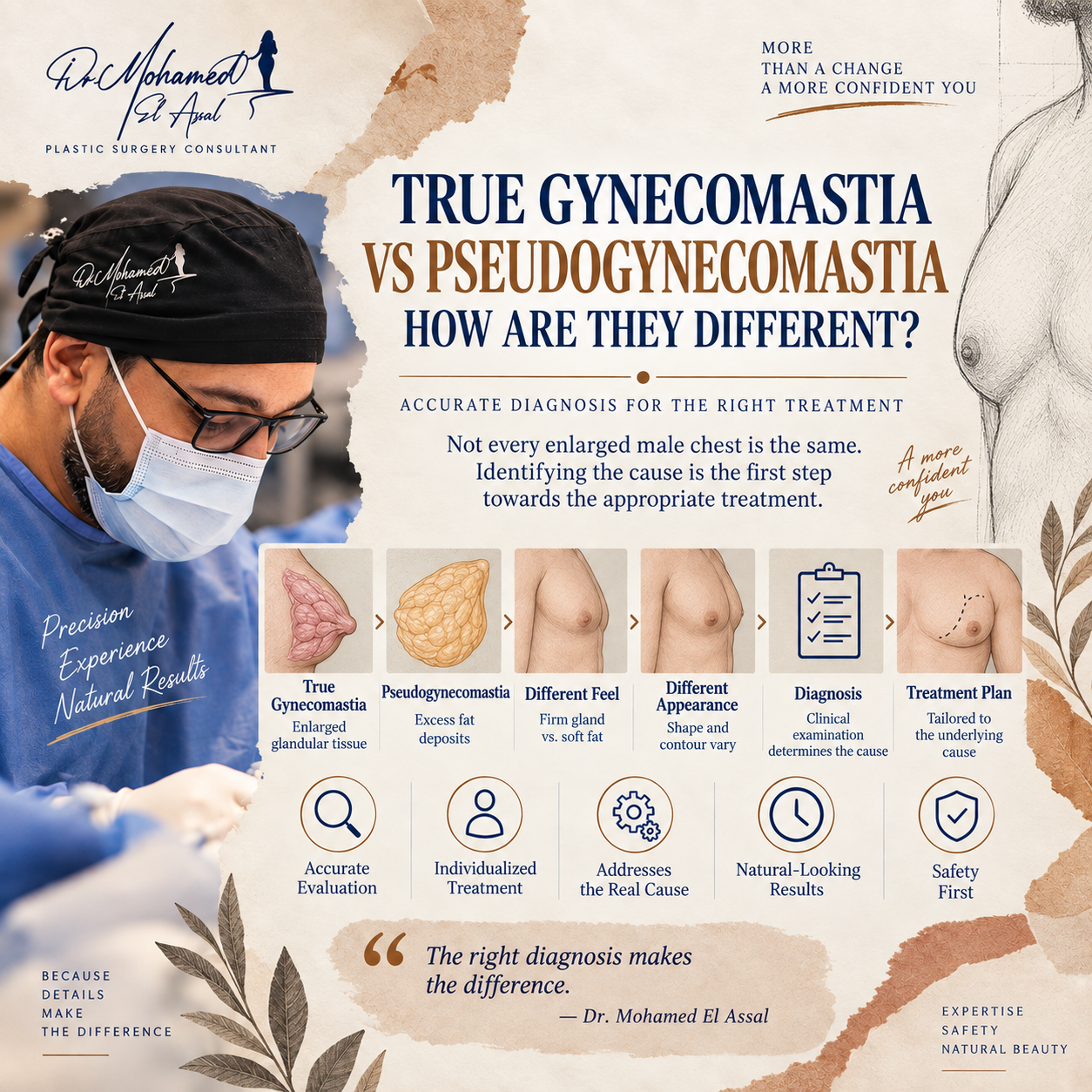
True gynecomastia is benign growth of glandular breast tissue in a male chest, while pseudogynecomastia is enlargement caused mainly by excess fat without comparable glandular proliferation. They can look similar from the outside, and gland and fat can coexist in the same chest, so diagnosis depends primarily on medical history and physical examination.
Distinguishing the tissue matters because treatment is not identical. Fat-related enlargement may improve with weight reduction or, in selected patients, liposuction. Persistent glandular tissue requires evaluation for possible hormonal, medication-related or medical causes and may be surgically excised when appropriate. The treatment plan follows the actual tissue and underlying cause.
Distinguishing the tissue matters because treatment is not identical. Fat-related enlargement may improve with weight reduction or, in selected patients, liposuction. Persistent glandular tissue requires evaluation for possible hormonal, medication-related or medical causes and may be surgically excised when appropriate. The treatment plan follows the actual tissue and underlying cause.
What is the difference between true gynecomastia and pseudogynecomastia?
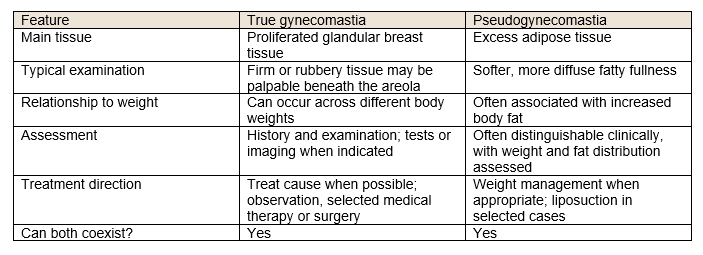
The key difference is the tissue causing chest enlargement. True gynecomastia contains proliferated glandular breast tissue, often felt as firmer tissue beneath or around the areola. Pseudogynecomastia is primarily excess adipose tissue and tends to feel softer and more diffuse. Some patients have both components, making clinical examination especially important.
Can you tell gynecomastia from chest fat by appearance alone?
Appearance alone cannot reliably determine whether enlargement is gland, fat or a mixture. Both can produce a similar chest contour, and excess fat can obscure a smaller glandular component. Examination assesses tissue consistency and distribution, skin quality, nipple-areola changes and any unusual mass before deciding whether laboratory tests or imaging are needed.
What does glandular tissue feel like on examination?
True gynecomastia may produce a firm or rubbery disc of tissue centered beneath the nipple-areola complex, whereas pseudogynecomastia tends to feel softer and more diffusely fatty. This distinction is useful clinically but is not a definitive home test because thicker fat layers or mixed tissue can make palpation less straightforward.
How does a doctor diagnose true gynecomastia or pseudogynecomastia?
Diagnosis starts with medical history and examination of the chest, including questions about onset, tenderness, weight change, medications, supplements, hormones, anabolic steroids and general health. European Academy of Andrology guidance recommends confirming palpable glandular tissue to distinguish true gynecomastia from lipomastia while also checking for findings that could suggest another breast condition.
Why do medications and hormones matter?
True gynecomastia can develop when estrogenic effects outweigh androgenic effects, and certain medications, substances or disorders involving the testes, thyroid, liver or kidneys can contribute. Finding a possible factor does not automatically prove causation. The clinician combines history and examination and orders targeted testing when there is a reason to investigate further.
Does every patient with gynecomastia need hormone tests?
Not every patient with clearly fatty chest enlargement requires a broad hormone panel, but adult true gynecomastia may warrant investigation depending on age, onset, symptoms and examination. European guidance lists several possible hormonal and organ-function tests, but these are selected according to the clinical situation rather than ordered as one mandatory panel for everyone.
What determines whether blood tests are needed?
Testing is guided by age, how quickly enlargement appeared, tenderness, medication or steroid exposure, signs of androgen deficiency, systemic illness and breast or testicular findings. The purpose is to investigate a plausible reversible or medical cause rather than order extensive tests automatically for every man with chest enlargement.
Do you need ultrasound or mammography to distinguish gynecomastia from fat?
When history and examination are typical for gynecomastia or pseudogynecomastia, American College of Radiology criteria do not recommend routine breast imaging. Imaging becomes useful when examination is indeterminate or suspicious. Ultrasound, mammography or other testing may then be chosen according to age, the nature of the palpable finding and clinical concern.
Why do sources differ on the role of ultrasound?
Recent imaging reviews emphasize ultrasound as a useful tool for characterizing glandular and fatty tissue when diagnosis is uncertain, while imaging guidelines emphasize avoiding unnecessary tests when the clinical examination is classic. These positions are compatible: ultrasound can add information in selected cases, but it is not required to diagnose every typical presentation.
What findings need medical assessment rather than assuming gynecomastia?
A hard or unusual breast mass, particularly one not centered beneath the areola, or changes involving the nipple or skin should be medically assessed. One-sided enlargement does not automatically indicate cancer, but it deserves examination. Mayo Clinic stresses distinguishing gynecomastia from other causes of male breast swelling or masses before treatment is selected.
Can male breast cancer look like gynecomastia?
Male breast cancer can present as a breast lump, although it is much less common than gynecomastia. Description alone cannot establish the diagnosis. Clinicians assess the location and consistency of the mass, skin and nipple changes and lymph nodes, then use imaging or biopsy when the clinical picture is indeterminate or suspicious.
Can weight loss get rid of true gynecomastia?
Weight loss can reduce overall and chest fat, so it may improve pseudogynecomastia when excess adipose tissue is the main cause. It does not remove proliferated glandular breast tissue in true gynecomastia. In a mixed chest, the fatty component may decrease while a firmer glandular component remains and requires separate clinical assessment.
What if puffy nipples remain after weight loss?
Persistent projection can reflect residual glandular tissue beneath the areola, loose skin, remaining localized fat or a combination. Nipple appearance alone cannot identify which tissue is responsible. Examination after weight has stabilized helps determine the remaining component and whether observation, contouring or glandular treatment should be discussed.
How is pseudogynecomastia caused by excess fat treated?
Management starts by assessing whether chest fullness reflects general weight gain and body-fat distribution. When excess body fat is the main factor, weight reduction may decrease chest volume. If localized fat persists at a stable weight and skin quality is suitable, liposuction can be discussed to reduce fat, but it does not remove glandular tissue.
Is liposuction enough when there is loose chest skin?
Not always. Liposuction reduces fat but does not directly remove significant excess skin. When skin laxity is substantial, particularly after major weight loss, surgical skin removal or nipple-areola repositioning may be discussed in selected patients. Planning therefore considers fat, gland and skin together rather than chest size alone.
How is true glandular gynecomastia treated?
Treatment depends on cause, duration and symptoms. Some physiologic or recent cases can be observed or managed by addressing an underlying factor, while medical therapy may be considered in selected situations. When persistent glandular tissue is appropriate for surgery, ASPS explains that excision is used when gland or excess skin needs removal rather than liposuction alone.
Does every case of glandular gynecomastia need surgery?
No. Some cases, particularly those linked to a physiologic stage or a reversible cause, may improve with observation or treatment of the cause. Surgery is generally discussed for stable, persistent enlargement that remains bothersome or symptomatic after appropriate evaluation. Timing depends on age, cause, tissue stability and individual goals.
When are liposuction and gland excision combined?
When chest enlargement contains both a fatty and a glandular component, a surgeon may combine liposuction to reduce fat with excision to remove firm glandular tissue. ASPS describes combined treatment as appropriate in some cases. The relative amounts of gland, fat and skin laxity guide the operation rather than the diagnostic label by itself.
Is one technique suitable for every gynecomastia case?
No. Predominantly fatty enlargement may be treated with liposuction in an appropriate patient, firm glandular tissue may require excision, and significant loose skin can require additional removal. No single technique is universally superior. Procedure selection follows tissue composition, skin quality, chest anatomy, underlying cause and the patient’s goals.
Can true gynecomastia and pseudogynecomastia exist together?
Yes. Male chest enlargement is often not purely gland or purely fat; varying amounts of both can be present. For this reason, the terms “true” and “pseudo” may not fully describe every chest. Examination identifies the dominant component, assesses skin and areola position and supports a treatment plan based on the tissues actually present.
Why does the dominant tissue component matter?
Each component responds differently. Fat can decrease with weight loss or be removed by liposuction in selected cases, glandular tissue is not treated as fat, and excess skin requires separate assessment. Identifying tissue composition also helps explain expected incisions, limitations of each technique and when more than one surgical method may be needed.
Dr. Mohamed El Assal – Expertise
Dr. Mohamed El Assal’s treatment philosophy reflects a firm commitment to natural, balanced, and harmonious results. Every case of gynecomastia is evaluated individually to distinguish true gynecomastia, caused by excess glandular breast tissue, from pseudogynecomastia, resulting primarily from excess fat accumulation in the chest. Particular importance is placed on understanding each patient’s anatomy, identifying the underlying cause, and selecting the most appropriate treatment approach. Through a personalized, evidence-based approach, Dr. Mohamed El Assal aims to achieve a flatter, more masculine chest contour while preserving natural body proportions and long-term aesthetic harmony — free from generic templates and one-size-fits-all solutions.
Frequently asked questions about true gynecomastia and pseudogynecomastia
How can I tell whether my chest enlargement is gland or fat?
Glandular tissue may feel firmer and more concentrated beneath the areola, while fat is usually softer and more diffuse, but these clues are not a definitive self-test. Fat can conceal glandular tissue, and both components may coexist. Clinical examination determines tissue type, with laboratory tests or imaging used when the diagnosis or cause is unclear.
Does pseudogynecomastia go away with weight loss?
Pseudogynecomastia may decrease as body fat is reduced when weight gain is the main driver, but the amount of change varies with fat distribution and skin elasticity. If localized fullness remains after weight stabilizes, examination can determine whether residual fat, glandular tissue or loose skin is responsible before a procedure is considered.
Can liposuction remove gynecomastia gland tissue?
Liposuction primarily removes fat and should not be relied upon to remove firm glandular breast tissue. ASPS describes excision when gland or excess skin must be removed, while liposuction may be sufficient for predominantly fatty enlargement. Mixed cases can be treated with both techniques when examination shows that each tissue component needs correction.
Does every man with gynecomastia need an ultrasound?
No. When history and examination are typical for gynecomastia or pseudogynecomastia, ACR criteria do not recommend routine imaging. Imaging is used when examination is indeterminate or a mass has suspicious features. The clinician selects ultrasound, mammography or another test according to age and the specific finding being investigated.
Does one-sided gynecomastia mean something serious?
Not necessarily. Gynecomastia can be unilateral or asymmetric. However, new one-sided enlargement, a hard mass or changes in the nipple or skin should be examined rather than assumed to be simple gynecomastia. After assessment, the clinician decides whether imaging or tissue sampling is needed to exclude another breast condition.
Can gynecomastia be treated without surgery?
It depends on cause, tissue type and duration. Some cases improve with observation, treatment of an underlying medical condition or supervised medication changes, and selected recent cases may be considered for medical therapy. Fat-related enlargement may improve with weight loss. Surgery is considered for appropriate persistent cases rather than being required for everyone.
How does Dr. Mohamed El Assal assess gynecomastia before choosing treatment?
Assessment begins by determining whether chest enlargement is mainly gland, fat or a combination, while also examining skin quality, nipple-areola position and laxity. Dr. Mohamed El Assal reviews duration, weight change, medications and relevant health factors and requests further testing when indicated. Treatment is then matched to the tissue and underlying clinical findings.
For more information about male breast reduction, read: Male Breast Reduction (Gynecomastia). [Internal Link → Male Breast Reduction (Gynecomastia)]
CTA: If you have male chest enlargement, avoid relying on appearance or a home test to decide whether it is gland or fat. A medical examination can identify the tissue involved and look for causes that need treatment, after which options ranging from observation and weight management to surgery can be discussed appropriately.
For more information about male breast reduction, read: Male Breast Reduction (Gynecomastia). [Internal Link → Male Breast Reduction (Gynecomastia)]
CTA: If you have male chest enlargement, avoid relying on appearance or a home test to decide whether it is gland or fat. A medical examination can identify the tissue involved and look for causes that need treatment, after which options ranging from observation and weight management to surgery can be discussed appropriately.
Internal Links
• Male Breast Reduction (Gynecomastia) — https://drmohamedelassal.com/faq/male-breast-reduction-gynecomastia/
References
Mayo Clinic. Enlarged breasts in men (gynecomastia): Symptoms and causes. https://www.mayoclinic.org/diseases-conditions/gynecomastia/symptoms-causes/syc-20351793
Mayo Clinic. Enlarged breasts in men (gynecomastia): Diagnosis and treatment. https://www.mayoclinic.org/diseases-conditions/gynecomastia/diagnosis-treatment/drc-20351799
Cleveland Clinic. Gynecomastia: What It Is, Causes, Diagnosis & Treatment. https://my.clevelandclinic.org/health/symptoms/16227-enlarged-male-breast-tissue-gynecomastia
American Society of Plastic Surgeons (ASPS). Gynecomastia Surgery. https://www.plasticsurgery.org/cosmetic-procedures/gynecomastia-surgery
American Society of Plastic Surgeons (ASPS). Gynecomastia Surgery Procedure Steps. https://www.plasticsurgery.org/cosmetic-procedures/gynecomastia-surgery/procedure
Kanakis GA, et al. EAA clinical practice guidelines—gynecomastia evaluation and management. Andrology. 2019. https://pubmed.ncbi.nlm.nih.gov/31099174/
Johnson RE, Murad MH. Gynecomastia: pathophysiology, evaluation, and management. Mayo Clin Proc. 2009. https://pubmed.ncbi.nlm.nih.gov/19880691/
Dialani V, et al. ACR Appropriateness Criteria Evaluation of the Symptomatic Male Breast. J Am Coll Radiol. 2018. https://pubmed.ncbi.nlm.nih.gov/30392600/
Imaging in gynecomastia. Andrology. 2021. https://pubmed.ncbi.nlm.nih.gov/34033252/
Endotext. Gynecomastia: Etiology, Diagnosis, and Treatment. Updated 2023. https://www.ncbi.nlm.nih.gov/books/NBK279105/
Dr. Mohamed El Assal. Male Breast Reduction (Gynecomastia) FAQ. https://drmohamedelassal.com/faq/male-breast-reduction-gynecomastia/
Medically reviewed by Dr. Mohamed El Assal, Consultant Plastic Surgeon
Mayo Clinic. Enlarged breasts in men (gynecomastia): Diagnosis and treatment. https://www.mayoclinic.org/diseases-conditions/gynecomastia/diagnosis-treatment/drc-20351799
Cleveland Clinic. Gynecomastia: What It Is, Causes, Diagnosis & Treatment. https://my.clevelandclinic.org/health/symptoms/16227-enlarged-male-breast-tissue-gynecomastia
American Society of Plastic Surgeons (ASPS). Gynecomastia Surgery. https://www.plasticsurgery.org/cosmetic-procedures/gynecomastia-surgery
American Society of Plastic Surgeons (ASPS). Gynecomastia Surgery Procedure Steps. https://www.plasticsurgery.org/cosmetic-procedures/gynecomastia-surgery/procedure
Kanakis GA, et al. EAA clinical practice guidelines—gynecomastia evaluation and management. Andrology. 2019. https://pubmed.ncbi.nlm.nih.gov/31099174/
Johnson RE, Murad MH. Gynecomastia: pathophysiology, evaluation, and management. Mayo Clin Proc. 2009. https://pubmed.ncbi.nlm.nih.gov/19880691/
Dialani V, et al. ACR Appropriateness Criteria Evaluation of the Symptomatic Male Breast. J Am Coll Radiol. 2018. https://pubmed.ncbi.nlm.nih.gov/30392600/
Imaging in gynecomastia. Andrology. 2021. https://pubmed.ncbi.nlm.nih.gov/34033252/
Endotext. Gynecomastia: Etiology, Diagnosis, and Treatment. Updated 2023. https://www.ncbi.nlm.nih.gov/books/NBK279105/
Dr. Mohamed El Assal. Male Breast Reduction (Gynecomastia) FAQ. https://drmohamedelassal.com/faq/male-breast-reduction-gynecomastia/
Medically reviewed by Dr. Mohamed El Assal, Consultant Plastic Surgeon