Breast Lift vs Breast Augmentation: Which Is Right for You?
breast lift vs breast augmentation
mastopexy vs breast augmentation; breast lift or implants; breast lift with augmentation; sagging breasts vs volume loss; breast lift scars; breast augmentation scars; augmentation mastopexy
Breast Lift vs Breast Augmentation: Which Is Right for You?
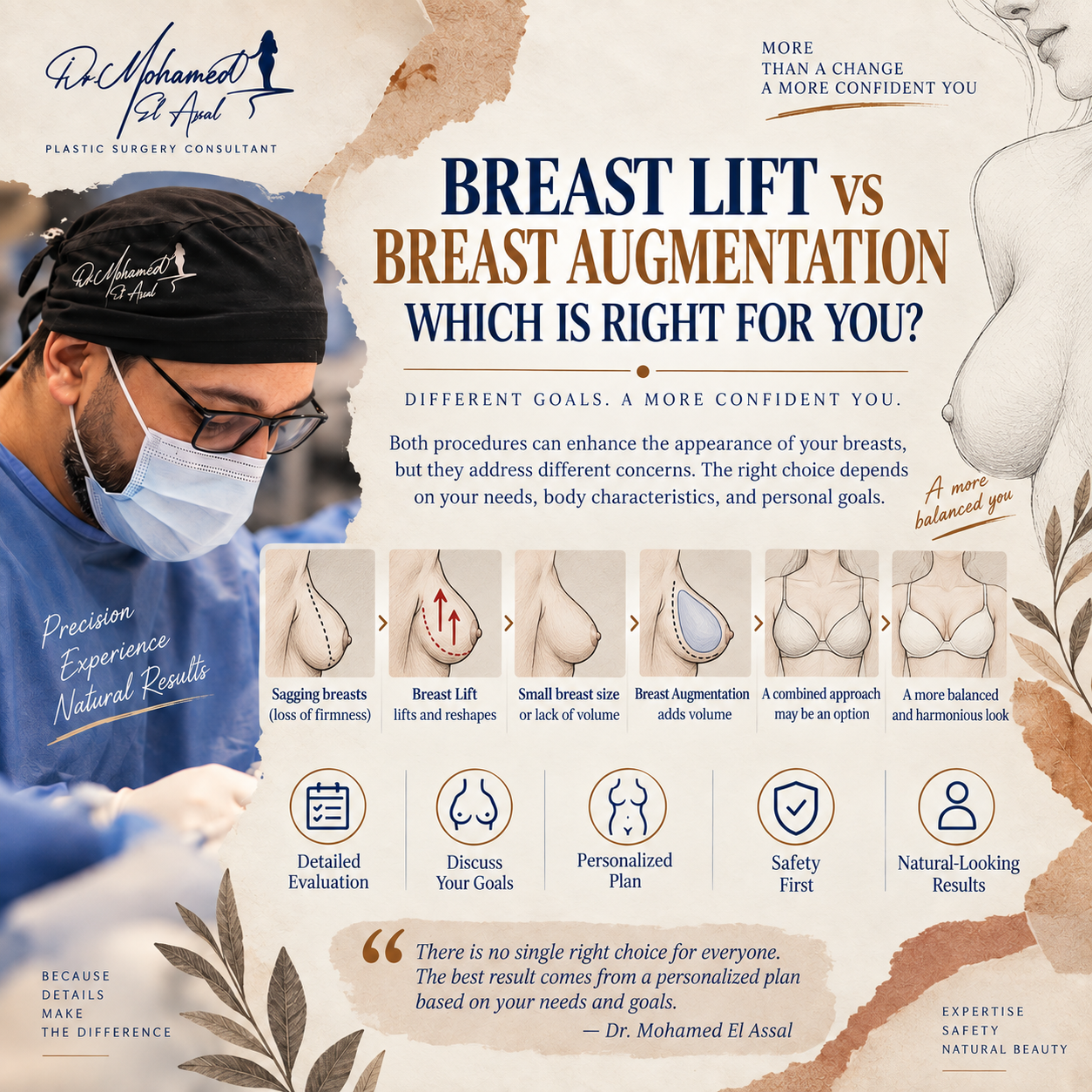
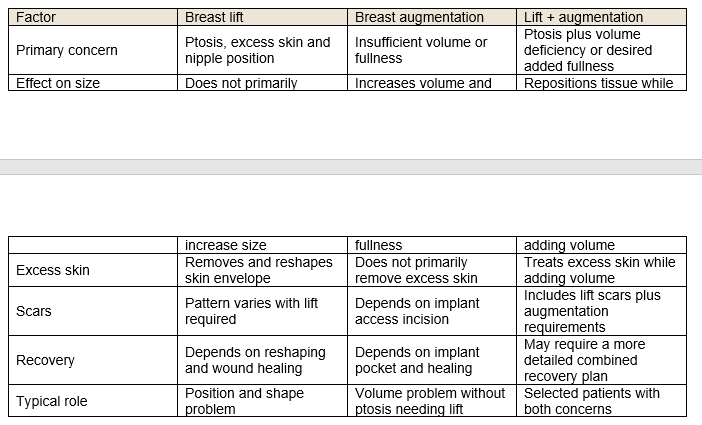
A breast lift and breast augmentation solve different anatomical concerns. A breast lift, or mastopexy, reshapes sagging tissue, removes excess skin and repositions the nipple-areola complex when needed. Breast augmentation primarily adds breast volume and fullness, most commonly with implants. Neither operation should be selected simply because one sounds more comprehensive than the other.
The decision starts by identifying the main concern: breast position and skin laxity, insufficient volume, or a combination of both. Examination considers nipple position, skin quality, existing breast tissue, symmetry, chest dimensions and desired size. That assessment determines whether lift, augmentation or a combined approach reasonably matches the patient’s anatomy and goals.
What is the difference between a breast lift and breast augmentation?
The central difference is the problem each operation treats. A breast lift removes excess skin and reshapes sagging breast tissue but does not substantially increase breast size. Breast augmentation adds volume and fullness but does not reliably correct significant ptosis by itself. Some patients have both concerns and may be candidates for a combined procedure.
Do you need a breast lift if sagging is the main concern?
If the main concern is breast descent, downward-pointing nipples or excess stretched skin, a breast lift may more directly address the anatomy. Mayo Clinic and ASPS describe mastopexy as reshaping tissue, removing extra skin and raising the breast and nipple. It is not primarily a volume-increasing operation, so examination should define the actual ptosis.
Can breast augmentation correct sagging breasts?
Breast augmentation can restore or add fullness when volume deficiency is the primary issue, but an implant is not a substitute for mastopexy when there is substantial skin excess or a low nipple position. ASPS notes that lift changes position while augmentation adds fullness; patients who need both changes may require a combined plan.
When is an implant alone unlikely to be enough?
If the nipple sits clearly low or substantial loose skin remains, adding volume alone may not correct the underlying position problem. Choosing a larger implant simply to avoid a lift is not appropriate for every anatomy because added volume and weight affect the tissues. The plan should follow examination rather than scar avoidance alone.
How do scars differ between breast lift and breast augmentation?
Breast lift scars depend on the amount of ptosis and skin removal and may involve the areola, a vertical line and sometimes the breast crease. Implant augmentation usually uses one access incision selected for the patient and implant plan. All surgical incisions create permanent scars that generally improve with time but do not disappear completely.
What determines the breast lift scar pattern?
Scar pattern is determined by the amount of excess skin, degree of ptosis, breast shape, areolar position and the reshaping required. ASPS describes periareolar, vertical and inframammary components depending on technique. Asking for the shortest scar should not override the incision pattern needed to safely reshape the breast for a particular anatomy.
Is recovery different after breast lift versus augmentation?
Both operations require wound care, swelling control and temporary activity restrictions, but recovery varies with technique, surgical extent and implant placement when augmentation is performed. ASPS advises individualized postoperative instructions for both procedures. A combined augmentation-mastopexy can change the recovery plan because breast tissue, skin and implant-related healing must be considered together.
When can a breast lift and augmentation be combined?
Lift and augmentation may be combined when a patient has both ptosis requiring reshaping and a desire or need for additional volume or upper-breast fullness. Cleveland Clinic and ASPS describe combined surgery as an option for selected patients. It is not automatically appropriate for everyone, and staging may be considered when anatomy or risk favors it.
Can lift and augmentation always be performed in one operation?
No. Simultaneous augmentation-mastopexy is possible for selected patients, but a staged plan may be preferable in others. Augmentation expands breast volume while mastopexy reduces and reshapes the skin envelope, creating competing surgical considerations. Tissue quality, ptosis, implant goals, previous surgery and safety factors influence whether one-stage or staged treatment is chosen.
Is combined lift and augmentation better than staging the procedures?
There is no universally superior approach. Systematic reviews and surgical series support single-stage augmentation-mastopexy in selected patients, while ASPS educational material also notes that some surgeons prefer staged surgery because the combined operation balances opposing changes in skin envelope and volume. Patient anatomy, desired augmentation, tissue quality and risk determine the plan.
How does examination determine whether you need lift, augmentation or both?
Examination defines the anatomical problem before choosing the procedure. The surgeon assesses nipple position relative to the breast fold, skin excess and elasticity, existing breast volume, upper-pole fullness, asymmetry and desired size. These findings show whether the priority is repositioning tissue, adding volume or addressing both concerns with a combined or staged strategy.
Can pregnancy, weight change or aging alter the result?
Yes. Neither lift nor augmentation stops future breast change. Pregnancy, breastfeeding, weight fluctuation, aging and gravity can alter skin, volume and position over time. ASPS notes that pregnancy may reduce a lift’s improvement, while breast implants require long-term follow-up for implant-related changes. Future pregnancy and weight plans should therefore be discussed before surgery.
Do breast implants last for life?
Breast implants should not be considered lifetime devices that require no follow-up. Mayo Clinic lists implant rupture, displacement and capsular contracture among problems that can lead to additional surgery. Appropriate surveillance depends on implant type, symptoms and current medical guidance, so long-term follow-up remains part of choosing augmentation with implants.
Dr. Mohamed El Assal – Expertise
Dr. Mohamed El Assal's approach to Breast Lift vs. Breast Augmentation reflects a commitment to natural proportions, balanced contours, and results that harmonize with each patient's body. Every procedure is carefully tailored to the individual's anatomy, breast shape, skin elasticity, and personal goals, with particular emphasis on safety, symmetry, and preserving a natural appearance. While breast lift surgery focuses on elevating and reshaping sagging breasts to achieve a firmer, more youthful contour, breast augmentation aims to enhance breast volume and fullness. His approach combines surgical precision with an appreciation for aesthetic balance, helping each patient understand which procedure—or combination of both—best suits their needs. The goal is to achieve refined, long-lasting results that enhance each patient's natural silhouette, without standardized approaches or one-size-fits-all solutions.
Frequently asked questions about breast lift vs breast augmentation
Does a breast lift make breasts larger?
A breast lift does not primarily increase breast size. It removes excess skin, reshapes existing tissue and raises the breast and nipple position. The breast may look differently proportioned after reshaping, but patients seeking a true increase in volume may discuss augmentation or combined augmentation-mastopexy depending on anatomy, tissue quality and goals.
Can breast augmentation replace a breast lift?
Not in every patient. Augmentation adds volume and may improve fullness when nipple position and skin quality are suitable, but it does not correct significant ptosis in the same way as mastopexy. If the nipple is low or excess skin is substantial, examination determines whether a lift is also needed to address position.
Can breast lift and augmentation be done at the same time?
Yes, simultaneous augmentation-mastopexy can be considered for selected patients who need both tissue elevation and additional volume. However, combining the operations is more complex than either procedure alone, and staging may be preferred in some cases. Tissue quality, ptosis, implant goals, previous surgery and individual safety factors influence that decision.
Which leaves more scarring, a breast lift or augmentation?
A breast lift generally requires incisions based on how much skin must be removed and how far the breast is reshaped, potentially around the areola, vertically and in the breast crease. Implant augmentation usually needs an access incision. Scar extent cannot be judged by procedure name alone because anatomy, technique and healing vary.
Is recovery longer when breast lift and augmentation are combined?
Recovery can differ after a combined procedure because the body is healing from skin and tissue reshaping while also adapting to an implant. There is no single recovery duration for everyone. Technique, incision pattern, implant position and individual healing affect restrictions, and the surgeon’s postoperative instructions determine return to work, exercise and normal activity.
How can I tell whether my concern is sagging or volume loss?
Sagging involves breast descent, excess skin and nipple position, while volume loss means the breast is smaller or less full than desired even when position is acceptable. Both can occur after pregnancy, breastfeeding or weight change. Clinical examination assesses skin, nipple level, tissue volume and symmetry to identify which problem actually requires correction.
How does Dr. Mohamed El Assal determine the appropriate breast procedure?
Assessment begins by defining the anatomical goal: lifting the breast, adding volume, removing excess skin or addressing more than one concern. Nipple position, skin elasticity, tissue volume, symmetry and chest dimensions are examined, then scars, implants, recovery and risks are discussed. The plan is individualized rather than assuming one breast procedure suits every patient.
For more information about correcting sagging, read: Breast Lift. [Internal Link → Breast Lift]
For more information about increasing breast volume, read: Breast Augmentation. [Internal Link → Breast Augmentation]
CTA: If you are unsure whether your main concern is ptosis or volume loss, examination can separate those goals before surgery is selected. Discuss your current breast shape, desired size, acceptance of scars, future pregnancy or weight plans and implant preferences so the proposed procedure reflects your anatomy and realistic expectations.
For more information about correcting sagging, read: Breast Lift. [Internal Link → Breast Lift]
For more information about increasing breast volume, read: Breast Augmentation. [Internal Link → Breast Augmentation]
CTA: If you are unsure whether your main concern is ptosis or volume loss, examination can separate those goals before surgery is selected. Discuss your current breast shape, desired size, acceptance of scars, future pregnancy or weight plans and implant preferences so the proposed procedure reflects your anatomy and realistic expectations.
Internal Links
• Breast Lift — https://drmohamedelassal.com/service/breast-lift/
• Breast Surgery — https://drmohamedelassal.com/faq/breast-surgery/
• Breast Surgery — https://drmohamedelassal.com/faq/breast-surgery/
References
Mayo Clinic. Breast lift. https://www.mayoclinic.org/tests-procedures/breast-lift/about/pac-20393218
Mayo Clinic. Breast augmentation. https://www.mayoclinic.org/tests-procedures/breast-augmentation/about/pac-20393178
Cleveland Clinic. Breast Lift (Mastopexy): Surgery & Recovery. https://my.clevelandclinic.org/health/treatments/23298-breast-lift
Cleveland Clinic. Breast Augmentation: What It Is, Types, Surgery & Recovery. https://my.clevelandclinic.org/health/treatments/11024-breast-augmentation
American Society of Plastic Surgeons (ASPS). Breast Lift. https://www.plasticsurgery.org/cosmetic-procedures/breast-lift
American Society of Plastic Surgeons (ASPS). Breast Lift Procedure Steps. https://www.plasticsurgery.org/cosmetic-procedures/breast-lift/procedure
American Society of Plastic Surgeons (ASPS). Breast Lift Recovery. https://www.plasticsurgery.org/cosmetic-procedures/breast-lift/recovery
American Society of Plastic Surgeons (ASPS). Breast Augmentation Procedure Steps. https://www.plasticsurgery.org/cosmetic-procedures/breast-augmentation/procedure
American Society of Plastic Surgeons (ASPS). Breast Augmentation Recovery. https://www.plasticsurgery.org/cosmetic-procedures/breast-augmentation/recovery
Khavanin N, Jordan SW, Rambachan A, Kim JYS. A systematic review of single-stage augmentation-mastopexy. Plast Reconstr Surg. 2014;134(5):922-931. https://pubmed.ncbi.nlm.nih.gov/25347628/
Dr. Mohamed El Assal. Breast Lift. https://drmohamedelassal.com/service/breast-lift/
Dr. Mohamed El Assal. Breast Surgery. https://drmohamedelassal.com/faq/breast-surgery/
Medically reviewed by Dr. Mohamed El Assal, Consultant Plastic Surgeon
Mayo Clinic. Breast augmentation. https://www.mayoclinic.org/tests-procedures/breast-augmentation/about/pac-20393178
Cleveland Clinic. Breast Lift (Mastopexy): Surgery & Recovery. https://my.clevelandclinic.org/health/treatments/23298-breast-lift
Cleveland Clinic. Breast Augmentation: What It Is, Types, Surgery & Recovery. https://my.clevelandclinic.org/health/treatments/11024-breast-augmentation
American Society of Plastic Surgeons (ASPS). Breast Lift. https://www.plasticsurgery.org/cosmetic-procedures/breast-lift
American Society of Plastic Surgeons (ASPS). Breast Lift Procedure Steps. https://www.plasticsurgery.org/cosmetic-procedures/breast-lift/procedure
American Society of Plastic Surgeons (ASPS). Breast Lift Recovery. https://www.plasticsurgery.org/cosmetic-procedures/breast-lift/recovery
American Society of Plastic Surgeons (ASPS). Breast Augmentation Procedure Steps. https://www.plasticsurgery.org/cosmetic-procedures/breast-augmentation/procedure
American Society of Plastic Surgeons (ASPS). Breast Augmentation Recovery. https://www.plasticsurgery.org/cosmetic-procedures/breast-augmentation/recovery
Khavanin N, Jordan SW, Rambachan A, Kim JYS. A systematic review of single-stage augmentation-mastopexy. Plast Reconstr Surg. 2014;134(5):922-931. https://pubmed.ncbi.nlm.nih.gov/25347628/
Dr. Mohamed El Assal. Breast Lift. https://drmohamedelassal.com/service/breast-lift/
Dr. Mohamed El Assal. Breast Surgery. https://drmohamedelassal.com/faq/breast-surgery/
Medically reviewed by Dr. Mohamed El Assal, Consultant Plastic Surgeon