Arm Lift After Weight Loss: Who Is a Good Candidate?
arm lift after weight loss
brachioplasty after weight loss; loose arm skin after weight loss; arm lift candidate; stable weight before arm lift; arm lift scar; brachioplasty scar location; excess upper arm skin
Arm Lift After Weight Loss: Who Is a Good Candidate?
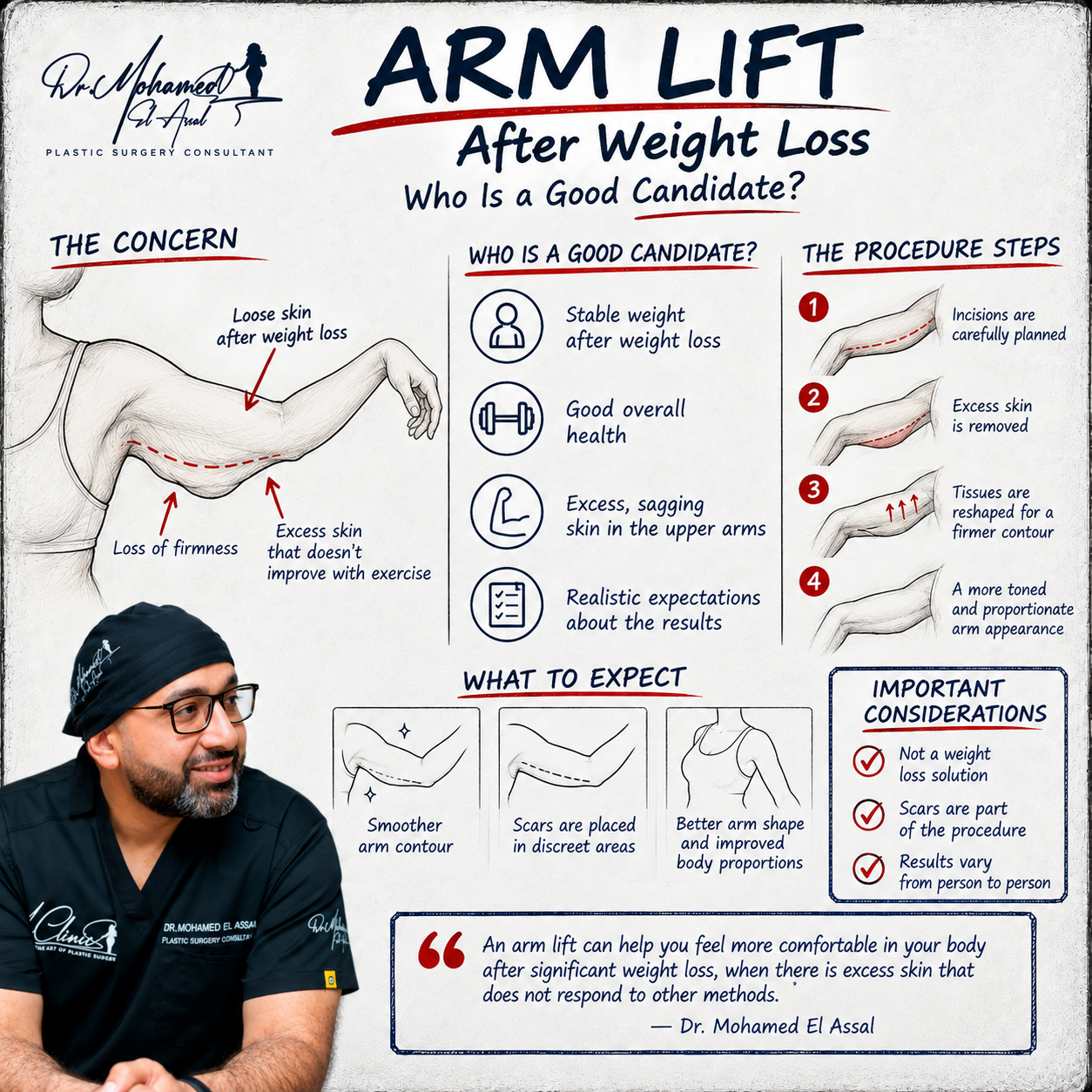
After major weight loss, fat volume may decrease more than the skin can contract, leaving loose or hanging tissue along the upper arms. An arm lift, or brachioplasty, removes excess skin and reshapes the area. Liposuction may be added in selected patients when localized fat remains, depending on skin quality and examination.
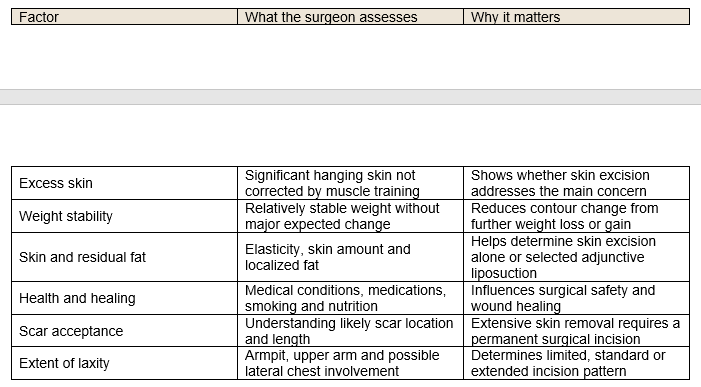
Candidacy is not determined by the amount of weight lost alone. Important factors include significant skin laxity that exercise cannot correct, relatively stable weight, health that supports wound healing, nonsmoking status and realistic expectations. Patients also need to understand that meaningful skin removal creates a permanent scar whose length depends on the excess tissue.
Candidacy is not determined by the amount of weight lost alone. Important factors include significant skin laxity that exercise cannot correct, relatively stable weight, health that supports wound healing, nonsmoking status and realistic expectations. Patients also need to understand that meaningful skin removal creates a permanent scar whose length depends on the excess tissue.
Why does upper-arm skin sag after major weight loss?
After substantial weight loss, the skin may not contract to match the smaller volume of tissue underneath, particularly when elasticity has been reduced. Cleveland Clinic and ASPS identify major weight loss, aging and heredity as common contributors to loose upper-arm skin. Strength training can improve muscle tone but cannot remove redundant hanging skin.
Who is a good candidate for an arm lift after weight loss?
Typical candidates are adults with significant upper-arm skin laxity, relatively stable weight, health that supports surgery and healing, nonsmoking status and realistic expectations about contour and scarring. ASPS and Cleveland Clinic emphasize these factors when describing candidacy. A physical examination is still necessary because skin distribution and medical risk vary between patients.
Why should your weight be stable before brachioplasty?
Stable weight matters because further weight loss can create new laxity, while weight gain can stretch tissues and alter the contour. ASPS requires relatively stable weight, and The Aesthetic Society recommends a dependable weight before upper-arm lift surgery. Sources do not give one universally accepted stabilization period specifically for every brachioplasty patient.
Can exercise or liposuction replace an arm lift?
Exercise strengthens upper-arm muscles but cannot remove skin that has lost elasticity. Liposuction treats localized fat rather than redundant skin and may make laxity more obvious when skin quality is poor. However, liposuction alone may suit selected patients with good elasticity and excess fat, so examination should distinguish skin, fat and muscle concerns
When might liposuction be combined with an arm lift?
Liposuction may be added when localized fat remains alongside redundant skin, but it is not required for every brachioplasty. Tissue thickness, skin quality, circulation and the planned excision influence whether combining procedures is appropriate. Some observational studies report differences in wound-healing problems with combined procedures, so the decision should be individualized.
How does a surgeon decide how much skin to remove?
The surgeon evaluates how far loose skin extends from the armpit toward the elbow, skin elasticity, residual fat and whether laxity continues onto the side of the chest. These findings determine incision length and lift pattern. ASPS and The Aesthetic Society describe limited, standard and extended approaches based on tissue distribution and severity.
Where is the arm lift scar after weight loss?
Scar location and length depend on the amount and distribution of excess skin. ASPS states that standard incisions are generally placed on the inner or back of the arm and may run from the armpit toward the elbow. After extensive weight loss, an extended incision may continue onto the side of the chest.
Can the scar be limited to the armpit?
A shorter incision concentrated near the armpit may be possible when excess skin is limited to the uppermost arm. When laxity extends toward the elbow, a longer incision is generally required to remove the redundant skin effectively. Incision choice follows the distribution of excess tissue rather than the desire for a short scar alone.
Does everyone with loose skin after weight loss need an arm lift?
No. Loose skin does not automatically make surgery necessary or appropriate. With limited laxity, the resulting scar may outweigh the expected contour change for some patients, while extensive hanging skin may make excision worth discussing. The decision balances skin amount, symptoms, medical fitness, expectations and the patient’s acceptance of a permanent scar.
What health factors are assessed before an arm lift after weight loss?
Preoperative assessment reviews medical conditions, medications, smoking and factors that may impair wound healing. After major weight loss, especially following bariatric surgery, nutritional status may also deserve attention before body-contouring surgery. Testing is individualized rather than automatic, with the goal of identifying correctable risks and confirming readiness for elective surgery.
Why can nutrition matter after major weight loss?
Wound healing requires adequate protein and micronutrient status, and some patients after major weight loss or bariatric surgery may have nutritional issues that need assessment before body-contouring surgery. This does not mean every patient has a deficiency. Medical history, diet, symptoms and appropriate testing guide whether correction is needed before an elective procedure.
Can upper-arm sagging return after surgery?
Upper-arm contour can change again with major weight fluctuations, aging and continued loss of skin elasticity. Cleveland Clinic and ASPS advise maintaining a stable weight and general fitness to support longer-lasting contour. Brachioplasty cannot stop natural aging or prevent new laxity if substantial weight loss or weight gain occurs after the procedure.
Is arm lift surgery different after massive weight loss?
It can be more extensive when redundant skin continues from the armpit toward the elbow or lateral chest after major weight loss. The Aesthetic Society describes extended brachioplasty as commonly used for this pattern. Limited laxity may allow a shorter incision. Surgical extent should follow tissue distribution rather than the number of kilograms or pounds lost.
Does losing weight through bariatric surgery change candidacy?
The method of weight loss alone does not determine candidacy. Stable weight, current health, nutritional status, excess-skin distribution and individual risk remain central. Recent body-contouring research suggests that factors such as current body mass and diabetes can be more relevant to postoperative complications than whether weight loss occurred through surgery, medication or lifestyle changes.
Dr. Mohamed El Assal – Expertise
Dr. Mohamed El Assal places the highest priority on selecting the appropriate surgical candidate before proceeding with an arm lift after significant weight loss. His comprehensive assessment includes a thorough clinical examination, evaluation of skin laxity and tissue condition, assessment of overall health, and identification of potential contraindications and risk factors. Procedures are performed in fully equipped medical facilities with a specialist anaesthesia team and clear protocols for deep vein thrombosis (DVT) prevention and post-operative follow-up, prioritising patient safety, smooth recovery, and well-proportioned, natural-looking results.
Frequently asked questions about arm lift after weight loss
Do I need to reach a specific weight before an arm lift?
There is no single target weight for every patient. ASPS emphasizes relatively stable weight and avoiding significant overweight, while The Aesthetic Society recommends reaching a dependable weight that can be maintained. Your surgeon considers current weight, health, nutrition and whether additional major weight loss is expected before deciding whether timing is appropriate.
How long should my weight be stable before an arm lift?
Sources do not agree on one arm-lift-specific stabilization period. ASPS describes relatively stable weight without assigning a universal duration, while broader post-weight-loss body-contouring guidance sometimes recommends longer stability intervals. The practical decision considers whether major weight change has stopped, nutrition is adequate and your surgeon considers the tissues ready for contouring.
Can excess arm skin be removed without a long scar?
It depends on where the excess skin is located and how far it extends. Limited laxity near the armpit may allow a shorter incision, while skin extending toward the elbow generally requires a longer scar. ASPS describes inner-arm and posterior-arm placements. Scar reduction should not compromise adequate treatment of the actual skin excess.
Can gym training tighten loose arm skin after weight loss?
Resistance exercise can strengthen and define upper-arm muscles, but it cannot remove redundant skin that has lost elasticity. Cleveland Clinic and ASPS specifically note that exercise does not correct hanging skin. If the concern is primarily residual fat rather than skin, treatment options differ, which is why examination should distinguish muscle, fat and skin.
Can liposuction be used instead of an arm lift?
Liposuction may be appropriate when localized fat is the main concern and skin has enough elasticity to contract, but it does not remove redundant skin. The Aesthetic Society notes that poor elasticity can make sagging more apparent after fat removal. In selected patients, liposuction may instead be combined with brachioplasty after tissue assessment.
Does an arm lift scar disappear completely?
No. An arm lift scar is permanent, although it can soften and become less noticeable as it matures. Cleveland Clinic and ASPS state that an incision scar remains after brachioplasty. Final appearance varies with incision length, healing and individual scar biology, so candidacy includes weighing scar acceptance against the concern caused by hanging skin.
How does Dr. Mohamed El Assal assess an arm lift candidate after weight loss?
Assessment first separates redundant skin from localized fat or a combination of both, then reviews weight stability, general health, nutrition and smoking. The extent of laxity and likely scar location are mapped before selecting an approach. The aim is to match surgical extent to the actual tissue problem and the patient’s realistic expectations.
For more information about the procedure itself, read: Arm Lift. [Internal Link → Arm Lift]
CTA: If loose upper-arm skin remains after your weight has stabilized, an examination can determine whether brachioplasty is appropriate, where the scar is likely to sit and whether skin removal alone or treatment of residual fat should be considered. Discuss your weight-loss history, health and scar expectations clearly before making a decision.
For more information about the procedure itself, read: Arm Lift. [Internal Link → Arm Lift]
CTA: If loose upper-arm skin remains after your weight has stabilized, an examination can determine whether brachioplasty is appropriate, where the scar is likely to sit and whether skin removal alone or treatment of residual fat should be considered. Discuss your weight-loss history, health and scar expectations clearly before making a decision.
Internal Links
• Arm Lift — https://drmohamedelassal.com/service/arm-lift/
References
American Society of Plastic Surgeons (ASPS). Arm Lift Candidates. https://www.plasticsurgery.org/cosmetic-procedures/arm-lift/candidates
American Society of Plastic Surgeons (ASPS). Arm Lift Procedure Steps. https://www.plasticsurgery.org/cosmetic-procedures/arm-lift/procedure
American Society of Plastic Surgeons (ASPS). Arm Lift Recovery. https://www.plasticsurgery.org/cosmetic-procedures/arm-lift/recovery
American Society of Plastic Surgeons (ASPS). Arm Lift Results. https://www.plasticsurgery.org/cosmetic-procedures/arm-lift/results
Cleveland Clinic. Brachioplasty (Arm Lift): Surgery, Recovery & What To Expect. https://my.clevelandclinic.org/health/treatments/23367-brachioplasty-arm-lift
Cleveland Clinic. Arm Lift: Plastic Surgery. https://my.clevelandclinic.org/cosmetic-plastic-surgery/procedures/arm-lift
The Aesthetic Society. Upper Arm Lift. https://prod.theaestheticsociety.org/procedures/body/upper-arm-lift
The Aesthetic Society. Preparing for Upper Arm Lift Surgery. https://www.theaestheticsociety.org/procedures/body/upper-arm-lift/preparing-your-procedure
The Aesthetic Society. Upper Arm Lift Incisions & Scars. https://www.theaestheticsociety.org/procedures/body/upper-arm-lift/incisions-and-scars
Sisti A, et al. Complications in Brachioplasty: A Systematic Review and Meta-Analysis. Plast Reconstr Surg. 2022. https://pubmed.ncbi.nlm.nih.gov/34936607/
Gusenoff JA, Coon D, Rubin JP. Brachioplasty and concomitant procedures after massive weight loss: a statistical analysis from a prospective registry. Plast Reconstr Surg. 2008. https://pubmed.ncbi.nlm.nih.gov/18626379/
Rojas Gutiérrez CD, et al. Brachioplasty after massive weight loss: analyzing wound healing and risk factors for dehiscence. Acta Chir Plast. 2025. https://pubmed.ncbi.nlm.nih.gov/41579361/
Dr. Mohamed El Assal. Arm Lift. https://drmohamedelassal.com/service/arm-lift/
Medically reviewed by Dr. Mohamed El Assal, Consultant Plastic Surgeon
American Society of Plastic Surgeons (ASPS). Arm Lift Procedure Steps. https://www.plasticsurgery.org/cosmetic-procedures/arm-lift/procedure
American Society of Plastic Surgeons (ASPS). Arm Lift Recovery. https://www.plasticsurgery.org/cosmetic-procedures/arm-lift/recovery
American Society of Plastic Surgeons (ASPS). Arm Lift Results. https://www.plasticsurgery.org/cosmetic-procedures/arm-lift/results
Cleveland Clinic. Brachioplasty (Arm Lift): Surgery, Recovery & What To Expect. https://my.clevelandclinic.org/health/treatments/23367-brachioplasty-arm-lift
Cleveland Clinic. Arm Lift: Plastic Surgery. https://my.clevelandclinic.org/cosmetic-plastic-surgery/procedures/arm-lift
The Aesthetic Society. Upper Arm Lift. https://prod.theaestheticsociety.org/procedures/body/upper-arm-lift
The Aesthetic Society. Preparing for Upper Arm Lift Surgery. https://www.theaestheticsociety.org/procedures/body/upper-arm-lift/preparing-your-procedure
The Aesthetic Society. Upper Arm Lift Incisions & Scars. https://www.theaestheticsociety.org/procedures/body/upper-arm-lift/incisions-and-scars
Sisti A, et al. Complications in Brachioplasty: A Systematic Review and Meta-Analysis. Plast Reconstr Surg. 2022. https://pubmed.ncbi.nlm.nih.gov/34936607/
Gusenoff JA, Coon D, Rubin JP. Brachioplasty and concomitant procedures after massive weight loss: a statistical analysis from a prospective registry. Plast Reconstr Surg. 2008. https://pubmed.ncbi.nlm.nih.gov/18626379/
Rojas Gutiérrez CD, et al. Brachioplasty after massive weight loss: analyzing wound healing and risk factors for dehiscence. Acta Chir Plast. 2025. https://pubmed.ncbi.nlm.nih.gov/41579361/
Dr. Mohamed El Assal. Arm Lift. https://drmohamedelassal.com/service/arm-lift/
Medically reviewed by Dr. Mohamed El Assal, Consultant Plastic Surgeon