Tummy Tuck vs Liposuction: Which One Fits Your Case?
tummy tuck vs liposuction
liposuction vs tummy tuck; do I need a tummy tuck or liposuction; tummy tuck with liposuction; loose abdominal skin; diastasis recti tummy tuck; abdominal fat liposuction; tummy tuck scar; lipoabdominoplasty
Tummy Tuck vs Liposuction: Which One Fits Your Case?
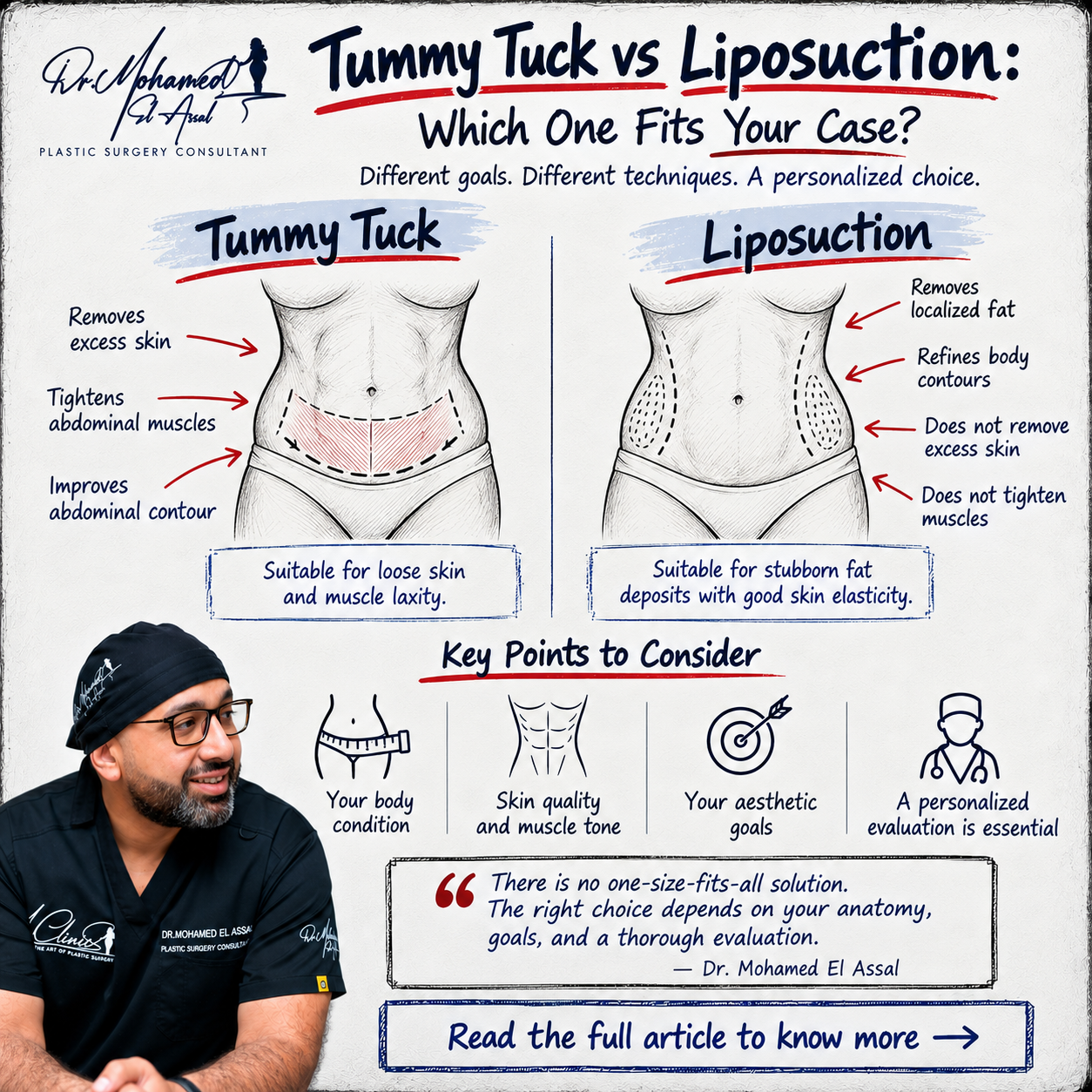
Choosing between a tummy tuck and liposuction depends on what is creating the abdominal contour concern. Liposuction removes localized subcutaneous fat, while abdominoplasty removes excess skin and can address abdominal wall laxity or muscle separation. Some patients have more than one component, so the procedures may be combined after an individualized surgical examination.
The practical question is whether the contour is driven mainly by localized fat, loose skin, diastasis recti, or a combination. Mayo Clinic, Cleveland Clinic and ASPS describe tummy tuck and liposuction as procedures that address different anatomical problems. Neither should automatically be treated as a substitute for the other simply because both can change abdominal contour.
The practical question is whether the contour is driven mainly by localized fat, loose skin, diastasis recti, or a combination. Mayo Clinic, Cleveland Clinic and ASPS describe tummy tuck and liposuction as procedures that address different anatomical problems. Neither should automatically be treated as a substitute for the other simply because both can change abdominal contour.
What is the main difference between a tummy tuck and liposuction?
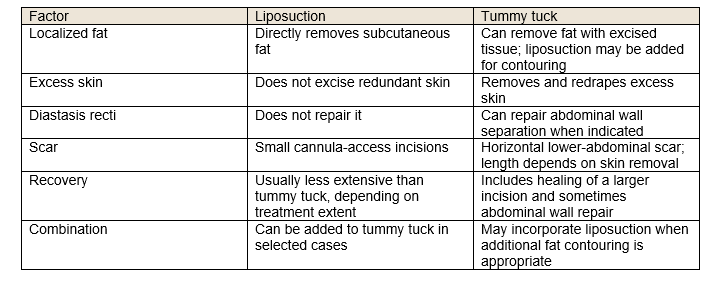
Liposuction removes localized subcutaneous fat through a cannula and suction but does not excise loose skin or repair abdominal muscle separation. A tummy tuck removes excess abdominal skin and fat and can tighten the abdominal fascia when indicated. The appropriate procedure therefore depends on which anatomical component is responsible for the contour concern.
When might liposuction alone fit an abdominal concern?
Liposuction alone may be discussed when the primary issue is localized subcutaneous fat, the skin has enough elasticity to adapt after fat removal, and there is no significant redundant skin or abdominal wall separation requiring repair. ASPS notes that skin elasticity influences contour after liposuction, so candidacy depends on examination rather than weight or fat thickness alone.
Why does skin elasticity matter?
After fat removal, the skin must adapt to the smaller underlying volume. Elastic skin may retract more effectively, while thin or lax skin after pregnancy, weight loss or aging may not reshape to the same degree. In that situation, removing fat alone can leave excess skin visible, and a skin-removing procedure may need to be discussed.
When is a tummy tuck more closely matched to the problem?
A tummy tuck is more likely to be discussed when there is clearly redundant abdominal skin, a bulge related to abdominal wall laxity or diastasis recti, or a combination of skin and fat that liposuction alone cannot address. Mayo Clinic and ASPS describe abdominoplasty as removing excess skin and fat while tightening fascia and repairing separated muscles when needed.
What is diastasis recti?
Diastasis recti is widening between the two sides of the rectus abdominis muscles and is commonly associated with pregnancy and changes in the abdominal wall. Liposuction does not bring these structures together. During abdominoplasty, the surgeon can repair abdominal wall laxity or separation when clinical examination shows that this is part of the contour problem.
For related guidance, read Diastasis Recti and Tummy Tuck: Can Surgery Repair Separated Abdominal Muscles?. For independent medical information, see Mayo Clinic guidance on tummy tuck.
For related guidance, read Diastasis Recti and Tummy Tuck: Can Surgery Repair Separated Abdominal Muscles?. For independent medical information, see Mayo Clinic guidance on tummy tuck.
Can liposuction tighten loose abdominal skin?
Liposuction is not a skin-excision operation and should not be expected to correct clearly redundant skin in the way abdominoplasty can. ASPS specifically notes that liposuction cannot improve lax skin tone and that some patients may require an additional procedure to remove excess skin. The amount of remaining elasticity influences how the skin adapts after fat removal.
Does a tummy tuck remove abdominal fat too?
A tummy tuck removes excess skin together with some fat contained in the excised tissue, but it is not simply a larger form of liposuction. Mayo Clinic notes that liposuction is often performed as part of abdominoplasty to contour the abdominal region. Whether it is added depends on fat distribution, tissue safety and the individualized surgical plan.
When can a tummy tuck and liposuction be combined?
The procedures may be combined when excess skin or abdominal wall laxity coexists with localized fat that would benefit from additional contouring of the abdomen, waist or flanks. This combined approach is often called lipoabdominoplasty. Published techniques vary substantially, so the surgeon determines where and how much liposuction is appropriate based on anatomy, perfusion and overall safety.
Is the combined operation appropriate for everyone?
No. Combining procedures adds surgical considerations that must be balanced against health status, treatment extent, previous abdominal surgery, smoking, weight stability, clot risk and tissue healing. Systematic reviews support the feasibility of lipoabdominoplasty in appropriately selected patients, but that evidence does not mean the combined approach is necessary or suitable for every abdominal contour concern.
How do scars differ between liposuction and a tummy tuck?
Liposuction uses small access incisions for the cannula, while abdominoplasty requires a horizontal lower-abdominal incision to remove redundant skin and may also involve an incision around the navel in a full tummy tuck. ASPS explains that the length and shape of the tummy tuck scar depend on how much excess skin needs to be removed.
Does a tummy tuck scar disappear completely?
No surgical scar disappears completely, although it usually changes and matures with time. ASPS notes that a tummy tuck scar may take several months to a year to fade as much as it will. Final appearance varies with incision placement, tissue tension, individual healing, smoking and postoperative scar care, so invisibility cannot be promised.
How does recovery differ between tummy tuck and liposuction?
Tummy tuck recovery generally involves healing a larger incision and supporting the abdominal wall, and temporary drains may be used depending on technique. Liposuction recovery focuses more on swelling, bruising and treated areas. There is no single recovery-time comparison because treatment extent, number of liposuction areas and whether muscle repair is performed substantially change the individual course.
Do pregnancy and weight loss affect which procedure is considered?
Yes. ASPS and Mayo Clinic generally emphasize stable weight before abdominoplasty, and surgery may be postponed when a future pregnancy is planned because pregnancy or major weight change can stretch the skin and abdominal wall again. Liposuction is also not a weight-loss treatment; both procedures are body-contouring operations selected after considering weight stability and future plans.
How does a surgeon tell whether a bulge comes from fat, skin or muscle?
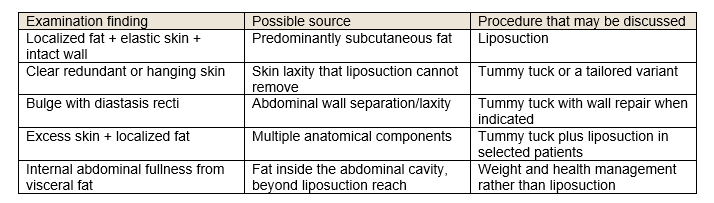
Clinical examination assesses subcutaneous fat thickness, skin excess and elasticity, abdominal wall separation or hernia, the location of fullness above and below the navel, and pregnancy, weight-loss and surgical history. Photographs alone may not show the full problem. Palpation and examination during abdominal contraction help distinguish the anatomical components that may require treatment.
Is one procedure always the right choice for the abdomen?
No single operation fits every abdominal contour pattern. Liposuction and tummy tuck address different problems and can complement each other when appropriate. The decision should not be based only on wanting a smaller scar or on the amount of fat. Skin, subcutaneous fat, abdominal wall anatomy, general health and realistic goals all influence the surgical plan.
For more detail about excess skin removal and abdominal wall treatment, read about tummy tuck surgery.
For more detail about localized fat removal, explore liposuction and the areas it can treat.
For more detail about excess skin removal and abdominal wall treatment, read about tummy tuck surgery.
For more detail about localized fat removal, explore liposuction and the areas it can treat.
Dr. Mohamed El Assal – Expertise
Dr. Mohamed El Assal's surgical philosophy reflects a firm commitment to patient safety and optimal, natural-looking results. Choosing between a tummy tuck and liposuction requires a carefully planned approach tailored to each patient's body condition, aesthetic concerns, and desired outcomes. Particular importance is placed on identifying the most suitable procedure, minimizing complications, and achieving a well-contoured abdominal appearance. His approach emphasizes personalized treatment planning, with liposuction recommended when excess localized fat is the primary concern, while a tummy tuck may be more appropriate when excess skin and abdominal muscle separation need to be addressed. In some cases, combining both procedures may help achieve more comprehensive results. The goal is to deliver a flatter, more defined abdominal contour and long-lasting surgical results — without overlooking individual needs or following a one-size-fits-all treatment approach.
Frequently asked questions about tummy tuck vs liposuction
Can liposuction replace a tummy tuck?
Not when the main problem is clearly redundant skin or abdominal muscle separation. Liposuction removes subcutaneous fat but does not excise excess skin or repair diastasis recti. If localized fat is the primary concern, skin elasticity is adequate and the abdominal wall is intact, liposuction alone may be considered after examination.
Can tummy tuck and liposuction be performed together?
Yes, the procedures can be combined in selected patients who need skin removal or abdominal wall repair plus contouring of localized fat. Medical literature often calls this lipoabdominoplasty, but the extent and technique of liposuction vary. Suitability depends on anatomy, health status and an individualized assessment of surgical risk.
Which leaves a larger scar, tummy tuck or liposuction?
A tummy tuck generally requires a longer horizontal lower-abdominal scar because excess skin is surgically removed, and a full procedure may include a scar around the navel. Liposuction uses small cannula-access incisions. Tummy tuck scar length is not identical for everyone because it depends on skin excess, procedure type and surgical planning.
Can liposuction repair diastasis recti?
No. Liposuction works in the subcutaneous fat layer and does not bring separated abdominal muscles together. If abdominal protrusion is partly caused by diastasis recti, abdominal wall repair may be discussed as part of a tummy tuck. The separation should be confirmed clinically, with additional testing used when the diagnosis is uncertain.
Is a tummy tuck a weight-loss operation?
No. A tummy tuck is not a weight-loss procedure, and liposuction is not an obesity treatment either. Their purpose is body contouring by addressing excess skin, localized fat and abdominal wall anatomy as appropriate. ASPS and Mayo Clinic emphasize weight stability because substantial weight changes after surgery can alter the abdominal contour again.
Can I choose between the procedures from photos alone?
Photographs help assess external contour but cannot fully show abdominal wall separation, fat thickness or skin quality. Direct examination allows the surgeon to assess skin elasticity, subcutaneous fat, diastasis and possible hernia. Images can start the discussion, but the final surgical plan requires an appropriate clinical evaluation and health assessment.
How does Dr. Mohamed El Assal choose an abdominal contouring plan?
Dr. Mohamed El Assal assesses skin quantity and elasticity, fat distribution, abdominal wall anatomy and possible diastasis, together with weight stability, pregnancy or weight-loss history and previous surgery. The consultation then covers procedure options, expected scars, recovery and risks. The aim is to match treatment to the actual anatomical problem rather than assume one operation fits everyone.
If you are unsure whether your abdominal concern is mainly localized fat, excess skin or muscle separation, a clinical examination can identify the source of the contour and clarify whether liposuction, tummy tuck or a combined approach is reasonable for your anatomy, health status and realistic goals.
If you are unsure whether your abdominal concern is mainly localized fat, excess skin or muscle separation, a clinical examination can identify the source of the contour and clarify whether liposuction, tummy tuck or a combined approach is reasonable for your anatomy, health status and realistic goals.
Internal Links
References
- Mayo Clinic. Tummy tuck.
- American Society of Plastic Surgeons (ASPS). Tummy Tuck.
- American Society of Plastic Surgeons (ASPS). Tummy Tuck Procedure Steps.
- American Society of Plastic Surgeons (ASPS). Liposuction.
- American Society of Plastic Surgeons (ASPS). Liposuction Procedure Steps.
- Cleveland Clinic. Tummy Tuck: Plastic Surgery.
- Cleveland Clinic. Liposuction: What It Is, Surgery, Recovery & Results.
- Xia Y, Zhao J, Cao DS. Safety of Lipoabdominoplasty Versus Abdominoplasty: A Systematic Review and Meta-analysis. Aesthetic Plast Surg. 2019;43(1):167-174.
- Matarasso A, Matarasso DM, Matarasso EJ. Standards and Trends in Lipoabdominoplasty. Plast Reconstr Surg Glob Open. 2020.
- Dr. Mohamed El Assal. Tummy Tuck.
- Dr. Mohamed El Assal. شد البطن.