Diastasis Recti and Tummy Tuck: Can Surgery Repair Separated Abdominal Muscles?
diastasis recti tummy tuck
diastasis recti repair; tummy tuck for diastasis recti; separated abdominal muscles after pregnancy; diastasis recti vs hernia; exercise for diastasis recti; abdominal muscle repair; rectus diastasis surgery
Diastasis Recti and Tummy Tuck: Can Surgery Repair Separated Abdominal Muscles?
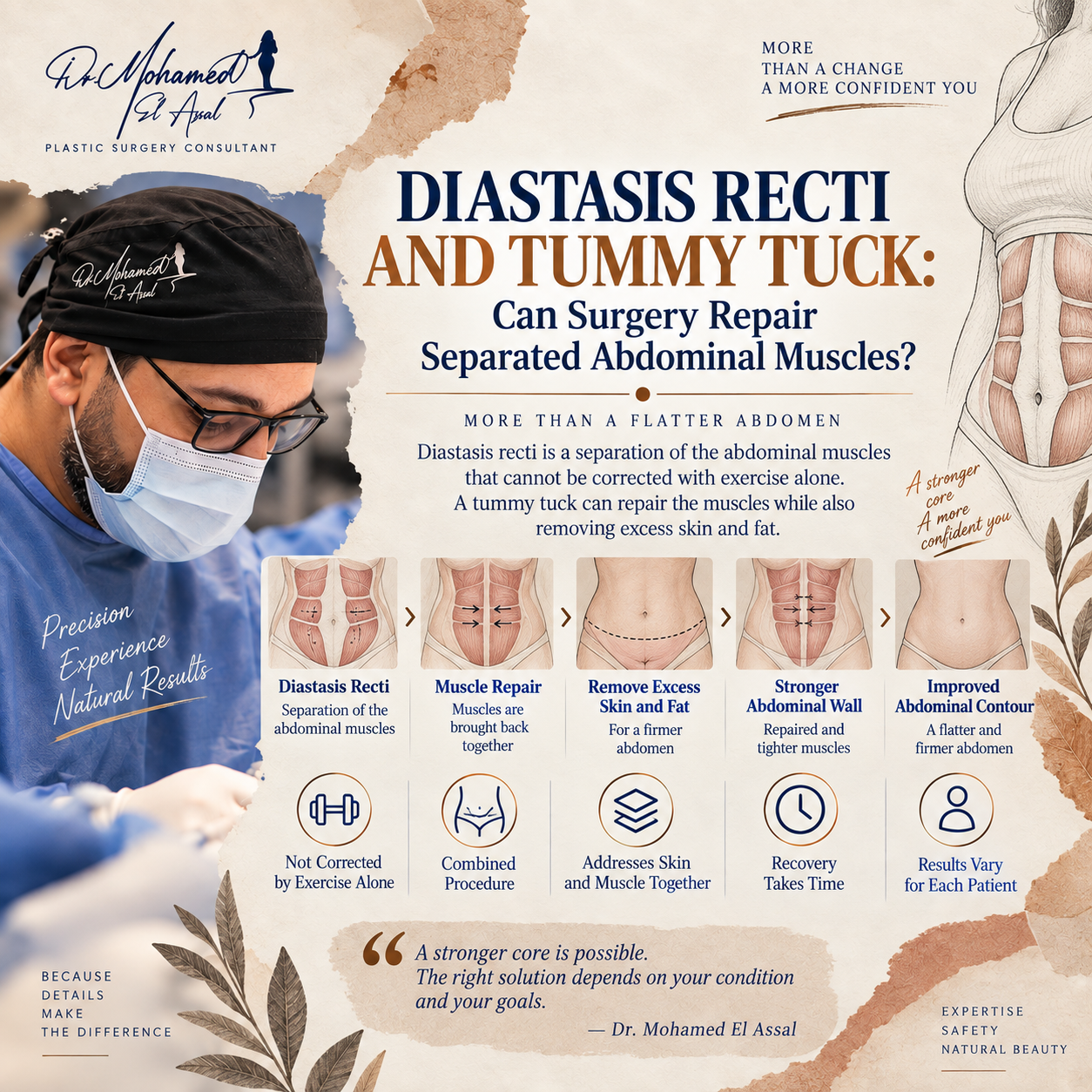
Diastasis recti is a widening of the connective tissue between the two rectus abdominis muscles rather than a tear in the muscles themselves. It commonly develops with pregnancy and can also accompany weight changes. A tummy tuck can include repair of this separation when examination shows that abdominal-wall tightening is appropriate for the patient.
Not every diastasis requires surgery. Assessment considers symptoms, abdominal-wall bulging, excess skin and whether a true hernia is also present. European Hernia Society guidance says physiotherapy may be considered before surgery, while operative repair remains individualized, particularly when separation persists or occurs alongside excess skin that is already being addressed with abdominoplasty.
Not every diastasis requires surgery. Assessment considers symptoms, abdominal-wall bulging, excess skin and whether a true hernia is also present. European Hernia Society guidance says physiotherapy may be considered before surgery, while operative repair remains individualized, particularly when separation persists or occurs alongside excess skin that is already being addressed with abdominoplasty.
What exactly is diastasis recti?
Diastasis recti is widening of the linea alba, the connective tissue running between the paired rectus abdominis muscles in the center of the abdomen. The muscles move farther apart without a true fascial hole like a hernia. It can appear as a midline ridge or bulge, particularly when the abdominal wall is tensed.
Are the abdominal muscles actually torn?
Usually, no. The principal problem is stretching and widening of the connective tissue between the muscles, which reduces midline support. This is why “muscle separation” is a convenient description rather than a literal muscle tear. Surgical repair commonly works by bringing the fascial layer over the muscles toward the midline with sutures.
Why does diastasis recti develop after pregnancy or weight change?
Pregnancy is a major cause because the enlarging uterus stretches the abdominal wall and linea alba, allowing the rectus muscles to move apart. Weight gain and substantial weight fluctuation can also increase abdominal-wall stretching. Mayo Clinic and Cleveland Clinic emphasize pregnancy, while surgical sources note that diastasis can also occur in men and nonpregnant patients.
Does having several pregnancies automatically mean severe diastasis?
No. Pregnancy increases the likelihood of separation, but the width and persistence of diastasis vary with tissue characteristics, abdominal expansion and other factors. The number of pregnancies alone cannot determine severity or the need for surgery. Examination of the abdominal wall, symptoms and associated skin changes is more useful for treatment planning.
What is the difference between diastasis recti and a hernia?
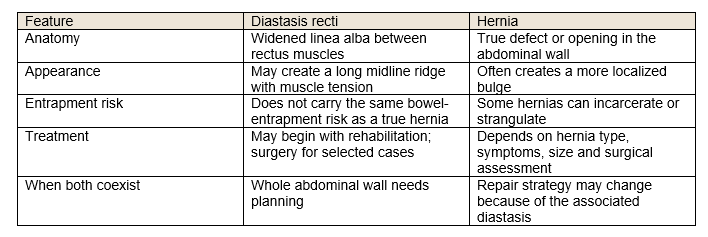
Diastasis recti is widening of the linea alba without a true fascial defect, whereas a hernia contains an actual opening through which fat or internal tissue can protrude. European Hernia Society guidance specifically separates these diagnoses because a coexisting midline hernia can change surgical planning, repair technique and the specialists involved.
How can you tell whether an abdominal bulge is diastasis rather than fat?
Appearance alone is not enough because subcutaneous fat, visceral fat, loose skin, diastasis and hernia can produce overlapping abdominal contours. Clinical examination while the abdominal muscles are activated helps assess the linea alba, and imaging may be used when a hernia is suspected or when additional anatomical information is needed before treatment planning.
Does every postpartum abdominal bulge mean diastasis recti?
No. A postpartum bulge can reflect subcutaneous fat, deeper visceral fat, loose skin, posture, generalized core weakness, a hernia or a combination of factors. Identifying the source matters because treatments address different tissues. Liposuction, for example, can reduce subcutaneous fat but does not repair widening of the linea alba itself.
Can exercise fix diastasis recti?
Exercise and physiotherapy may improve core control and symptoms, and some studies report reduced inter-rectus distance, but evidence is inconsistent about complete anatomical correction. European Hernia Society guidance allows physiotherapy before surgery. Recent systematic reviews reach different conclusions about the magnitude of distance reduction, so exercise should not be presented as a guaranteed anatomical repair.
Why do studies disagree about exercise?
Trials use different exercise programs, measurement methods, follow-up periods and patient groups. A 2025 review found low-certainty evidence that postpartum abdominal exercise reduced inter-rectus distance, whereas an updated 2026 review found no evidence that exercise alone produced meaningful anatomical correction. This uncertainty means there is no single exercise program that can be promised to close every diastasis.
Are there exercises that should be avoided?
The goal is not to ban one exercise for every patient but to avoid movements that create pronounced midline bulging or doming or worsen symptoms until technique is assessed. Cleveland Clinic cautions that some traditional abdominal exercises can aggravate visible bulging in certain patients, supporting a controlled, individualized rehabilitation program rather than unsupervised progression.
When can diastasis recti be repaired during a tummy tuck?
Diastasis can be repaired during abdominoplasty when examination shows persistent separation that would benefit from abdominal-wall tightening, particularly when excess skin is also being removed. Mayo Clinic explains that a tummy tuck can address rectus diastasis by tightening the fascia and bringing separated muscles toward the midline, but not every patient requires identical muscle repair.
For related guidance, read Tummy Tuck vs Liposuction: Which One Fits Your Case?. For independent medical information, see Mayo Clinic guidance on tummy tuck.
For related guidance, read Tummy Tuck vs Liposuction: Which One Fits Your Case?. For independent medical information, see Mayo Clinic guidance on tummy tuck.
How is the separation repaired during surgery?
During a traditional tummy tuck, the surgeon exposes the fascial layer over the abdominal muscles and can bring it toward the midline with sutures, a maneuver commonly called plication. The goal is to reinforce the abdominal wall when clinically appropriate. The exact suture pattern and extent depend on anatomy rather than one mandatory technique for every patient.
Does everyone with diastasis recti need a tummy tuck?
No. A tummy tuck also addresses excess abdominal skin and contour, so the presence of diastasis alone does not automatically make full abdominoplasty appropriate. Conservative care may suit some patients, while other surgical approaches can be considered when muscle separation is the main problem without significant loose skin. Symptoms, anatomy, hernia status and goals guide the choice.
What if I have diastasis but very little loose skin?
When there is little excess skin to remove, full abdominoplasty may not be the only surgical route. Alternative approaches to diastasis repair have been described, including minimally invasive techniques in selected cases, sometimes with an abdominal-wall surgeon. The appropriate access depends on anatomy, associated hernia, surgical expertise and the patient’s goals.
Does a hernia change the surgical plan for diastasis recti?
Yes. An umbilical or other midline hernia can change the repair strategy. European Hernia Society guidance suggests linea alba plication for rectus diastasis without a concomitant hernia and a mesh-based approach when a midline hernia coexists, depending on the case. Diagnosing a hernia is therefore important before treating the problem as isolated diastasis.
Can a hernia be repaired at the same time as a tummy tuck?
In selected patients, hernia repair can be coordinated with abdominoplasty, but planning depends on hernia type, size, location, previous operations and safety considerations. Collaboration between a plastic surgeon and abdominal-wall or general surgeon may be appropriate. A true hernia should not simply be assumed to require the same repair used for isolated diastasis.
Should weight be stable before diastasis repair with a tummy tuck?
Weight is generally best stabilized before abdominoplasty and abdominal-wall repair because major postoperative weight change can alter skin, fat and tension across the repaired tissues. Mayo Clinic advises caution when substantial weight loss is still planned, and future pregnancy should also be discussed because another pregnancy can stretch the abdominal wall again.
What about pregnancy after diastasis repair?
A later pregnancy can stretch the abdominal wall and linea alba again, so surgical timing is commonly discussed in relation to future pregnancy plans. This does not mean pregnancy after abdominoplasty is impossible; it means pregnancy-related tissue expansion can affect the repair and contour. Timing should be individualized with the plastic surgeon and obstetric clinician.
Can repairing diastasis improve back pain or core weakness?
Some selected patients report functional improvement after diastasis repair, but back pain or core weakness cannot be assumed to come from diastasis alone. Mayo Clinic and ASPS discuss potential improvement in support and symptoms, while the broader evidence shows that abdominal-wall function is multifactorial. Other causes of pain should be considered before promising functional benefit.
Why can't symptom improvement be guaranteed?
Back pain, posture and core weakness can reflect muscular, joint, neurological, weight-related and lifestyle factors in addition to abdominal-wall separation. Repair addresses a specific anatomical problem but cannot treat every source of pain. Expectations should therefore follow the clinical findings, and some patients may still benefit from physiotherapy or another specialist assessment.
Dr. Mohamed El Assal – Expertise
Dr. Mohamed El Assal’s surgical philosophy reflects a firm commitment to long-lasting results, patient safety, and natural-looking abdominal contours. Understanding diastasis recti and how a tummy tuck can repair separated abdominal muscles is an important part of setting realistic expectations and achieving the best possible outcome after surgery. Although diastasis recti occurs when the abdominal muscles separate along the midline, a tummy tuck can help address this condition by bringing the separated muscles closer together through surgical muscle repair, while also removing excess skin and improving abdominal definition. Particular importance is placed on careful patient assessment, meticulous surgical technique, and determining the most appropriate approach for each individual. His approach emphasizes personalized treatment planning, proper postoperative care, a gradual return to physical activity, and maintaining a healthy lifestyle to support recovery and long-lasting results. The goal is to achieve a flatter, firmer abdomen while helping patients understand the causes of diastasis recti, the role of tummy tuck surgery in repairing muscle separation, the recovery process, and the importance of realistic expectations and long-term follow-up.
Frequently asked questions about diastasis recti and tummy tuck
Is diastasis recti the same as a hernia?
No. Diastasis recti is widening of the linea alba between the rectus muscles without a true fascial opening, whereas a hernia includes an abdominal-wall defect through which tissue can protrude. Both can occur in the same patient, which is why identifying an associated hernia can change the assessment and surgical plan.
Can exercise alone repair diastasis recti?
Targeted exercise may improve core control and may reduce inter-rectus distance in some patients, but studies disagree about the degree of anatomical correction. European Hernia Society guidance allows physiotherapy before surgery, while no single exercise program has been shown to reliably restore every diastasis to normal anatomy. Rehabilitation should therefore be individualized.
Does a tummy tuck always repair separated abdominal muscles?
A tummy tuck gives the surgeon access to the abdominal wall and can include fascial plication when diastasis is present, but not every abdominoplasty requires the same muscle repair. Examination determines separation, tissue quality, associated hernia and excess skin before the operative steps are chosen for an individual patient.
Can liposuction fix diastasis recti?
No. Liposuction targets subcutaneous fat and does not narrow a widened linea alba or bring the rectus muscles toward the midline. It may be included in abdominal contouring when localized fat is also present, but it serves a different purpose. Treatment depends on whether the bulge comes from fat, skin, abdominal-wall separation or several factors.
Can diastasis recti return after surgical repair?
Future stretching of the abdominal wall from pregnancy or substantial weight change can affect a previous repair, and tissue quality and healing vary among patients. No operation can guarantee that separation will never recur. Surgeons therefore discuss weight stability, future pregnancy plans and individual tissue factors when deciding when surgery should be performed.
When should I see a surgeon about suspected diastasis recti?
Seek assessment if you have persistent midline abdominal bulging, functional symptoms or uncertainty about whether the problem is diastasis or a hernia. Clinical examination can often clarify the diagnosis, while imaging may be requested when a hernia is suspected or when abdominal-wall anatomy needs further definition before treatment planning.
How does Dr. Mohamed El Assal assess diastasis recti before tummy tuck surgery?
Assessment starts by identifying what contributes to the abdominal contour: skin, fat, abdominal wall or a combination. Dr. Mohamed El Assal then examines the linea alba, degree of separation and possible hernia and reviews weight stability, pregnancy plans and functional symptoms before discussing whether conservative management is sufficient or tummy tuck with abdominal-wall repair is appropriate.
For more information about the operation itself, read about tummy tuck surgery and abdominal wall repair when indicated.
If you notice a persistent midline bulge after pregnancy or weight change, diagnosis is more useful than choosing a procedure in advance. Examination can distinguish diastasis from hernia, fat or loose skin, after which treatment options and timing can be discussed according to your anatomy, symptoms and the surgeon’s instructions.
Internal Links
References
- Mayo Clinic. Tummy tuck.
- Cleveland Clinic. Diastasis Recti (Abdominal Separation): Causes & Treatment.
- American Society of Plastic Surgeons (ASPS). How can a tummy tuck help with separated abdominal muscles?
- American Society of Plastic Surgeons (ASPS). Diastasis recti repair: Restoring core strength and abdominal integrity.
- Hernández-Granados P, et al. European Hernia Society guidelines on management of rectus diastasis. Br J Surg. 2021.
- Gluppe S, Engh ME, Bø K. What is the evidence for abdominal and pelvic floor muscle training to treat diastasis recti abdominis postpartum? A systematic review with meta-analysis. Braz J Phys Ther. 2021.
- Beamish NF, et al. Impact of postpartum exercise on pelvic floor disorders and diastasis recti abdominis: a systematic review and meta-analysis. Br J Sports Med. 2025.
- Lyons G, et al. What is the evidence for abdominal and pelvic floor muscle training to treat diastasis recti abdominis postpartum? An updated systematic review and meta-analysis. Hernia. 2026.
- Dr. Mohamed El Assal. Tummy Tuck.