Liposuction vs Body Contouring: What Is the Difference?
liposuction vs body contouring
body contouring vs liposuction; liposuction and body contouring; body sculpting surgery; liposuction with skin removal; liposuction with tummy tuck; fat transfer body contouring; fat grafting body contouring; loose skin after liposuction
Liposuction vs Body Contouring: What Is the Difference?
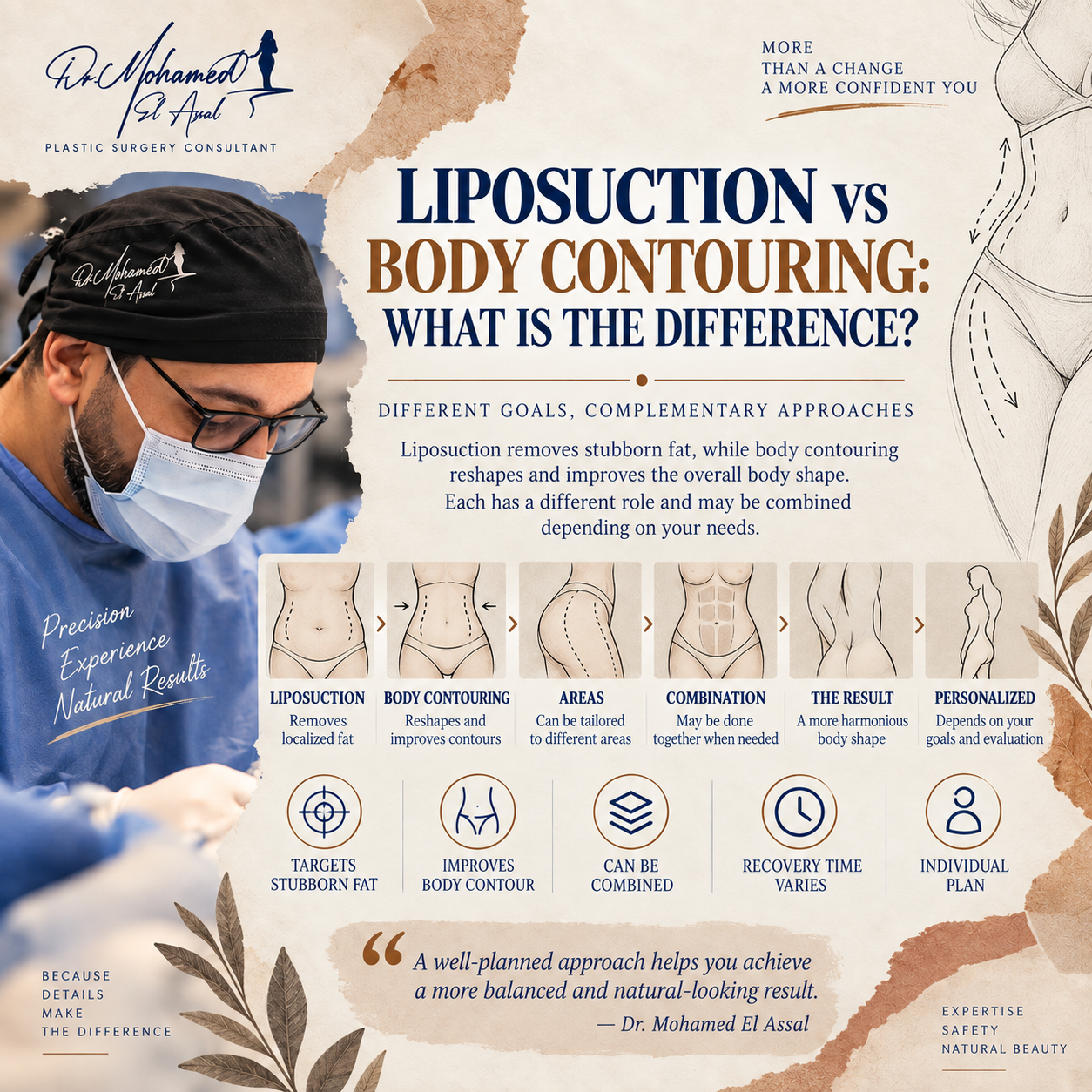
Liposuction is a specific surgical tool that removes localized subcutaneous fat and reshapes selected areas. Body contouring is a broader concept that may use liposuction alone or combine it with skin excision, lifting procedures, tissue repositioning or fat transfer. In other words, liposuction can be the entire plan for one patient and only one component for another.
Choosing between them is not simply about how much fat is present. Skin elasticity, excess skin, fat distribution, weight stability, abdominal wall anatomy, volume balance and the area being treated all influence planning. The first question is anatomical: is the concern fat alone, loose skin, loss of volume elsewhere, or a combination of these?
Choosing between them is not simply about how much fat is present. Skin elasticity, excess skin, fat distribution, weight stability, abdominal wall anatomy, volume balance and the area being treated all influence planning. The first question is anatomical: is the concern fat alone, loose skin, loss of volume elsewhere, or a combination of these?
What is the difference between liposuction and body contouring?
Liposuction removes subcutaneous fat from selected areas through a thin tube called a cannula. Body contouring is a broader treatment category aimed at changing shape and proportion. It can use liposuction, skin-removal or lifting surgery, and sometimes fat transfer. The two terms overlap, but they do not always describe the same surgical plan.
Why are the terms sometimes used differently?
Terminology varies among medical sources. Mayo Clinic describes the shaping performed by liposuction as contouring and lists body contouring among related terms, while Cleveland Clinic and ASPS use body contouring more broadly for multiple procedures involving fat and skin. For patients, the useful distinction is the actual surgical steps proposed rather than the label alone.
What can liposuction treat on its own?
Liposuction can reduce localized fat deposits in areas such as the abdomen, waist, thighs, arms and back and refine the contour when fat is the main concern and the skin can adapt reasonably well. It is not a general weight-loss treatment, does not remove excess skin and does not repair abdominal muscle separation.
Does liposuction tighten loose skin?
Liposuction does not excise excess skin. After fat removal, the surface appearance partly depends on how well the skin contracts around the new volume. Mayo Clinic and ASPS note that thin or poorly elastic skin may remain loose after liposuction, and a separate skin-removal or lifting procedure may be needed when laxity is significant.
What does body contouring include beyond liposuction?
Body contouring describes a goal and treatment plan rather than one operation. Depending on anatomy, it can include fat reduction with liposuction, removal of redundant skin with a lift or tuck, abdominal wall treatment when indicated, or volume addition with autologous fat transfer. The plan therefore changes according to the tissue problem and body region.
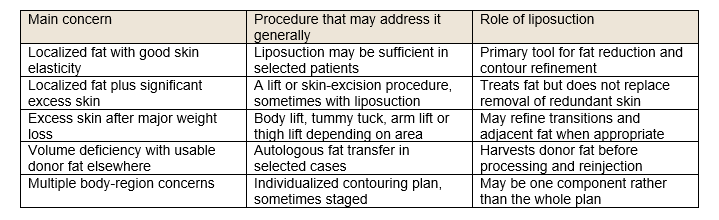
When is liposuction alone more likely to be appropriate?
Liposuction alone may be discussed when the dominant issue is a localized fat deposit, weight is relatively stable, skin has sufficient ability to conform after volume reduction and there is no substantial redundant skin or muscle problem requiring correction. Physical examination matters because appearance alone does not fully predict how skin will behave after fat removal.
Is removing more fat always better for contour?
No. Contour depends on proportion, residual fat thickness, skin quality and smooth transitions between treated and untreated areas. ASPS notes that soft, thin or poorly elastic skin may not reshape well after liposuction. Planning therefore balances fat reduction with preservation of a smooth surface rather than treating the maximum removable volume as the goal.
When is liposuction combined with skin removal or a lifting procedure?
Liposuction may be combined with a lift when localized fat coexists with redundant skin that is unlikely to conform adequately after fat removal. Common examples include abdominal laxity after pregnancy or weight change and excess skin of the arms or thighs after major weight loss. The type and extent of lifting depend on where the excess skin is located.
How is abdominal liposuction different from a tummy tuck?
Abdominal liposuction removes subcutaneous fat but does not repair rectus muscle separation or remove a substantial apron of excess skin. Abdominoplasty can remove redundant skin and address the abdominal wall when indicated, while liposuction may be added to refine surrounding contours. The decision therefore depends on skin, muscle and fat rather than fat volume alone.
For related guidance, read Tummy Tuck vs Liposuction: Which One Fits Your Case?. For independent medical information, see Mayo Clinic guidance on tummy tuck.
For related guidance, read Tummy Tuck vs Liposuction: Which One Fits Your Case?. For independent medical information, see Mayo Clinic guidance on tummy tuck.
When is fat transfer part of body contouring?
Autologous fat transfer uses fat harvested from a donor area, processed and then placed in another area to add volume or improve proportion in selected patients. Liposuction therefore serves two purposes in that plan: donor-fat harvest and contour reduction. However, the amount of transferred fat that persists is variable and cannot be guaranteed for an individual patient.
Can all suctioned fat simply be reinjected elsewhere?
No. Fat grafting requires an appropriate donor area, processing and injection technique, and a recipient site where transfer is suitable and safe. Scientific reviews describe variation in harvesting, processing and graft survival, with no universally standardized method that guarantees retention. The final volume should therefore not be assumed to equal the volume initially transferred.
Does body contouring always mean combining several operations?
No. Body contouring may consist of one procedure, including liposuction in an appropriate patient, or several procedures when fat, loose skin and multiple regions need treatment. Some combinations can be performed together, while others are better staged. General health, operative scope, recovery demands, goals and the surgeon’s safety assessment determine the plan.
Why might body contouring be staged?
Adding procedures changes operative time, the amount of tissue treated, recovery demands and potential risk. Reviews of surgical body contouring emphasize patient selection, safety and decisions about combining or staging procedures. For that reason, performing the largest possible combination in one session is not automatically the appropriate approach for every patient.
How does a surgeon decide between liposuction and a broader body-contouring plan?
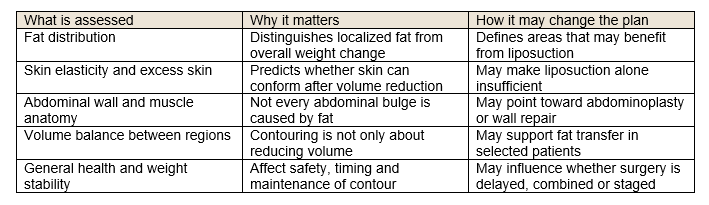
The surgeon first identifies the source of each contour concern: fat, skin, muscle or volume deficiency. Skin elasticity, weight stability, medical and surgical history, smoking and patient goals are then assessed. The resulting plan may be liposuction alone, liposuction with a lift, fat transfer or treatment of multiple regions in a staged strategy.
Are liposuction and body contouring weight-loss procedures?
Liposuction is not a treatment for obesity or a substitute for weight loss, and the primary purpose of body contouring is shape and proportion rather than reducing overall body weight. Mayo Clinic, Cleveland Clinic and ASPS make this distinction. Major weight changes after surgery can also alter skin, remaining fat and the balance between treated areas.
Why does weight stability matter before contouring surgery?
Meaningful weight gain or loss after surgery can change the size of remaining fat cells, skin laxity and proportion between body regions. Some skin-removal procedures after major weight loss are also planned after weight has stabilized. The appropriate timing depends on the operation, health status and weight trajectory and should be individualized by the surgical team.
Is one liposuction technology better for body contouring?
Traditional, power-assisted, ultrasound-assisted and other liposuction technologies can all be used to remove fat in appropriate settings. Technology does not replace patient selection, skin assessment, anatomical planning or safe technique. Reliable sources do not support treating a device name as a guarantee of superior contouring results for every patient or body region.
What about VASER and ultrasound-assisted liposuction?
Ultrasound-assisted liposuction uses energy to help disrupt fat before suction, and VASER is one form of this approach. ASPS describes several liposuction technologies, while its educational material also notes limited evidence proving that assisted methods consistently produce better final results than traditional liposuction. Technique selection should therefore be individualized rather than marketed as universally superior.
Dr. Mohamed El Assal – Expertise
Dr. Mohamed El Assal’s surgical philosophy reflects a firm commitment to long-lasting results, patient safety, and smooth, natural-looking body contours. Understanding the difference between liposuction and body contouring, including their purposes, techniques, and expected results, is an important part of setting realistic expectations and helping patients make informed decisions about their body transformation journey. Liposuction is a surgical procedure designed to remove stubborn fat deposits from specific areas of the body, while body contouring is a broader term that refers to a range of surgical and non-surgical procedures aimed at improving body shape, proportions, and overall appearance. Particular importance is placed on identifying each patient’s individual concerns, selecting the most appropriate procedure, and developing a personalized treatment plan based on their body type and aesthetic goals. His approach emphasizes patient safety, natural-looking outcomes, personalized surgical recommendations, proper postoperative care, and regular follow-up appointments to support healing and long-lasting results. The goal is to help patients achieve smoother, more defined body contours while understanding the differences between liposuction and body contouring, the benefits and limitations of each approach, and the importance of choosing the most suitable treatment according to their individual needs, as the recommended procedure varies depending on the amount and distribution of excess fat, skin elasticity, treated areas, and each patient’s desired results.
Frequently asked questions about liposuction vs body contouring
Is liposuction the same as body contouring?
Not always. Liposuction removes localized fat and is used to change the contour of a specific area, so it is one body-contouring tool. But body contouring is also used as a broader category that includes skin-removal surgery, lifting procedures and fat transfer. The useful question is which surgical steps are actually proposed for your anatomy.
Can body contouring be done without liposuction?
Yes. Some body-contouring plans primarily remove redundant skin or lift tissues, particularly after major weight loss, and liposuction may not be the main component. In other patients, fat removal is central to the plan. The choice depends on whether the dominant problem is fat, loose skin or a combination of both.
Does liposuction tighten loose skin?
Liposuction does not remove redundant skin. Skin with good elasticity may conform to the reduced volume to a variable degree, while loose or poorly elastic skin may remain lax. When excess skin is substantial, a surgeon may discuss a lifting or skin-excision procedure rather than relying on greater fat removal to solve the problem.
Can liposuction and tummy tuck be combined?
They can be combined in selected patients who have localized fat together with excess abdominal skin or an abdominal-wall problem, but combination surgery is not required for everyone. Abdominoplasty treats issues liposuction cannot, while liposuction can refine adjacent contours. The appropriate scope depends on anatomy, health and surgical safety.
Can fat removed by liposuction be used somewhere else?
Autologous fat can be used in selected contouring plans after it is harvested, processed and transferred to an appropriate recipient area. Suitability depends on donor and recipient anatomy, technique and safety. Fat retention is variable, so the volume placed at surgery should not be interpreted as a guaranteed final volume.
How do I know whether I need liposuction alone or broader body contouring?
Examination looks at fat distribution, skin elasticity, redundant skin, muscle or abdominal-wall anatomy, volume balance, health and weight stability. If localized fat is the main issue and skin quality is suitable, liposuction may be enough. Loose skin, muscle changes or volume deficiency can make additional procedures relevant.
How does Dr. Mohamed El Assal plan body contouring?
Dr. Mohamed El Assal begins by identifying the anatomical problem in each region rather than selecting a procedure by name: fat amount and distribution, skin quality, laxity, muscle changes and balance between body areas. The consultation then defines the limits of liposuction and whether skin removal, lifting or fat transfer is relevant, while considering health and surgical safety.
For more detail about localized fat removal, read about liposuction and the areas it can treat.
For an example of combining fat removal with volume transfer, learn about Brazilian Butt Lift (BBL) surgery.
If your concern is localized fat, loose skin or disproportion between several areas, start with an anatomical assessment of what is creating the contour. This helps determine whether liposuction alone addresses the problem or whether a broader body-contouring plan is needed, with the limits and risks of each component discussed clearly.
Internal Links
References
- Mayo Clinic. Liposuction.
- Cleveland Clinic. Liposuction: What It Is, Surgery, Recovery & Results.
- Cleveland Clinic. Body Contouring: What Is It, Benefits, Risks & Recovery.
- Cleveland Clinic Cosmetic & Plastic Surgery. Cosmetic Procedures.
- American Society of Plastic Surgeons (ASPS). Liposuction.
- American Society of Plastic Surgeons (ASPS). Liposuction Procedure Steps.
- American Society of Plastic Surgeons (ASPS). Body Contouring.
- American Society of Plastic Surgeons (ASPS). Body Lift.
- American Society of Plastic Surgeons (ASPS). How skin tightening improves liposuction results and body contouring. 2026.
- Rubin JP, et al. Body Contouring. Plast Reconstr Surg. 2016.
- Bellini E, et al. A journey through liposuction and liposculture: Review. Ann Med Surg. 2017.
- Chia CT, et al. Liposuction: Concepts, safety, and techniques in body-contouring surgery. Cleve Clin J Med. 2020.
- Simonacci F, et al. Autologous fat grafting: Latest insights. Ann Med Surg. 2017.
- Strong AL, et al. The Science of Fat Grafting. Semin Plast Surg. 2020.
- Dr. Mohamed El Assal. Liposuction.
- Dr. Mohamed El Assal. Brazilian Butt Lift BBL.