What Is the Right Age for a Facelift?
right age for a facelift
best age for facelift; when to get a facelift; facelift age; facelift candidacy; younger facelift candidates; facelift in older patients; signs you need a facelift; skin elasticity facelift
What Is the Right Age for a Facelift?
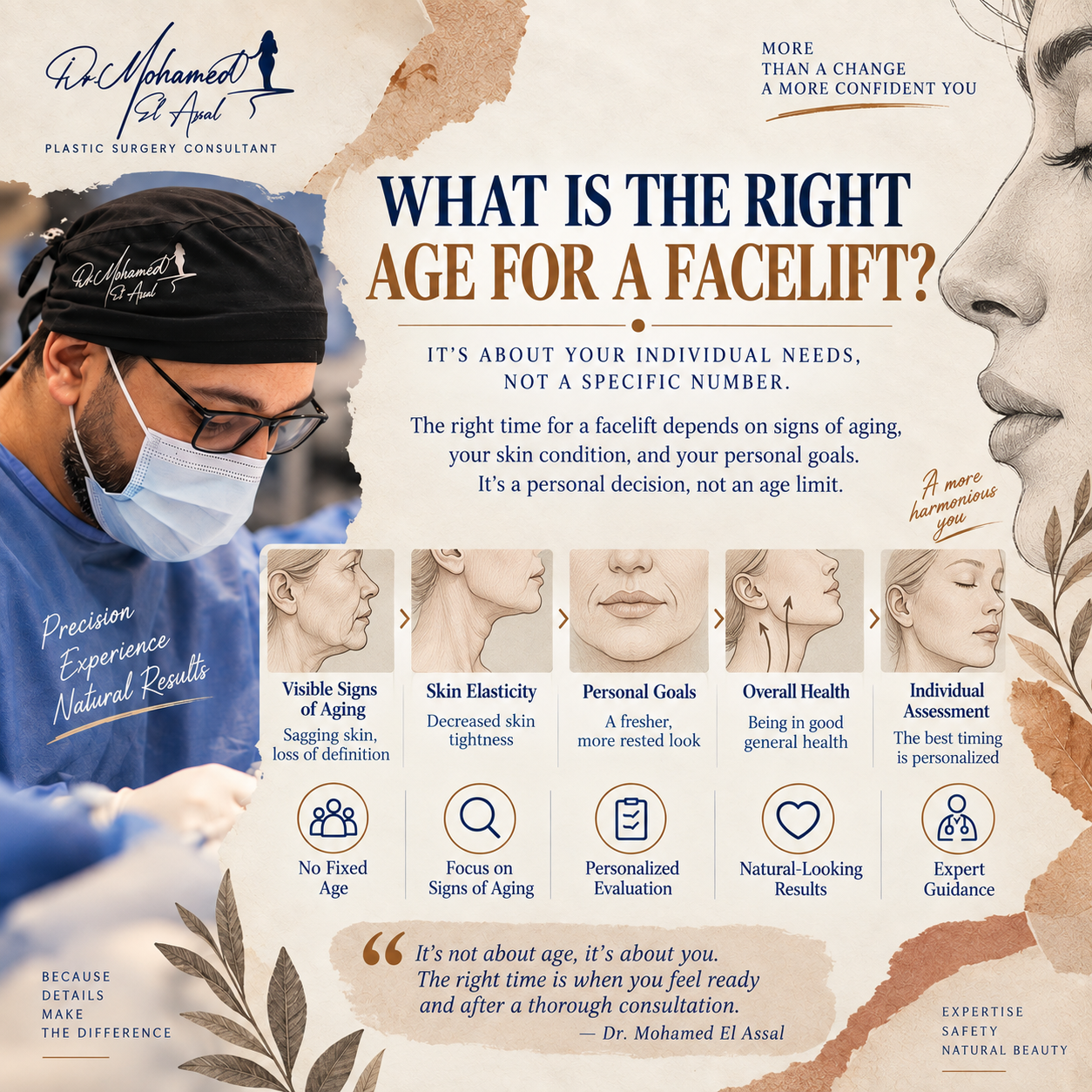
There is no single right age for a facelift. Candidacy depends more on visible facial and neck laxity, tissue quality, general health, smoking status and realistic goals than on a birthday. Two people of the same chronological age can have very different anatomy, aging patterns and reasons for considering surgery.
A facelift, or rhytidectomy, is corrective rather than preventive surgery: it treats existing tissue descent and laxity but does not stop future aging. The useful question is therefore not simply “How old am I?” but “What changes are present, can a facelift address them, and am I medically and psychologically prepared for surgery?”
A facelift, or rhytidectomy, is corrective rather than preventive surgery: it treats existing tissue descent and laxity but does not stop future aging. The useful question is therefore not simply “How old am I?” but “What changes are present, can a facelift address them, and am I medically and psychologically prepared for surgery?”
Is there a specific age when you should get a facelift?
No universal age automatically makes someone a facelift candidate. Cleveland Clinic and ASPS emphasize that people age differently because of anatomy, genetics, lifestyle, sun exposure and other influences. Age provides context, but the more important questions are whether meaningful laxity is present, whether surgery can address it and whether the person is healthy enough for elective surgery.
Why is chronological age not enough to make the decision?
Chronological age does not fully describe skin elasticity, deep-tissue descent, facial volume distribution, jawline definition or neck laxity. It also does not capture medical conditions, medications, smoking or expectations. A younger person may have surgically relevant laxity, while an older person should not be advised to have a facelift simply because of age.
What signs suggest it may be time to consider a facelift?
A facelift evaluation becomes reasonable when structural aging changes are present, such as cheek or lower-face descent, jowling, loss of jawline definition, deeper folds related to tissue descent, or neck laxity. The key is whether the concern is something lifting and repositioning can address, rather than primarily fine surface lines, pigmentation or sun-damaged skin.
What does a facelift usually not treat?
Facelift surgery repositions tissues and improves laxity, but it does not treat every sign of skin aging. Fine surface wrinkles, sun damage, pigmentation changes and some texture concerns may require different treatments. Mayo Clinic specifically distinguishes these skin-surface problems from the structural changes a facelift is designed to address, making diagnosis of the concern important.
How do skin quality and elasticity affect facelift timing?
Skin quality and elasticity help a surgeon judge how tissues may redrape after repositioning, but they are only part of candidacy. The examination also considers the degree of laxity, tissue thickness, volume loss, facial and neck structure and sun-related change. Good elasticity does not create a need for surgery, and reduced elasticity does not automatically exclude it.
Does having elastic skin mean I should have surgery earlier?
Not by itself. Elasticity may be favorable when surgically correctable laxity is already present, but it is not an indication for surgery in an otherwise appropriate-looking face. Timing should connect a specific concern with a treatment that can reasonably address it, while accounting for health, anatomy, goals and the limits of what a facelift can change.
Is a facelift preventive or corrective?
A facelift is primarily corrective surgery, not a procedure that prevents aging from occurring. It repositions tissues that have already descended or loosened, while natural aging continues afterward. Skin care, sun protection and selected nonsurgical treatments serve different purposes; they may complement facial aging care but do not equal surgical lifting when substantial laxity is present.
Does an early facelift prevent the need for future surgery?
No early operation can guarantee that another procedure will never be considered later. Facial tissues continue to age after surgery. Some patients may appropriately undergo a facelift when meaningful changes appear earlier, but that is different from operating solely to prevent future aging. The indication should remain a present, correctable concern and realistic expectations.
Can a younger person be a good facelift candidate?
Yes, a younger adult can be a candidate when there is genuine tissue laxity or anatomical change that a facelift can address and when health and expectations are appropriate. However, age alone is not a reason to operate. ASPS commentary emphasizes anatomy over a fixed age and cautions against unnecessary surgery when meaningful signs of laxity are absent.
When might a less invasive option make more sense?
If the concern is mild, superficial or does not involve meaningful tissue descent, a surgeon may discuss less invasive options matched to the actual problem. These treatments are not equivalent substitutes for a facelift when substantial laxity exists, but they can be more proportionate when the goal is limited and surgical repositioning is not currently justified.
Can you be too old for a facelift?
Older age alone does not automatically exclude facelift surgery, but medical assessment becomes increasingly important when chronic conditions, medications or anesthesia risks are present. Studies of carefully selected older patients have found that chronological age by itself was not an independent predictor of complications, supporting health-based screening rather than a simple upper-age cutoff.
What health factors are reviewed before facelift surgery?
The surgeon reviews medical history, medications and supplements, smoking, conditions that may affect healing or anesthesia, and previous operations. ASPS describes suitable candidates generally as healthy people without conditions that impair healing, nonsmokers and individuals with realistic expectations. Some patients need medical optimization, additional evaluation or postponement before elective surgery is appropriate.
How do I know whether I need a facelift alone or a face and neck lift?
The answer depends on where laxity is located, not on age. A patient with lower-face or jawline descent and relatively good neck tone may need a different plan from someone with neck skin laxity, platysmal banding or submental changes. Examination determines whether treating the face alone would leave the face and neck visually out of balance.
Why should the face and neck be assessed together?
The face and neck are anatomically connected, so obvious laxity in one region can affect the harmony of the other after treatment. For a detailed explanation of when combined treatment may be considered, read: Neck Lift: When Is It Recommended Alongside a Facelift? [Internal Link → Neck Lift: When Is It Recommended Alongside a Facelift?]
What factors determine the right time for a facelift?
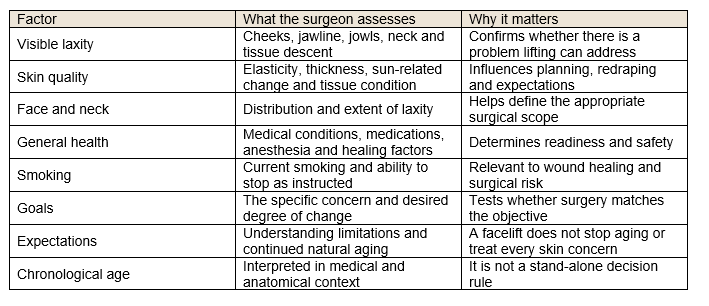
Appropriate timing combines a surgically correctable concern with medical, psychological and practical readiness. A birthday, a photograph or a wish to “prevent aging” is not enough. The surgeon evaluates laxity, skin quality, the neck, overall health, smoking, goals and expectations before discussing whether facelift surgery is appropriate now or whether another approach makes more sense.
How do expectations affect facelift candidacy?
Realistic expectations are part of candidacy, not an afterthought. A facelift can improve laxity and reposition tissues, but it does not stop aging, replace every skin treatment or create a completely different identity. When the goal is specific and anatomically achievable, the surgeon can explain the likely scope of change, limitations and tradeoffs more clearly.
Should the goal be to look a specific age after surgery?
A medically useful goal focuses on specific features such as jawline or neck laxity rather than promising to look a particular numerical age. Perceived age is subjective and influenced by many features. Consultation is better centered on proportion, tissue position and preserving recognizable facial characteristics than on guaranteeing a fixed number of years of apparent rejuvenation.
When may it make sense to postpone a facelift?
Postponement may be appropriate when there is no clear laxity for surgery to correct, the main concern is a skin-surface issue, health is not adequately controlled, smoking has not been addressed according to surgical instructions, or expectations exceed what surgery can reasonably achieve. The aim is to operate when the expected benefit is medically and aesthetically justified.
Can a consultation still help if I am not a candidate yet?
Yes. A consultation does not obligate you to schedule surgery. It can identify whether the change you notice is related to tissue descent, skin quality, volume or another factor, and clarify what should be observed over time. This helps replace age-based assumptions or comparisons with other people with an individualized understanding of your face.
Dr. Mohamed El Assal – Expertise
Dr. Mohamed El Assal’s surgical philosophy reflects a strong commitment to patient safety, long-lasting results, and natural-looking facial rejuvenation. Understanding the right age for a facelift is essential for setting realistic expectations and making informed decisions. Although facelift surgery is commonly considered in the 40s, 50s, and 60s, the ideal age varies depending on skin elasticity, facial aging, overall health, and individual aesthetic goals. His approach emphasizes personalized treatment plans, natural-looking outcomes, proper postoperative care, and regular follow-up appointments to support healing and lasting results.
Frequently asked questions about the right age for a facelift
What is the best age for a facelift?
There is no single best age for everyone. Surgically relevant laxity can appear at different times because genetics, anatomy, skin quality, lifestyle and sun exposure vary. The decision is based on examination, tissue descent, skin condition, health and realistic goals rather than reaching a particular birthday or comparing yourself with someone of the same age.
Can I have a facelift at a younger age?
A younger adult may be considered when genuine structural laxity or tissue descent is present and facelift surgery appropriately addresses the concern. Wanting to prevent aging without a correctable problem does not by itself justify surgery. Anatomy and clinical examination matter more than age alone, and unnecessary intervention should be avoided.
Is there an age when you become too old for a facelift?
There is no universal upper-age cutoff. In older patients, general health, medications, anesthesia considerations and healing capacity become especially important. Studies of carefully selected patients suggest chronological age alone does not determine complication risk. The decision therefore requires individualized medical assessment rather than approval or exclusion based only on age.
Is skin elasticity more important than age for a facelift?
Skin elasticity is important, but it is not the only determinant of timing. Surgeons also assess tissue descent, facial volume, jawline and neck anatomy, skin condition and general health. Elastic skin does not create an indication for surgery, and lower elasticity does not automatically rule surgery out when the patient is otherwise an appropriate candidate.
Does having a facelift earlier prevent facial aging?
No. A facelift does not stop natural aging, and earlier surgery cannot guarantee that future procedures will never be considered. It is a corrective operation for existing changes. Timing varies among patients, but surgery should not be presented as a guaranteed preventive strategy. Sun protection, lifestyle and skin care have different roles in long-term aging.
Do I need a facelift or a face and neck lift?
That depends on where the laxity is located. A relatively well-supported neck may require a different plan from a neck with loose skin, platysmal bands or submental changes. Because facial and cervical tissues are anatomically related, the surgeon examines both regions and recommends a scope of surgery based on balance rather than age.
How does Dr. Mohamed El Assal decide when a facelift is appropriate?
Dr. Mohamed El Assal assesses the degree of facial and neck laxity, skin quality, facial structure, medical history, smoking, medications and goals before recommending surgery. The decision does not begin with age or a named facelift technique. It begins with the concern that can be treated safely, followed by a discussion of options, limitations and realistic expectations.
CTA: If you notice facial, jawline or neck laxity and are wondering whether this is the right time for a facelift, schedule a consultation with Dr. Mohamed El Assal, Consultant Plastic Surgeon, for an individualized assessment of your tissues, health and goals and to discuss whether surgery or another approach is appropriate now.
CTA: If you notice facial, jawline or neck laxity and are wondering whether this is the right time for a facelift, schedule a consultation with Dr. Mohamed El Assal, Consultant Plastic Surgeon, for an individualized assessment of your tissues, health and goals and to discuss whether surgery or another approach is appropriate now.
Internal Links
• Face Lift — https://drmohamedelassal.com/service/face-lift/
• Neck Lift: When Is It Recommended Alongside a Facelift? — https://drmohamedelassal.com/neck-lift-facelift-combination-guide/
• Neck Lift: When Is It Recommended Alongside a Facelift? — https://drmohamedelassal.com/neck-lift-facelift-combination-guide/
References
Mayo Clinic. Face-lift. Updated March 28, 2026. https://www.mayoclinic.org/tests-procedures/face-lift/about/pac-20394059
Cleveland Clinic. Facelift (Rhytidectomy): What It Is, Recovery & What to Expect. https://my.clevelandclinic.org/health/treatments/11023-facelift
American Society of Plastic Surgeons (ASPS). Facelift Candidates. https://www.plasticsurgery.org/cosmetic-procedures/facelift/candidates
American Society of Plastic Surgeons (ASPS). How young is too young for a facelift? 2024. https://www.plasticsurgery.org/news/articles/how-young-is-too-young-for-a-facelift
American Society of Plastic Surgeons (ASPS). The facelift timeline: What to know about the window. https://www.plasticsurgery.org/news/articles/the-facelift-timeline-what-to-know-about-the-window
The Aesthetic Society. Selecting a Facelift Surgeon. https://www.theaestheticsociety.org/procedures/head-face/facelift/selecting-surgeon
Martén E, Langevin CJ, Kaswan S, Zins JE. The safety of rhytidectomy in the elderly. Plast Reconstr Surg. 2011. https://pubmed.ncbi.nlm.nih.gov/21617479/
Effect of Age on Complications in Facelift Surgery. Aesthetic Surgery Journal. 2026. https://pubmed.ncbi.nlm.nih.gov/42045665/
Dr. Mohamed El Assal. Face Lift. https://drmohamedelassal.com/service/face-lift/
Dr. Mohamed El Assal. Neck Lift: When Is It Recommended Alongside a Facelift? https://drmohamedelassal.com/neck-lift-facelift-combination-guide/
Medically reviewed by Dr. Mohamed El Assal, Consultant Plastic Surgeon