Thigh Lift After Weight Loss: When and How?
thigh lift after weight loss
thighplasty after weight loss; inner thigh lift; outer thigh lift; loose thigh skin after weight loss; stable weight before thigh lift; thigh lift scars; thigh lift recovery; medial thigh lift
Thigh Lift After Weight Loss: When and How?
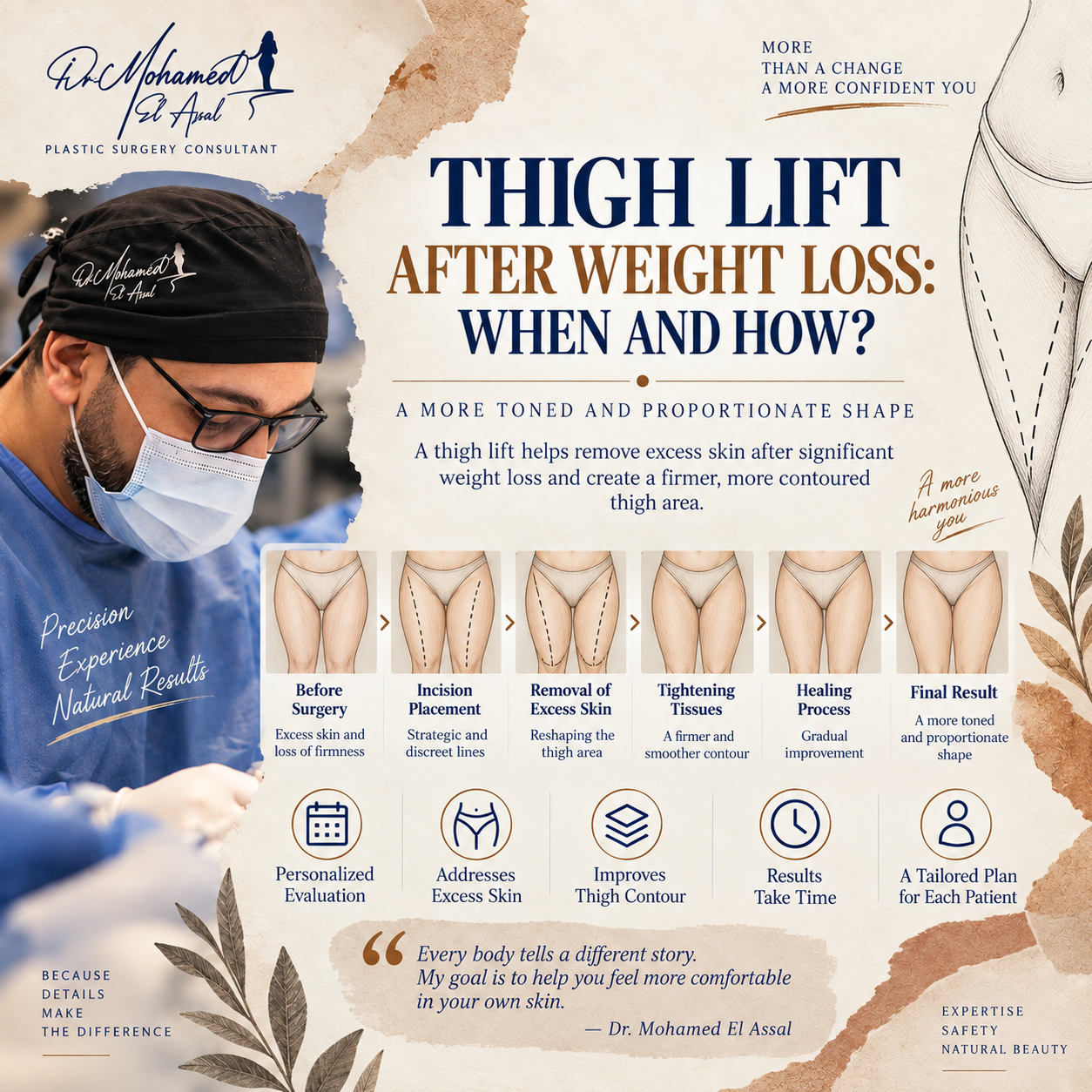
After major weight loss, excess thigh skin may remain because the skin does not always contract to match the reduction in underlying fat volume. A thigh lift, or thighplasty, removes redundant skin and reshapes the area. Surgery may focus on the inner or outer thigh depending on where laxity is located and how far it extends.
Timing and technique are not determined by the amount of weight lost alone. The surgeon assesses weight stability, general health, skin quality, distribution of laxity and residual fat, then explains likely scar placement and recovery. There is no single thigh-lift pattern for every patient, and inner and outer procedures create different incision patterns.
Timing and technique are not determined by the amount of weight lost alone. The surgeon assesses weight stability, general health, skin quality, distribution of laxity and residual fat, then explains likely scar placement and recovery. There is no single thigh-lift pattern for every patient, and inner and outer procedures create different incision patterns.
When is a thigh lift considered after weight loss?
A thigh lift may be considered when loose, redundant skin remains after weight loss and does not adequately improve with stable weight and fitness. ASPS and Cleveland Clinic describe candidates as generally healthy people with relatively stable weight and excess thigh tissue. Examination determines whether the main concern is skin, localized fat or both.
Why should your weight be stable before a thigh lift?
Weight stability helps reveal the true amount of redundant skin and reduces later contour change from substantial additional weight loss or gain. ASPS lists relatively stable weight as a candidacy factor, while Cleveland Clinic and newer ASPS educational material describe different stabilization periods. No single waiting interval therefore applies to every patient.
What is the difference between inner and outer thigh lift?
An inner, or medial, thigh lift treats excess skin and tissue along the inner thigh. An outer, or lateral, thigh lift targets the outer thigh and may extend into contouring around the hip and buttock. The appropriate procedure depends on where laxity is located and how broadly it extends, not on a preferred procedure name.
Is there a limited-incision inner thigh lift?
Yes. When excess skin is concentrated near the upper inner thigh, a shorter incision in the groin region may be possible. Laxity extending farther down the thigh may require a longer vertical incision. ASPS states that incision pattern depends on the area treated, degree of correction and individual surgical planning.
How is an inner thigh lift generally performed?
For an inner thigh lift, the incision commonly begins in the groin crease and may extend downward along the inner thigh when excess skin is more extensive. ASPS notes that selected patients with limited laxity may qualify for a shorter groin incision. After tissue removal, deeper sutures support the newly shaped contour during healing.
How is an outer thigh lift different from an inner lift?
An outer thigh lift treats laxity along the lateral thigh and may also reshape tissue around the hip or buttock. ASPS and The Aesthetic Society describe incisions that can extend from the groin around the hip toward the back. Scarring is therefore often more extensive than with a limited inner-thigh procedure, depending on tissue excess.
Where are thigh lift scars after weight loss?
Scar location follows the area requiring skin removal. An inner lift may leave a scar in the upper groin crease and, when laxity extends downward, a vertical inner-thigh scar. An outer lift may require an incision around the hip toward the back. Scars are permanent, although they generally become less noticeable as they mature.
Can liposuction replace a thigh lift after weight loss?
Liposuction removes localized fat but does not remove redundant skin that has lost elasticity. ASPS states that liposuction alone may suit patients with good skin elasticity, while it can be combined with lifting when fat and lax skin coexist. Research on combined liposuction techniques is mixed, so treatment should follow tissue characteristics.
When might liposuction be combined with thigh lift?
Liposuction may be added when localized fat requires contouring alongside redundant skin, but it is not mandatory in every thigh lift. Older and newer studies report differing complication findings depending on the technique used. This is why combined treatment should not be described as universally better or worse without considering anatomy and surgical method.
How should you prepare for a thigh lift after weight loss?
Preparation includes reviewing medical history, medications, smoking, skin and fat distribution, weight stability and general health. The Aesthetic Society emphasizes reaching a stable, dependable weight and stopping smoking according to surgical instructions. After major weight loss, nutritional status or laboratory testing may also be assessed when clinically appropriate before scheduling surgery.
What is recovery like after a thigh lift?
Recovery varies with lift type, incision length, tissue removal and whether another procedure is performed. ASPS emphasizes protecting incisions from excessive force and following surgeon-specific instructions, while Cleveland Clinic and The Aesthetic Society publish different approximate activity timelines. Activity should therefore increase according to wound healing rather than one fixed schedule.
What symptoms should prompt a call to your surgeon during recovery?
Contact the surgical team for concerning changes such as increasing pain, redness, drainage, significant leg swelling or wound problems. ASPS and Cleveland Clinic also advise urgent medical attention for symptoms such as shortness of breath or chest pain. Your own postoperative instructions should define which symptoms require routine review versus urgent assessment.

Can thigh lift be combined with other body-contouring procedures?
Combining thigh lift with other body-contouring surgery can be discussed when excess skin affects several areas after weight loss, but it is not automatically appropriate for every patient. A larger combined operation may change recovery and risk. The surgeon decides whether simultaneous treatment or staged procedures better fit health, tissue distribution and individual goals.
Are inner and outer thigh lifts interchangeable?
No. They address different patterns of excess skin. Some patients need treatment of only one region, while others have laxity extending across several parts of the thighs and lower body. Physical examination and preoperative markings define the required extent. Procedure choice should not be based on scar length alone.
Dr. Mohamed El Assal – Expertise
Dr. Mohamed El Assal has experience in thigh lift surgery after significant weight loss. His assessment is grounded in a comprehensive clinical examination of each patient, taking into account the degree of skin laxity, skin elasticity, tissue distribution, weight stability, overall health, and the presence of any relevant medical conditions before designing an individualised surgical plan to remove excess skin, improve thigh contours, and achieve the best possible natural-looking and well-proportioned outcome.
Frequently asked questions about thigh lift after weight loss
How long should my weight be stable before a thigh lift?
There is no universally agreed interval. ASPS lists relatively stable weight as a candidacy requirement, Cleveland Clinic describes maintaining goal weight for a longer period, and newer ASPS educational material mentions a shorter minimum in some cases. Your surgeon therefore considers whether weight loss has stopped, nutrition is adequate and future weight change is unlikely.
Does an inner thigh lift always leave a long scar?
No. If excess skin is concentrated near the groin, a limited incision may be possible. When laxity extends farther down the inner thigh, a vertical scar toward the knee may be required. ASPS and The Aesthetic Society explain that scar length follows the amount and location of redundant skin rather than one standard pattern.
Where is the scar for an outer thigh lift?
An outer thigh lift incision may begin near the upper thigh or groin and extend around the hip toward the back, depending on the area being reshaped. ASPS notes that surgeons can place incisions strategically for clothing coverage when possible, but extensive lateral correction can still require a substantial permanent scar.
Can a thigh lift be performed without liposuction?
Yes. Liposuction is not required for every thigh lift. When redundant skin is the primary problem, skin excision and tissue reshaping may be the main components. Liposuction can be added when localized fat also needs treatment. The decision depends on fat thickness, skin elasticity, circulation and the planned surgical technique.
When can I walk and exercise after a thigh lift?
Movement returns gradually, but there is no fixed schedule for everyone. ASPS emphasizes avoiding excessive force and motion across healing incisions, while other reputable sources provide approximate timelines that vary by procedure extent. Your surgeon should guide walking, work and exercise according to wound condition, swelling and the specific operation performed.
Do thigh lift scars disappear completely?
No. Thigh lift incisions create permanent scars, although they usually mature and become less noticeable over time. ASPS and The Aesthetic Society state that scar location and length depend on technique and the amount of skin removed. Final appearance also varies with individual healing, wound care, smoking status and other health factors.
How does Dr. Mohamed El Assal plan a thigh lift after weight loss?
Assessment maps excess skin across the inner and outer thighs, then reviews weight stability, health, nutrition, smoking and residual fat. The likely incision pattern, possible role of liposuction and recovery requirements are discussed before selecting the procedure. The plan follows the patient’s actual tissue distribution rather than applying one thigh-lift technique to everyone.
For more information about the procedure itself, read: Thigh Lift. [Internal Link → Thigh Lift]
CTA: If your weight has stabilized but loose thigh skin remains, examination can determine whether the concern is primarily inner, outer or extends across several lower-body areas, and where scars are likely to sit. Discuss your weight-loss history, medications, smoking, future weight plans and recovery support before choosing surgery.
Internal Links
References
American Society of Plastic Surgeons (ASPS). Thigh Lift. https://www.plasticsurgery.org/cosmetic-procedures/thigh-lift
American Society of Plastic Surgeons (ASPS). Thigh Lift Candidates. https://www.plasticsurgery.org/cosmetic-procedures/thigh-lift/candidates
American Society of Plastic Surgeons (ASPS). Thigh Lift Procedure Steps. https://www.plasticsurgery.org/cosmetic-procedures/thigh-lift/procedure
American Society of Plastic Surgeons (ASPS). Thigh Lift Recovery. https://www.plasticsurgery.org/cosmetic-procedures/thigh-lift/recovery
American Society of Plastic Surgeons (ASPS). Thigh Lift Risks and Safety. https://www.plasticsurgery.org/cosmetic-procedures/thigh-lift/safety
Cleveland Clinic. Thigh Lift (Thighplasty): Types, Surgery, Recovery & Scars. https://my.clevelandclinic.org/health/treatments/25012-thigh-lift-thighplasty
The Aesthetic Society. Thigh Lift Procedure Overview. https://prod.theaestheticsociety.org/procedures/body/thigh-lift/detailed-procedure-information
The Aesthetic Society. Preparing for Thigh Lift Surgery. https://prod.theaestheticsociety.org/procedures/body/thigh-lift/preparing-your-procedure
The Aesthetic Society. Thigh Lift Incisions & Scars. https://prod.theaestheticsociety.org/procedures/body/thigh-lift/incisions-and-scars
The Aesthetic Society. Thigh Lift Aftercare & Recovery. https://prod.theaestheticsociety.org/procedures/body/thigh-lift/aftercare-recovery
Gusenoff JA, Coon D, Nayar H, Kling RE, Rubin JP. Medial thigh lift in the massive weight loss population: outcomes and complications. Plast Reconstr Surg. 2015. https://pubmed.ncbi.nlm.nih.gov/25539299/
Sisti A, et al. Complications Associated With Medial Thigh Lift: A Comprehensive Literature Review. J Cutan Aesthet Surg. 2015. https://pubmed.ncbi.nlm.nih.gov/26865783/
Schmidt M, et al. Concomitant Liposuction Reduces Complications of Vertical Medial Thigh Lift in Massive Weight Loss Patients. Plast Reconstr Surg. 2016. https://pubmed.ncbi.nlm.nih.gov/27219231/
Dr. Mohamed El Assal. Thigh Lift. https://drmohamedelassal.com/service/thigh-lift/
Medically reviewed by Dr. Mohamed El Assal, Consultant Plastic Surgeon