Thick Skin Rhinoplasty: Does Skin Thickness Affect the Result?
Primary Keyword: thick skin rhinoplasty
Secondary Keywords: rhinoplasty for thick skin; thick nasal skin; nasal soft tissue envelope; thick skin nose job; tip definition thick skin; cartilage support rhinoplasty; thin skin rhinoplasty; skin thickness rhinoplasty results
Thick Skin Rhinoplasty: Does Skin Thickness Affect the Result?
In rhinoplasty, skin thickness matters because the skin and soft tissue covering the nasal framework influence how clearly changes to cartilage and bone are visible. A “thick-skinned nose” is not a single diagnosis: skin elasticity, sebaceous quality, subcutaneous tissue, cartilage strength and the distribution of thickness across the nose all contribute to surgical planning.
What does “thick skin” mean in rhinoplasty?
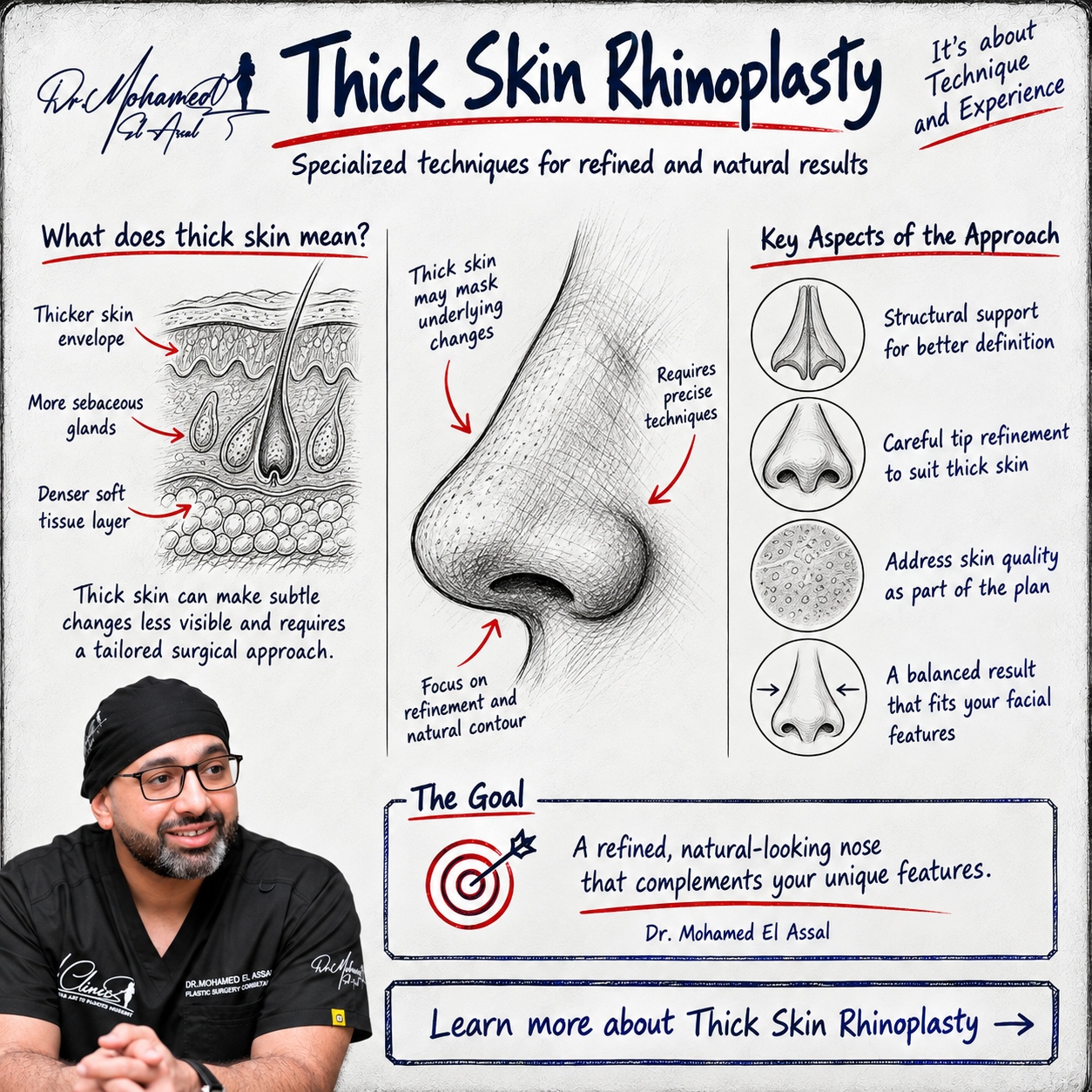
In rhinoplasty, “thick skin” usually refers to a thicker skin-soft tissue envelope covering the nasal bone and cartilage framework, rather than simply excess fat. The envelope can vary in dermal thickness, sebaceous quality, fibrous tissue and elasticity, and it is often particularly relevant around the supratip and nasal tip where fine definition is most visible.
Is thick nasal skin just extra fat?
No. The nasal envelope includes skin and several layers of soft tissue beneath it. Dermal thickness, sebaceous activity, fibrous tissue and deeper soft tissue can all contribute to the way the nose looks and feels. Treating the issue as a single removable fat layer oversimplifies anatomy and can lead to unrealistic expectations.
How does a surgeon assess nasal skin thickness before rhinoplasty?
Assessment begins with direct examination of skin quality, elasticity, oiliness and the thickness of the soft-tissue envelope over different nasal regions. A clinical pinch test can be useful, while research has used ultrasound or CT-based measurements. There is no single universally accepted numerical cutoff that reliably classifies every nose as thin, normal or thick.
Why are photographs not enough to judge skin thickness?
Photographs show external contour but cannot reliably separate fullness caused by the soft-tissue envelope from the shape of underlying cartilage and bone. Studies of nasal envelope thickness show meaningful regional variation and limitations in visual prediction. Standardized photographs therefore complement, rather than replace, hands-on examination and structural assessment.
Is skin thickness the same everywhere on the nose?
No. Imaging and clinical studies demonstrate that the nasal soft-tissue envelope varies across the nasion, rhinion, supratip and tip. This matters because a surgeon cannot assume that the same amount of structural change will be equally visible in every region. Tip planning and dorsal planning therefore require different considerations.
Why does thick skin affect nasal tip definition?
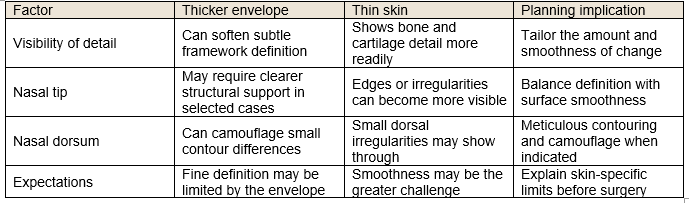
Visible tip definition depends on the relationship between lower lateral cartilage shape, structural support and the soft-tissue envelope draped over them. A thicker envelope can soften or mask subtle cartilage contours, so very small framework changes may not translate clearly to the surface. Planning therefore emphasizes proportionate, stable structure rather than aggressive cartilage reduction alone.
Does thick skin mean the nasal tip cannot be refined?
No. Thick skin does not prevent tip refinement, but it changes how refinement is planned and what degree of fine definition is realistic. The Photographic Atlas of Rhinoplasty repeatedly emphasizes stronger structural support in selected thick-skinned cases, particularly when tip cartilage is weak or projection is insufficient, rather than relying on reduction alone.
How does thick skin affect the nasal bridge after rhinoplasty?
A thicker soft-tissue envelope can soften the visibility of small contour changes along the nasal dorsum because the external surface does not reproduce every underlying detail as sharply. Bridge height, dorsal lines and their relationship to the tip are therefore planned together, rather than assuming that removing more bone or cartilage will automatically create greater visible definition.
Can thicker skin have any camouflage effect?
Yes. A thicker envelope may visually camouflage minor underlying contour irregularities more than very thin skin. That does not make thick skin inherently better or worse: the same camouflage that hides small irregularities can also soften desired fine definition. Skin thickness is therefore a planning variable, not a simple predictor of a good or poor result.
What is the difference between thick-skin and thin-skin rhinoplasty?
Thick skin can mask subtle changes made to the framework, while thin skin provides less camouflage and may reveal small bony or cartilaginous irregularities. Both present distinct technical considerations. The goal is not to label one skin type as easier, but to adapt framework shaping, surface smoothness and expectations to the envelope covering the nose.
What can realistically be achieved with thick-skin rhinoplasty?
Rhinoplasty can reshape the bony-cartilaginous framework and improve proportion, projection and definition, but the amount of visible fine detail is influenced by envelope thickness, elasticity and cartilage strength. A realistic plan aims for changes the skin can drape over predictably rather than trying to reproduce the appearance of a different skin type or promise a specific level of sharpness.
Why should I not compare my result with another patient?
Two noses can look similar in photographs yet differ in skin thickness, cartilage strength, dorsal height, bony anatomy and healing behavior. Dr. Mohamed El Assal’s Rhinoplasty page also describes skin quality and thickness as part of a broader structural and functional assessment. Reference photos can clarify goals, but they cannot guarantee an identical outcome.
Why is cartilage support important in some thick-skin rhinoplasty cases?
When the external envelope is heavier or less elastic, selected noses may need a stronger cartilage framework to maintain planned projection and contour. The Photographic Atlas of Rhinoplasty describes rigid structural support as important in thick-skinned patients, especially when the alar cartilage is weak or the tip is under-projected, rather than relying primarily on tissue reduction.
What does structural cartilage support mean?
Structural support may involve reshaping existing cartilage or adding cartilage grafts where stability, projection or contour requires reinforcement. The source and type of support depend on anatomy and surgical goals. Thick skin alone does not mean every patient needs the same grafts, the same approach, or an extensive structural rhinoplasty.
Does removing more tip cartilage create more definition?
Not necessarily. Excessive cartilage reduction can weaken support without producing clearer surface definition through a thick envelope. In selected thick-skinned noses, building a stable framework may be more important than pursuing maximal reduction. The amount of cartilage modification should reflect tip anatomy, skin characteristics, function and the intended proportion.
How is the soft-tissue envelope managed without over-thinning it?
Rhinoplasty planning considers both the framework and the soft-tissue envelope, but aggressive thinning is not a universal solution. Specialist reviews describe several envelope-management strategies while also emphasizing the need to protect vascularity and avoid indiscriminate tissue removal. Any soft-tissue maneuver should therefore be conservative, anatomy-specific and integrated with the structural plan.
Are there adjunctive treatments for thick nasal skin?
Medical literature discusses several preoperative and postoperative adjuncts, but evidence quality, indications and protocols vary. This article does not recommend a medication, injection or skin-treatment regimen. If an adjunct is appropriate, the operating surgeon should select it after assessing the patient’s skin, medical history, healing and overall rhinoplasty plan.
Is thick skin always associated with ethnic or African rhinoplasty?
No. Thick nasal skin is an anatomical characteristic that occurs across many backgrounds and should not be used by itself to classify a patient’s ethnicity. Ethnic rhinoplasty considers a broader combination of skin, cartilage, bone, nasal base, facial proportions and identity. Skin thickness is one planning factor within that larger anatomical assessment.
Does thick skin affect swelling or how long rhinoplasty results take to appear?
Specialist studies and reviews report that a thicker soft-tissue envelope can be associated with longer-lasting postoperative tissue changes, although recovery varies between patients and skin thickness alone does not determine the final timeline. For detailed timing, see: [Internal Link → Nose Swelling After Rhinoplasty: When Does It Go Away?] and [Internal Link → When Will You See the Final Results of Rhinoplasty?]
What should I ask during a rhinoplasty consultation if I have thick skin?
A useful consultation should identify where the envelope is thickest, how strong the tip cartilage is, how much definition is realistically visible, and whether structural support is needed. Breathing, septal anatomy and standardized photographs also matter. The practical question is not simply “Can my skin be thinned?” but “What change can this envelope safely reveal?”
What should the surgeon evaluate?
Evaluation commonly includes the skin-soft tissue envelope, cartilage strength, bony framework, septum and breathing function, together with photographs from multiple views and a discussion of specific goals. The surgeon can then explain which features are likely to respond clearly to framework changes and which fine details may remain limited by the overlying tissues.
Dr. Mohamed El Assal – Expertise
Dr. Mohamed El Assal's surgical philosophy reflects a firm commitment to natural, harmonious outcomes. Every intervention is designed according to the individual patient's anatomy and realistic goals, with paramount importance placed on preserving function and natural facial expression. His international training in Preservation Rhinoplasty and Deep Plane Facelift techniques supports the achievement of stable, natural long-term results — free from generic templates and one-size-fits-all solutions.
Frequently asked questions about thick skin rhinoplasty
Does thick skin prevent a good rhinoplasty result?
No. Thick skin does not prevent rhinoplasty or meaningful change, but it can influence how much fine detail from the bony-cartilaginous framework becomes visible at the surface. Surgical planning and expectations may therefore differ from a thin-skinned patient. Direct examination helps define what degree of refinement is realistic for the individual anatomy.
Can a thick-skinned nasal tip still be defined?
Tip shape and definition can often be improved, but visible sharpness depends on envelope thickness, cartilage strength and the starting anatomy. In selected cases, stronger cartilage support is more useful than aggressive reduction. The aim is proportionate definition that the tissues can display, not an artificially sharp tip that ignores the patient’s anatomy.
How can I tell if I have thick nasal skin before surgery?
A surgeon assesses skin quality, elasticity, oiliness and envelope thickness over several nasal regions, and may use a clinical pinch test. Ultrasound and CT-based measurements have been used in research, but there is no single universal number that classifies every patient or every part of the nose as thick or thin.
Is thin skin better than thick skin for rhinoplasty?
Not necessarily. Thin skin displays framework detail more clearly, but it can also reveal small cartilage edges or dorsal irregularities. Thick skin can camouflage some minor irregularities while softening desired definition. Each skin type creates different planning challenges, so neither should be treated as automatically more favorable for rhinoplasty.
Does every thick-skinned patient need cartilage grafts?
No. Skin thickness alone does not determine whether grafts are necessary. The decision depends on cartilage strength, tip projection, dorsal anatomy, the amount of reshaping required and nasal function. A surgeon may reshape existing cartilage, reinforce selected areas or add grafts only when the structural plan requires them.
Are medications or injections needed for thick skin after rhinoplasty?
Research discusses several adjunctive medical approaches, but evidence, indications and protocols vary, and no single regimen is appropriate for every patient. This article does not recommend a drug or injection. If adjunctive treatment is considered, the operating surgeon should choose it based on skin findings, medical history and the individual healing course.
How does Dr. Mohamed El Assal assess thick skin when planning rhinoplasty?
Planning considers the relationship between the skin-soft tissue envelope and the framework beneath it: skin thickness and elasticity, tip-cartilage strength, dorsal and bony anatomy, septal alignment, breathing and the patient’s broader anatomical background. The aim is to determine what degree of change can be expressed naturally and where structural support may be more appropriate than further reduction.
CTA: If you describe your nose as thick-skinned or feel that skin thickness affects tip or bridge definition, schedule a consultation with Dr. Mohamed El Assal, Consultant Plastic Surgeon, for assessment of the soft-tissue envelope, cartilage, bone and breathing function and a discussion of realistic anatomical limits before selecting a technique.
CTA: If you describe your nose as thick-skinned or feel that skin thickness affects tip or bridge definition, schedule a consultation with Dr. Mohamed El Assal, Consultant Plastic Surgeon, for assessment of the soft-tissue envelope, cartilage, bone and breathing function and a discussion of realistic anatomical limits before selecting a technique.
References
Mayo Clinic. Rhinoplasty. https://www.mayoclinic.org/tests-procedures/rhinoplasty/about/pac-20384532
Cleveland Clinic. Rhinoplasty (Nose Job): Surgery, Recovery, Before & After. https://my.clevelandclinic.org/health/treatments/11011-rhinoplasty
American Society of Plastic Surgeons (ASPS). Rhinoplasty Procedure. https://www.plasticsurgery.org/cosmetic-procedures/rhinoplasty/procedure
Kosins AM, Obagi ZE. Managing the Difficult Soft Tissue Envelope in Facial and Rhinoplasty Surgery. Aesthetic Surgery Journal. 2017. https://pubmed.ncbi.nlm.nih.gov/27965218/
Vahidi N, Wang L, Peng GL, Nassif P, Azizzadeh B. Rhinoplasty for Thick-Skinned Noses: A Systematic Review. Aesthetic Plastic Surgery. 2023. https://pubmed.ncbi.nlm.nih.gov/37369866/
Management of Thick Skin in Rhinoplasty. Facial Plastic Surgery Clinics of North America. 2024. https://pubmed.ncbi.nlm.nih.gov/39341669/
Daoud RM, et al. Thin Skin in Rhinoplasty: Considerations for Camouflaging Dorsal Nasal Irregularities. Cureus. 2024. https://pubmed.ncbi.nlm.nih.gov/39258084/
Effect of Nasal Soft-Tissue Envelope Thickness on Postoperative Healing Process Following Rhinoplasty. Journal of Craniofacial Surgery. 2021. https://pubmed.ncbi.nlm.nih.gov/33867511/
Assessing Nasal Soft-Tissue Envelope Thickness for Rhinoplasty: Normative Data and a Predictive Algorithm. JAMA Facial Plastic Surgery. 2019. https://pubmed.ncbi.nlm.nih.gov/31486840/
Saadoun R, et al. Dermatological assessment of thick-skinned patients before rhinoplasty—what may surgeons ask for? International Journal of Dermatology. 2023. https://pubmed.ncbi.nlm.nih.gov/35781878/
Şeneldir S. Photographic Atlas of Rhinoplasty. Springer; 2021. Thick-skin cases and structural support discussions in Wide Nasal Tip and Under-Projected Tip chapters. https://doi.org/10.1007/978-3-030-44325-2
Dr. Mohamed El Assal. Rhinoplasty. https://drmohamedelassal.com/service/rhinoplasty/
Dr. Mohamed El Assal. Wide Nasal Tip Refinement. https://drmohamedelassal.com/wide-nasal-tip-refinement/
Medically reviewed by Dr. Mohamed El Assal, Consultant Plastic Surgeon
Cleveland Clinic. Rhinoplasty (Nose Job): Surgery, Recovery, Before & After. https://my.clevelandclinic.org/health/treatments/11011-rhinoplasty
American Society of Plastic Surgeons (ASPS). Rhinoplasty Procedure. https://www.plasticsurgery.org/cosmetic-procedures/rhinoplasty/procedure
Kosins AM, Obagi ZE. Managing the Difficult Soft Tissue Envelope in Facial and Rhinoplasty Surgery. Aesthetic Surgery Journal. 2017. https://pubmed.ncbi.nlm.nih.gov/27965218/
Vahidi N, Wang L, Peng GL, Nassif P, Azizzadeh B. Rhinoplasty for Thick-Skinned Noses: A Systematic Review. Aesthetic Plastic Surgery. 2023. https://pubmed.ncbi.nlm.nih.gov/37369866/
Management of Thick Skin in Rhinoplasty. Facial Plastic Surgery Clinics of North America. 2024. https://pubmed.ncbi.nlm.nih.gov/39341669/
Daoud RM, et al. Thin Skin in Rhinoplasty: Considerations for Camouflaging Dorsal Nasal Irregularities. Cureus. 2024. https://pubmed.ncbi.nlm.nih.gov/39258084/
Effect of Nasal Soft-Tissue Envelope Thickness on Postoperative Healing Process Following Rhinoplasty. Journal of Craniofacial Surgery. 2021. https://pubmed.ncbi.nlm.nih.gov/33867511/
Assessing Nasal Soft-Tissue Envelope Thickness for Rhinoplasty: Normative Data and a Predictive Algorithm. JAMA Facial Plastic Surgery. 2019. https://pubmed.ncbi.nlm.nih.gov/31486840/
Saadoun R, et al. Dermatological assessment of thick-skinned patients before rhinoplasty—what may surgeons ask for? International Journal of Dermatology. 2023. https://pubmed.ncbi.nlm.nih.gov/35781878/
Şeneldir S. Photographic Atlas of Rhinoplasty. Springer; 2021. Thick-skin cases and structural support discussions in Wide Nasal Tip and Under-Projected Tip chapters. https://doi.org/10.1007/978-3-030-44325-2
Dr. Mohamed El Assal. Rhinoplasty. https://drmohamedelassal.com/service/rhinoplasty/
Dr. Mohamed El Assal. Wide Nasal Tip Refinement. https://drmohamedelassal.com/wide-nasal-tip-refinement/
Medically reviewed by Dr. Mohamed El Assal, Consultant Plastic Surgeon