Swelling After Liposuction: What Is Normal and When Does It Go Away?
swelling after liposuction
liposuction swelling timeline; how long does swelling last after liposuction; bruising after liposuction; fluid after liposuction; seroma after liposuction; postoperative swelling liposuction; abdominal swelling after liposuction; warning signs after liposuction
Swelling After Liposuction: What Is Normal and When Does It Go Away?
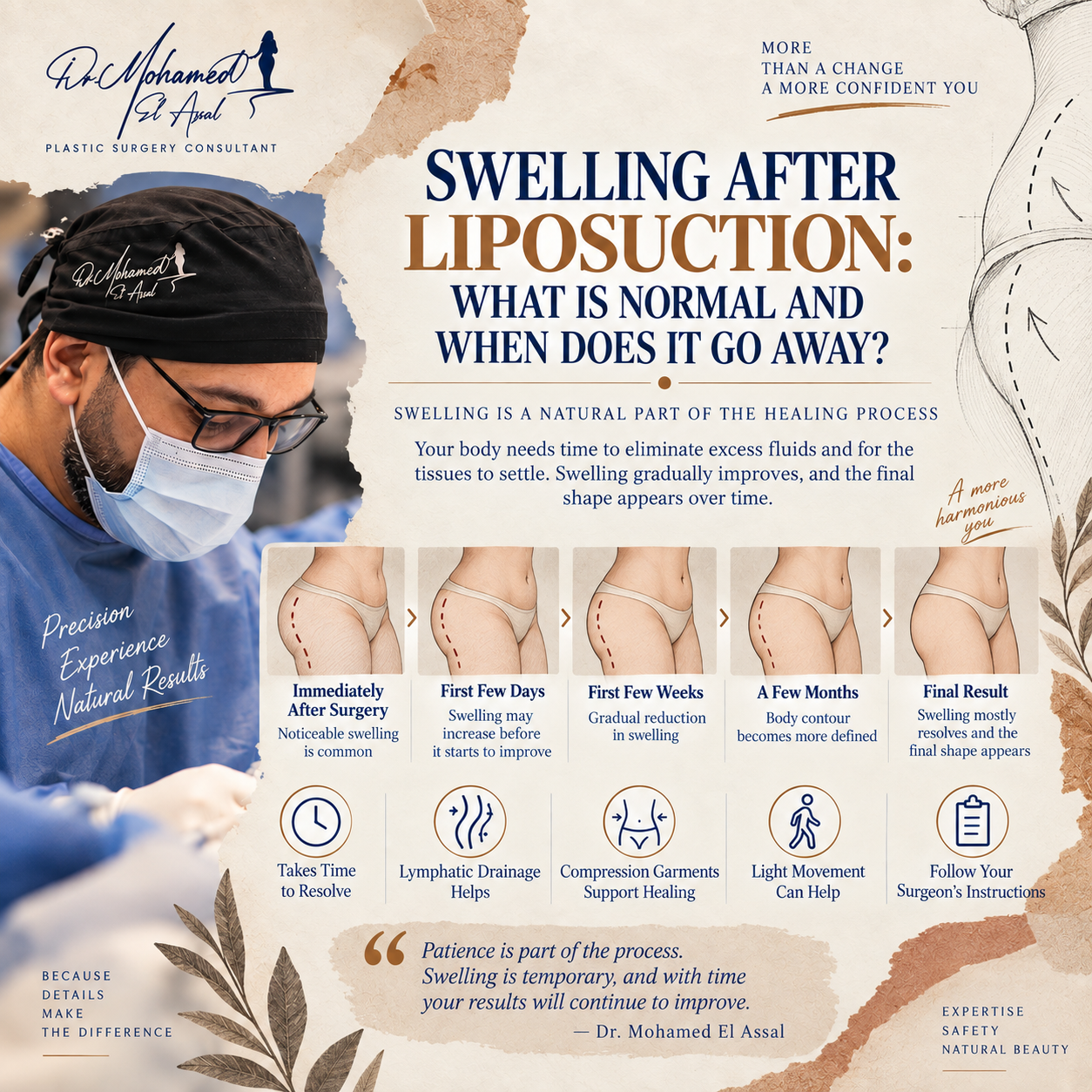
Swelling after liposuction is an expected tissue response to surgery and commonly occurs with bruising, soreness or tenderness. It should gradually decrease as healing progresses, but it does not disappear at the same speed for everyone. Mayo Clinic states that typical swelling often settles over a few weeks, while residual swelling can take longer to resolve.
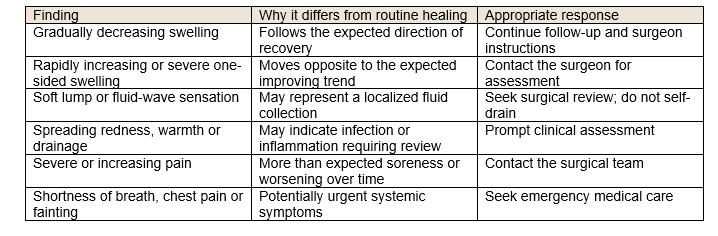
The important issue is not swelling alone but its direction and associated symptoms. Gradually improving fullness differs from swelling that suddenly worsens or comes with severe pain, spreading redness, drainage, feverish illness or breathing difficulty. A localized fluid pocket beneath the skin can represent a seroma and should be assessed by the surgical team.
The important issue is not swelling alone but its direction and associated symptoms. Gradually improving fullness differs from swelling that suddenly worsens or comes with severe pain, spreading redness, drainage, feverish illness or breathing difficulty. A localized fluid pocket beneath the skin can represent a seroma and should be assessed by the surgical team.
Are swelling and bruising normal after liposuction?
Yes. Swelling, bruising, soreness and tenderness are common during early liposuction recovery. They result from surgical manipulation of fat, soft tissue and small blood vessels and should improve progressively with healing. Mayo Clinic, Cleveland Clinic and ASPS all list these changes as expected postoperative findings, although their intensity and duration vary between patients and treated areas.
For related guidance, read Liposuction Results Timeline: When Will You See the Final Shape?. For independent medical information, see ASPS liposuction recovery guidance.
For related guidance, read Liposuction Results Timeline: When Will You See the Final Shape?. For independent medical information, see ASPS liposuction recovery guidance.
Why does swelling happen after liposuction?
Cannula movement through the fat layer and removal of tissue trigger a normal inflammatory response and temporary accumulation of fluid between tissues. Fluid is also introduced during common liposuction techniques and can contribute to early fullness. The body gradually clears excess fluid while tissues heal, which is why swelling generally improves progressively rather than disappearing immediately.
When does swelling start to go down after liposuction?
There is no single day that applies to everyone. Mayo Clinic says typical swelling usually subsides within a few weeks, while ASPS describes continued improvement beyond that point during recovery. Treatment area, procedure extent, tissue characteristics and individual healing all influence how quickly fullness decreases, so the overall trend is more useful than one calendar date.
Can liposuction swelling fluctuate during the day?
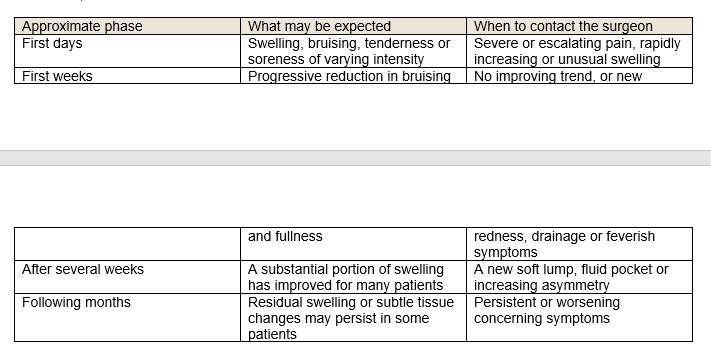
Swelling can fluctuate during recovery rather than decreasing in a perfectly straight line every day, particularly with activity or prolonged standing, but the overall direction should be toward improvement. A temporary increase is not automatically a complication, while a clear, persistent or sudden increase should not be dismissed. The pattern matters more than one isolated measurement.
Is it normal for one side to be more swollen?
Some temporary asymmetry can occur because both sides may not swell or drain fluid identically. However, marked or increasing one-sided swelling needs assessment, especially when accompanied by severe pain, skin-color change, warmth or a palpable lump. Examination can distinguish ordinary uneven healing from a localized fluid collection, hematoma or another postoperative problem.
What is normal bruising after liposuction?
Bruising is common because small blood vessels are disrupted as the cannula passes through tissue. The color generally changes and fades during healing. ASPS states in its recovery timeline that bruising should be gone around weeks four to five in a typical course, although timing varies with treatment area, procedure extent, medications and individual biology.
When does a bruise need medical assessment?
A bruise that progressively fades is different from rapidly enlarging painful swelling or a suspected hematoma. Contact the surgical team for severe disproportionate pain, a growing area of swelling, ongoing bleeding, dizziness or other unusual changes. Skin color alone cannot reliably distinguish routine bruising from a deeper blood collection without clinical assessment.
What is the difference between normal swelling and a seroma?
Normal postoperative swelling is usually diffuse within the tissues and gradually decreases. A seroma is a more defined pocket of serous fluid beneath the skin after surgery and may feel like a soft, fluctuant or mobile swelling. Small seromas can resolve spontaneously, while persistent, larger or symptomatic collections may need clinical monitoring or drainage.
Why can a seroma form after liposuction?
Fluid can collect in tissue spaces created during surgery as the body heals. Cleveland Clinic describes a seroma as a pocket of serous fluid that most often develops near a surgical site. Systematic reviews also identify seroma as a recognized liposuction complication, but reported frequency varies substantially among studies, techniques and patient populations.
Does every fluid collection need to be drained?
No. Some small seromas are reabsorbed by the body, while larger, persistent or uncomfortable collections may require treatment determined by the surgeon. Cleveland Clinic notes that many seromas resolve without intervention, but drainage or another treatment may be recommended when they do not improve or when complications develop. Management should be individualized after examination.
Why shouldn't you try to drain a fluid pocket yourself?
A swelling may not actually be a seroma, and inserting a needle without sterile technique and clinical assessment can introduce infection or injure tissue. The surgeon may also need to determine the type, location and extent of the collection before deciding what to do. A new postoperative fluid pocket should therefore be discussed with the surgical team.
What warning signs should you report after liposuction?
Contact your surgeon for swelling that clearly worsens instead of improving, severe or escalating pain, spreading redness or warmth, wound drainage, a new fluid-filled lump, persistent bleeding or unusual systemic symptoms. These findings do not diagnose a specific complication on their own, but they warrant assessment for infection, seroma, hematoma or another postoperative problem.
When are shortness of breath or chest pain after liposuction urgent?
Sudden shortness of breath, chest pain, fainting or significant deterioration should not wait for a routine postoperative appointment. Surgery carries uncommon but important risks such as venous thrombosis and pulmonary embolism. Acute chest or breathing symptoms after liposuction require urgent medical assessment rather than being interpreted as a normal part of swelling or recovery.
Does swelling in one leg matter after surgery?
One-sided leg swelling accompanied by pain, warmth or redness can require urgent evaluation for a possible venous clot, particularly after surgery or reduced mobility. These findings are not specific to liposuction and do not prove a clot, but they should not be ignored or self-treated. Medical assessment determines whether further testing is needed.
Are redness and fever normal after liposuction?
Minor local changes can occur around healing incisions, but spreading or increasing redness, marked warmth, drainage or feeling systemically unwell should be reviewed because they may be compatible with infection. Cleveland Clinic and Mayo Clinic list infection among possible surgical complications, so symptoms should be interpreted together rather than relying on one sign alone.
Should you wait if symptoms are clearly getting worse?
No. When symptoms are severe or clearly moving in the wrong direction, early contact allows the surgical team to decide whether the change is normal healing or requires treatment. This does not mean every worsening symptom represents a complication. It means postoperative instructions and clinical assessment should take priority over self-diagnosis or waiting for a routine visit.
Does swelling mean the liposuction result is not visible yet?
Swelling can hide part of the new contour, so the appearance of a swollen area should not be used to judge the final liposuction result. This article focuses on swelling itself rather than the final-shape timeline. For a detailed discussion of when body contour becomes clearer, explore the liposuction results timeline.
Do you have to wait for every bit of swelling to disappear before seeing a difference?
No. Contour change can begin to appear before swelling has completely resolved and then become clearer over time. Mayo Clinic notes that the treated area looks less bulky as swelling decreases, with further improvement over subsequent months. An early visible difference can therefore coexist with residual swelling and should not be treated as the fully stable result.
Is a compression garment the only factor controlling swelling?
No. Compression garments are commonly used to help manage swelling and support tissues, but the rate at which swelling resolves also depends on treatment extent, body area, inflammatory response and individual healing. Garment duration should follow the surgeon's plan, and patients should not independently increase pressure or wear time in an attempt to force swelling down faster.
Why isn't there one compression-garment schedule for everyone?
Garment type, fit and duration depend on the procedure, treated region and surgeon protocol rather than swelling alone. Excessive or inappropriate pressure can create problems, so the postoperative plan should be individualized. For more detail about the purpose and duration of compression, read about when to wear a compression garment after liposuction and for how long.
Dr. Mohamed El Assal – Expertise
Dr. Mohamed El Assal’s surgical philosophy reflects a firm commitment to patient safety, long-lasting results, and natural-looking body contours. Understanding swelling after liposuction, including what is considered normal and when it typically goes away, is an important part of setting realistic expectations and supporting a smooth recovery after surgery. Although swelling is a natural response to the body’s healing process, its severity and duration can vary depending on the treatment area, the extent of the procedure, and each patient’s individual healing response. In most cases, swelling is more noticeable during the first few days after surgery and gradually improves over the following weeks, although mild residual swelling may persist for several months. Particular importance is placed on careful patient assessment, meticulous surgical technique, and appropriate postoperative care tailored to each individual. His approach emphasizes following recovery instructions, wearing compression garments as recommended, gradually returning to physical activity, and attending scheduled follow-up appointments to monitor healing and support optimal results. The goal is to achieve smoother, more defined body contours while helping patients understand the normal stages of postoperative swelling, recognize potential warning signs, and maintain realistic expectations throughout the recovery process.
Frequently asked questions about swelling after liposuction
How long does swelling last after liposuction?
Mayo Clinic states that typical swelling usually subsides within a few weeks, while ASPS describes continued improvement beyond that as recovery progresses. Some residual fullness may last longer depending on treatment area and procedure extent. The trend toward gradual improvement is therefore more useful than applying one fixed date to every patient.
Is it normal to have more swelling on one side?
Temporary asymmetry can occur because swelling and fluid drainage are not perfectly identical on both sides. Marked or increasing asymmetry should be reviewed, particularly when associated with severe pain, redness, warmth or a palpable lump. Examination helps distinguish ordinary uneven healing from a seroma, hematoma or another postoperative issue.
How do I know if I have a seroma after liposuction?
A seroma may feel like a soft or fluctuant pocket beneath the skin, sometimes with a fluid-wave sensation, but it cannot be diagnosed reliably from description alone. Small collections may resolve spontaneously, while others require drainage. Contact your surgeon for a new localized swelling and do not attempt to aspirate it yourself.
When does bruising go away after liposuction?
ASPS states in its recovery timeline that bruising should generally be gone around weeks four to five in a typical recovery, but individual timing varies. Bruising that progressively fades is expected. Rapid swelling, severe pain, persistent bleeding, dizziness or a growing mass should be assessed rather than assumed to be routine bruising.
Is severe swelling after liposuction dangerous?
The amount of swelling alone cannot diagnose a complication, but rapidly increasing swelling, marked one-sided enlargement, escalating pain, spreading redness, drainage or systemic illness should be evaluated. Sudden shortness of breath, chest pain or fainting requires urgent medical care because these are not routine symptoms of postoperative swelling.
Can swelling remain after I start seeing my liposuction result?
Yes. The new contour can begin to appear while some residual swelling remains. Mayo Clinic describes swelling decreasing over weeks to months as results become more visible. Seeing a change in body shape therefore does not mean every postoperative fluid shift has resolved, and subtle fullness may continue to improve afterward.
How does Dr. Mohamed El Assal monitor swelling after liposuction?
Follow-up considers the direction of swelling, bruising and pain, symmetry between treated areas, incision appearance and any localized fluid collection. Dr. Mohamed El Assal explains what is expected at each stage and when a finding needs further assessment. Patients should not perform unprescribed massage, aggressive pressure or fluid drainage without instructions from their surgeon.
For more information about the procedure itself, read about liposuction and its treatment considerations.
If swelling is gradually improving without concerning symptoms, it may be part of expected recovery. If it suddenly increases or is accompanied by a new fluid pocket, spreading redness or escalating pain, contact the surgical team. Shortness of breath, chest pain or fainting requires urgent medical care.
Internal Links
References
- Mayo Clinic. Liposuction.
- Mayo Clinic. Cosmetic surgery.
- Cleveland Clinic. Liposuction: What It Is, Surgery, Recovery & Results.
- Cleveland Clinic. Seroma: What It Is, Symptoms & Treatment.
- American Society of Plastic Surgeons (ASPS). Liposuction Recovery.
- Kanapathy M, et al. Risks and Complications Rate in Liposuction: A Systematic Review and Meta-Analysis. Aesthetic Surgery Journal. 2024.
- Complications of Aesthetic Liposuction Performed in Isolation: A Systematic Literature Review and Meta-Analysis. 2024.
- Kaoutzanis C, et al. Plastic Surgery Complications: A Review for Emergency Clinicians. 2020.
- Gusenoff JA, et al. Prevention and management of complications in body contouring surgery. Clin Plast Surg. 2014.
- Dr. Mohamed El Assal. Liposuction.