Final Facelift Results: When Do They Appear and How Long Do They Last?
final facelift results
when do facelift results show; how long does a facelift last; facelift results timeline; facelift swelling final result; facelift scar maturation; facelift longevity; maintaining facelift results
Final Facelift Results: When Do They Appear and How Long Do They Last?
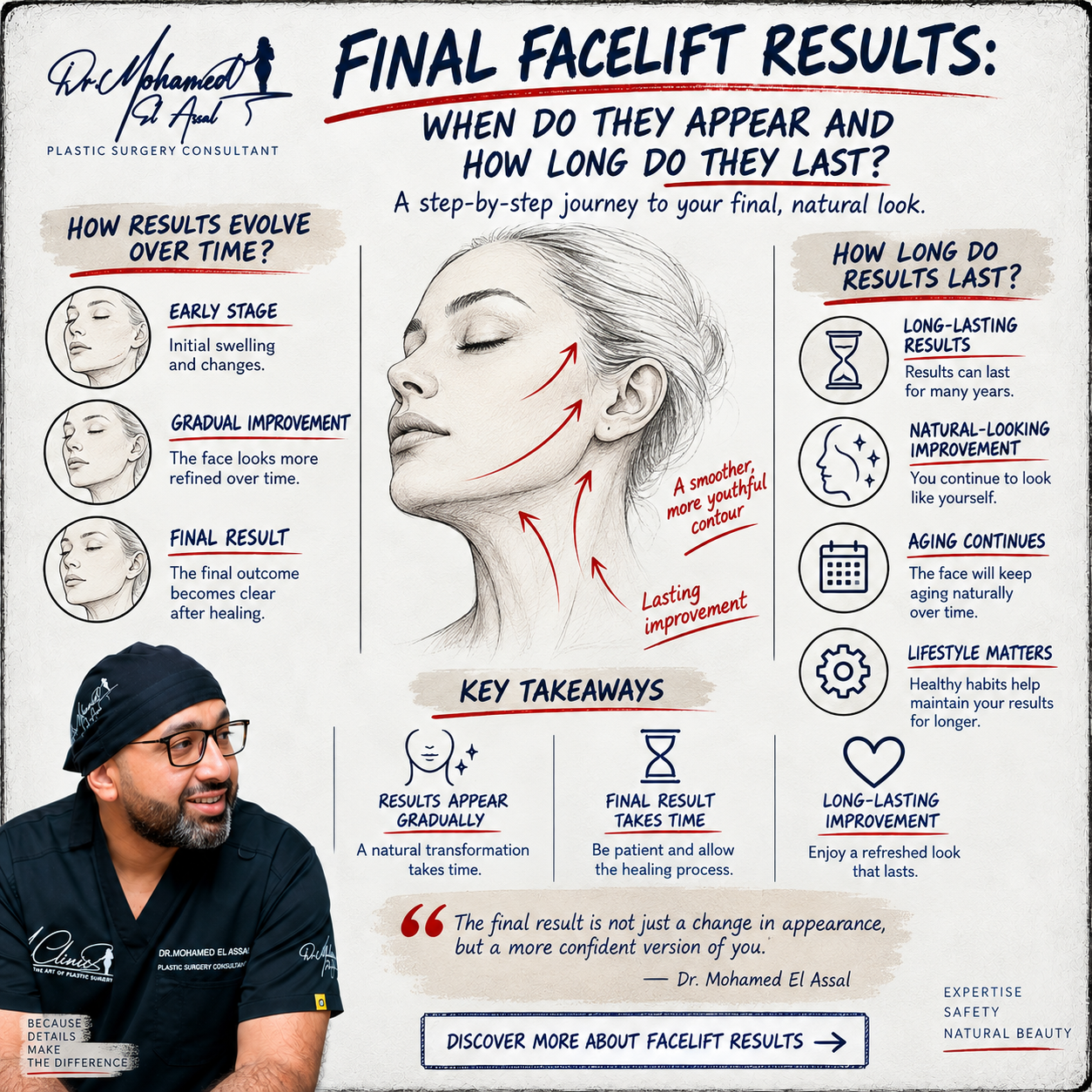
Final facelift results do not appear immediately after surgery. The improvement becomes clearer as bruising and swelling settle, while tissue texture, sensation and scars continue to mature over the following months. There is also no guaranteed lifespan for a facelift result because natural facial aging continues after surgery and varies from person to person.
It is useful to separate being socially presentable from having fully settled tissues. This article focuses on when results become stable, scar maturation and factors that influence longevity. For activity, work, driving and exercise, read: Facelift Recovery Timeline: What to Expect Week by Week. [Internal Link → Facelift Recovery Timeline: What to Expect Week by Week]
It is useful to separate being socially presentable from having fully settled tissues. This article focuses on when results become stable, scar maturation and factors that influence longevity. For activity, work, driving and exercise, read: Facelift Recovery Timeline: What to Expect Week by Week. [Internal Link → Facelift Recovery Timeline: What to Expect Week by Week]
When do facelift results start to become clearly visible?
Visible improvement emerges as early bruising and swelling subside, but that appearance is not necessarily fully settled. ASPS notes that texture, sensation and tightness may take roughly two to three months to feel more normal, while Cleveland Clinic states that minor swelling can take several months to resolve. Individual healing changes the timeline.
Why should I avoid judging the result from early photographs?
Early swelling, temporary asymmetry, tightness and altered sensation can change the apparent contour of the cheeks, jawline and neck. Tissues also need time to soften and settle. Early photographs are useful for documenting healing, but they are not equivalent to later images when swelling is lower and tissue behavior is more representative.
When are facelift results considered more settled?
There is no single day when a facelift becomes “final.” Cleveland Clinic notes that minor swelling can take several months to disappear, while The Aesthetic Society advises that complete internal and external healing may take at least six months. Surgeons therefore assess stability progressively rather than using one fixed calendar date for every patient.
Does the face keep changing for several months?
Yes, but the changes usually become subtler. After most visible swelling has resolved, tissue softness, sensation, residual tightness and scar appearance can continue to improve. This does not mean the surgical improvement has not appeared; it means biological healing continues after the main facial contour is already easier to appreciate.
How does swelling affect the final facelift result?
Swelling can hide contour details and create temporary fullness or asymmetry. Cleveland Clinic describes obvious bruising and swelling during the early weeks, with minor swelling potentially persisting for several months. The overall direction of improvement is therefore more informative than comparing the face from day to day or assuming early asymmetry is permanent.
Does mild persistent swelling mean the facelift has failed?
Not necessarily. Mild residual swelling can be part of normal healing, particularly after broader face and neck surgery. However, a sudden increase, marked one-sided swelling, worsening pain, bleeding or another unexpected change deserves prompt discussion with the surgeon. Not every postoperative swelling pattern should be self-diagnosed as normal.
When do facial texture and sensation feel more normal after a facelift?
A patient may look socially recovered before facial texture, softness and sensation feel fully normal. ASPS states that this can take around two to three months, while altered sensation may persist longer in some patients. The duration depends on surgical extent, tissue handling, swelling and individual nerve recovery rather than appearance alone.
Does a facelift improve skin surface quality itself?
A facelift primarily addresses tissue laxity and descent rather than every skin-surface problem. Mayo Clinic notes that it does not directly treat fine lines from sun damage or skin discoloration. Redraping may improve the overall appearance, but pigmentation, texture and photodamage can require separate assessment and should not be confused with surgical lifting.
When do facelift scars reach their mature appearance?
Facelift scars mature more slowly than bruising disappears. The Aesthetic Society notes that scars can remain red, firm or raised early and may take at least a year to reach their final appearance. ASPS describes general scar maturation as taking roughly six months to a year, so scar assessment should be separated from early facial recovery.
Does sun exposure affect facelift scars?
Yes. Immature scars are more sensitive to ultraviolet exposure and can develop unwanted pigment changes. ASPS and The Aesthetic Society emphasize sun protection during scar maturation. The timing of silicone, massage, topical products or other scar treatments should be individualized by the surgeon after the incision has healed sufficiently.
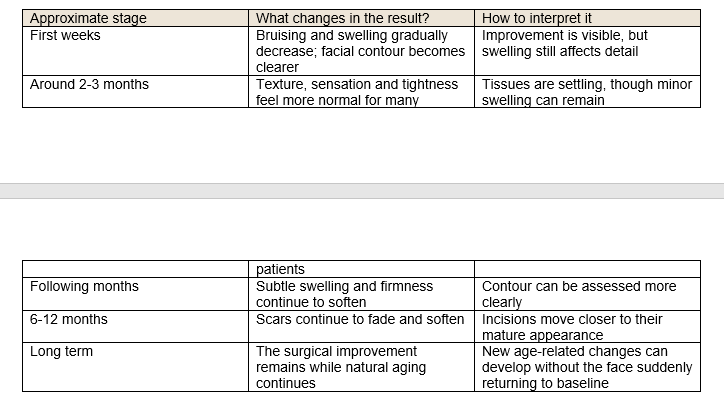
How do facelift results evolve from the first weeks through the first year?
The appearance progresses from a swelling-dominant early phase to clearer facial and neck definition, followed by slower changes in texture, sensation and scar maturation. The table below describes this approximate progression. It is not an activity-recovery schedule and does not imply that every patient reaches each healing milestone at exactly the same time.
How long do facelift results last?
There is no guaranteed duration. Cleveland Clinic states that facelift results commonly last around seven to 10 years, while The Aesthetic Society gives different ranges for different procedural extents. Long-term studies confirm durable improvement for years, but also show that facial regions age differently and that patients vary substantially in anatomy and lifestyle.
Why should patients not be promised a fixed number of years?
Longevity can be defined by photographs, patient satisfaction, persistence of jawline or neck correction, or the timing of another operation. Techniques, ages, skin quality and follow-up also differ. A 2026 scoping review found substantial variation in how facelift outcomes are defined and measured, limiting precise comparisons and universal longevity claims.
Does the face return to its preoperative appearance as aging continues?
Aging continues after a facelift, but the face does not suddenly reset to its preoperative starting point. A study with more than five years of follow-up found persistent objective improvement in several regions despite partial relapse over time, particularly in the neck. A useful model is that surgery repositions tissues and aging then continues from there.
Does needing another facelift later mean the first surgery failed?
No. Some patients consider another operation years later because natural aging continues. A recent deep-plane series examining patients who returned for revision found an average interval of about 11 years, but this was a selected group who underwent repeat surgery and should not be interpreted as a guaranteed lifespan for every facelift.
What factors influence how long facelift results last?
Longevity reflects both nonmodifiable factors, such as genetics, tissue quality and natural aging, and modifiable factors, including sun exposure, smoking, major weight changes and general lifestyle. Surgical extent and starting anatomy also matter. Maintaining a result therefore means supporting skin and tissue health while accepting that no operation can stop biological aging.
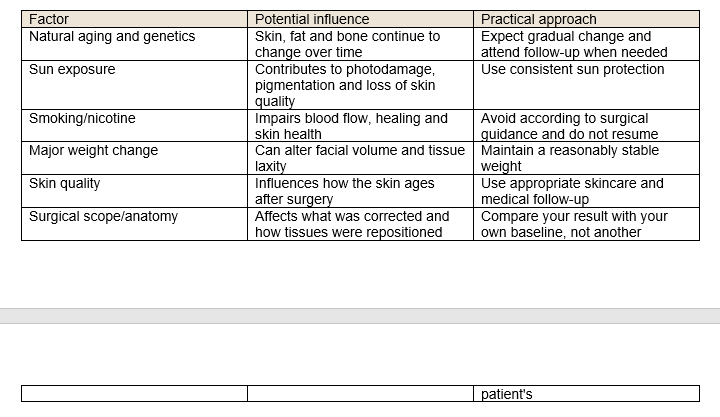
How do sun exposure, smoking and weight changes affect facelift longevity?
Sun protection and a healthy lifestyle do not make facelift results permanent, but they help protect skin that continues to age. ASPS and Cleveland Clinic recommend ongoing sun protection and healthy habits, while The Aesthetic Society highlights smoking as harmful to healing and recommends stable weight as part of maintaining plastic surgery results over time.
Can skincare maintain the surgical lift itself?
Skincare supports surface health and helps limit additional sun damage, but it cannot mechanically re-suspend deep tissues if new laxity develops. It complements rather than replaces the structural effect of surgery. Any lasers, peels, devices or injectable treatments after a facelift should be timed with the surgeon once healing is sufficiently advanced.
Does facelift technique determine how long the result lasts?
Surgical extent and the tissues treated can influence durability, but a technique name should not be converted into a guaranteed timeline. The Aesthetic Society describes broad longevity differences between limited and full procedures, while contemporary outcome research shows substantial heterogeneity in techniques and measurement. Technique should therefore be selected for anatomy, not a promised number of years.
Does a deep plane facelift last a fixed amount of time?
No. Long-term deep-plane data exist, including a recent series of patients returning for repeat surgery, but they do not establish a guaranteed duration for every patient. Age at surgery, skin quality, anatomy, lifestyle and the definition of “lasting” all influence estimates. A study of revision patients cannot represent everyone who had the primary operation.
When should I discuss my result with my surgeon instead of simply waiting?
Scheduled follow-up is the safest way to interpret the result because the surgeon can distinguish expected healing from a change that needs attention. Do not wait for a “final result” date if you develop sudden swelling, worsening pain, bleeding, new facial movement changes or wound concerns. Early aesthetic questions can also be discussed in context.
When is facial symmetry more fairly assessed?
Assessment becomes more reliable as swelling decreases and tissues soften, which is why photographs from the first weeks should not be treated like images taken several months later. Still, you do not need to remain silent about a concern. Follow-up allows the surgeon to explain whether an asymmetry is swelling-related or deserves different monitoring.
Dr. Mohamed El Assal – Expertise
Dr. Mohamed El Assal’s surgical philosophy reflects a firm commitment to patient safety, long-lasting results, and natural-looking facial rejuvenation. Understanding when final facelift results appear and how long they last is important for setting realistic expectations and helping patients make informed decisions. Although initial improvements may become noticeable within a few weeks, final results typically develop over several months as swelling subsides and the tissues settle. The longevity of facelift results varies depending on factors such as age, skin quality, lifestyle, and the natural aging process. His approach emphasizes proper post-operative care, maintaining a healthy lifestyle, and following medical instructions to support recovery. The goal is to achieve a refreshed, youthful appearance while helping patients understand the recovery timeline and expected longevity of their facelift results.
Frequently asked questions about final facelift results
When do final facelift results appear?
Improvement becomes clearer as bruising and swelling subside. ASPS notes that texture, sensation and tightness may take around two to three months to feel more normal, while The Aesthetic Society states that complete healing can continue for six months or longer. Scars themselves continue to mature beyond the early facial result.
How long does a facelift last?
There is no guaranteed duration. Cleveland Clinic states that results commonly last around seven to 10 years, while long-term studies document persistent improvement for years as aging continues. Longevity varies with anatomy, skin quality, surgical extent, lifestyle and how “lasting” is measured, so one number should not be promised to everyone.
Does your face keep aging after a facelift?
Yes. A facelift repositions tissues and improves existing laxity, but it does not stop biological aging. Skin, fat and bone continue to change over time. A patient may remain improved relative to the preoperative baseline even as new age-related changes develop, but the amount and pace of change vary individually.
When are facelift scars fully mature?
Scars mature more slowly than bruising resolves. ASPS describes scar maturation as taking roughly six months to a year, while The Aesthetic Society notes that a facelift scar may need at least a year to reach its final appearance. Sun protection and scar care should follow the surgeon’s instructions after the incision has healed.
Does smoking affect facelift results?
Smoking and nicotine reduce tissue blood flow and are associated with impaired healing in aesthetic surgery. Surgeons therefore require cessation according to an individualized perioperative plan. Long term, avoiding smoking also supports skin health and is one of the modifiable habits recommended for maintaining surgical results, although it cannot make them permanent.
Can weight changes affect facelift results?
Major weight changes can alter facial fat volume and tissue laxity. The Aesthetic Society recommends weight stability when planning surgery and as part of maintaining results. Normal minor fluctuations do not automatically erase a facelift, but substantial gains or losses can change facial proportions and the appearance of tissues after they have settled.
How does Dr. Mohamed El Assal assess facelift results over time?
Dr. Mohamed El Assal evaluates facelift results progressively, considering swelling, tissue texture, sensation, scar maturation and balance between the face and neck rather than judging an early photograph. Follow-up also addresses factors that may influence longevity, including sun exposure, smoking and weight stability, without promising a fixed duration for every patient.
CTA: If you are considering a facelift, discuss not only the change you want but also how long tissue settling may take and how natural aging continues afterward. If you have already had surgery, keep your follow-up appointments so the result can be interpreted according to your actual stage of healing rather than a generic timeline.
CTA: If you are considering a facelift, discuss not only the change you want but also how long tissue settling may take and how natural aging continues afterward. If you have already had surgery, keep your follow-up appointments so the result can be interpreted according to your actual stage of healing rather than a generic timeline.
Internal Links
• Face Lift — https://drmohamedelassal.com/service/face-lift/
References
Mayo Clinic. Face-lift. https://www.mayoclinic.org/tests-procedures/face-lift/about/pac-20394059
Cleveland Clinic. Facelift (Rhytidectomy): What Is It, Recovery & What to Expect. https://my.clevelandclinic.org/health/treatments/11023-facelift
Cleveland Clinic Cosmetic & Plastic Surgery. Facelift (Rhytidectomy). https://my.clevelandclinic.org/cosmetic-plastic-surgery/procedures/facelift
American Society of Plastic Surgeons (ASPS). Facelift Results. https://www.plasticsurgery.org/cosmetic-procedures/facelift/results
American Society of Plastic Surgeons (ASPS). What to expect as a scar heals following plastic surgery. https://www.plasticsurgery.org/news/articles/what-to-expect-as-a-scar-heals-following-plastic-surgery
The Aesthetic Society. Facelift Surgery Recovery & Aftercare. https://www.theaestheticsociety.org/procedures/head-face/facelift/aftercare-recovery
The Aesthetic Society. Facelift Results. https://www.theaestheticsociety.org/procedures/head-face/facelift/results
Jones BM, Lo SJ. How long does a face lift last? Objective and subjective measurements over a 5-year period. Plast Reconstr Surg. 2012. https://pubmed.ncbi.nlm.nih.gov/23190814/
Botti C, Botti G, Pascali M. Facial Aging Surgery: Healing Time, Duration Over the Years, and the Right Time to Perform a Facelift. Aesthetic Surg J. 2021. https://pubmed.ncbi.nlm.nih.gov/34337655/
Hornick MM, et al. Assessing Rigor in Facelift Research: A Scoping Review of 20 Years of Reported Outcomes in the United States. Aesthetic Surg J. 2026. https://pubmed.ncbi.nlm.nih.gov/41843484/
Levin M, Frankel A. Thirty Years of Deep Plane Facelifts: Characterizing Outcomes and Longevity. Facial Plast Surg Aesthet Med. 2026. https://pubmed.ncbi.nlm.nih.gov/41749415/
Dr. Mohamed El Assal. Face Lift. https://drmohamedelassal.com/service/face-lift/
Medically reviewed by Dr. Mohamed El Assal, Consultant Plastic Surgeon