Facelift vs Non-Surgical Facial Rejuvenation: Which Is Right for You?
facelift vs non-surgical facial rejuvenation
facelift vs nonsurgical facelift; nonsurgical facelift options; fillers vs facelift; Botox vs facelift; thread lift vs facelift; laser facial rejuvenation; radiofrequency skin tightening face; focused ultrasound face tightening; facial rejuvenation options
Facelift vs Non-Surgical Facial Rejuvenation: Which Is Right for You?
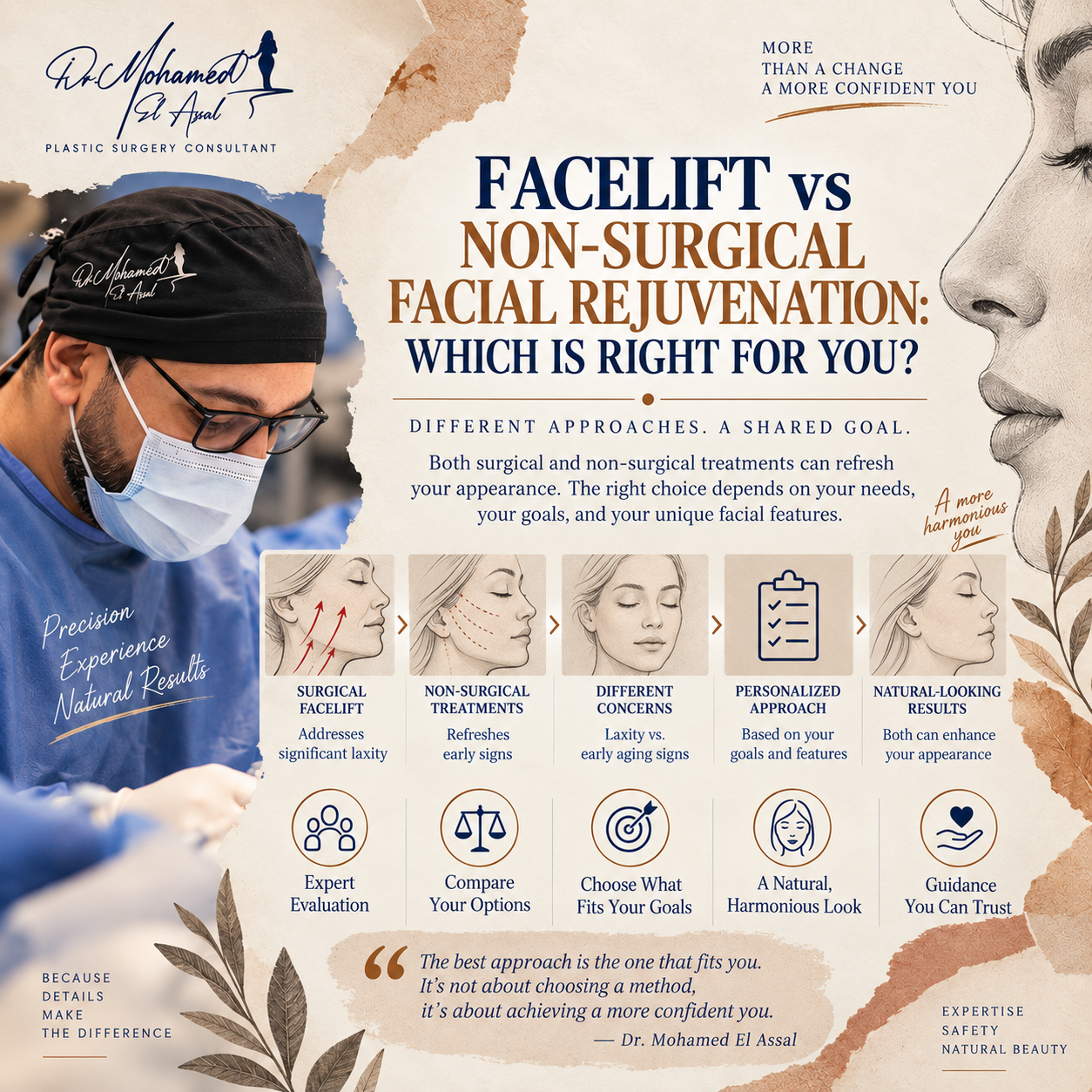
Choosing between facelift surgery and non-surgical facial rejuvenation is not about finding one universally superior treatment. It depends on the problem being treated. Surgery repositions descended tissues and addresses excess skin, while non-surgical treatments target more specific concerns such as volume loss, dynamic wrinkles, skin-surface quality or mild laxity.
“Non-surgical facial rejuvenation” is an umbrella term for treatments that do different jobs. Dermal fillers restore volume, botulinum toxin reduces selected muscle activity, threads provide limited suspension, and laser or energy-based devices target skin quality or collagen remodeling. A useful consultation therefore starts by identifying the anatomical cause of the concern.
“Non-surgical facial rejuvenation” is an umbrella term for treatments that do different jobs. Dermal fillers restore volume, botulinum toxin reduces selected muscle activity, threads provide limited suspension, and laser or energy-based devices target skin quality or collagen remodeling. A useful consultation therefore starts by identifying the anatomical cause of the concern.
What is the main difference between a facelift and non-surgical facial rejuvenation?
A surgical facelift, or rhytidectomy, is designed to reposition descended facial tissues and address lower-face, jawline and neck laxity within the planned surgical scope. Non-surgical treatments work more selectively on volume, muscle activity, skin surface or mild laxity. They can be valuable for the right concern but do not reproduce surgical tissue repositioning when laxity is substantial.
Why should non-surgical treatments not be treated as one category?
Their mechanisms and goals are different. Fillers add volume, botulinum toxin reduces selected muscle contraction, lasers target skin resurfacing, radiofrequency and focused ultrasound deliver energy to stimulate tissue remodeling, and threads provide mechanical suspension. Calling all of them a “non-surgical facelift” can obscure these differences and create expectations that a treatment was not designed to meet.
What can facelift surgery treat, and what are its limits?
Facelift surgery is most relevant to structural descent of the cheeks or lower face, jowls, loss of jawline definition and selected neck laxity, depending on surgical scope. It does not stop aging or directly correct every surface concern such as pigmentation, photodamage or fine textural lines. It also involves surgery, anesthesia, recovery and procedure-specific risks.
Does a facelift automatically correct volume loss or dynamic wrinkles?
Not necessarily. Some faces combine laxity with volume loss or muscle-related wrinkles, and each component may require separate assessment. Fat grafting or other treatments may be discussed in selected patients, but additional procedures are not automatically required. The plan should follow anatomy and goals rather than trying to treat every sign of aging with one operation.
What do dermal fillers do, and when are they not a substitute for a facelift?
Dermal fillers are primarily used to restore or support volume in selected facial areas and soften certain folds, depending on the product and treatment site. Cleveland Clinic includes fillers among non-surgical rejuvenation options, but fillers do not remove excess skin or reposition descended tissues. Adding volume is therefore not an appropriate solution for every form of facial laxity.
Who may generally be suited to fillers?
Fillers may be considered when the main concern is localized volume loss or reduced fullness with limited laxity, after facial anatomy and skin quality are assessed. If the dominant issue is tissue descent or significant excess skin, adding volume alone may not address the concern. Product, amount and treatment area should be individualized by a qualified clinician.
What does botulinum toxin treat compared with a facelift?
Botulinum toxin temporarily reduces activity in selected muscles responsible for certain dynamic wrinkles, such as appropriate forehead, frown-line or periocular concerns. It does not remove excess skin or reposition descended lower-face tissues the way surgery can. It is therefore chosen for muscle-related lines rather than used as a smaller version of facelift surgery.
Can botulinum toxin correct jawline and neck laxity?
Botulinum toxin can be used for specific muscle-related indications after clinical assessment, but it does not re-suspend descended facial and neck tissues or excise excess skin. When jowling or jawline loss is caused mainly by structural descent, the underlying anatomy should be identified before assuming that weakening a muscle will correct the laxity.
Can a thread lift create the same effect as facelift surgery?
A thread lift is a minimally invasive procedure intended to provide limited tissue suspension, but it is not equivalent to surgical facelift correction when laxity or excess skin is substantial. Published reviews describe improvement in selected patients while also emphasizing uncertainty about long-term efficacy and durability. Patient selection and realistic expectations are therefore particularly important.
Who may generally be suited to a thread lift?
Threads may be discussed for selected patients with mild to moderate laxity who prefer a less invasive approach and understand the limits of correction. Systematic reviews emphasize the need to discuss adverse events and uncertain long-term durability. For procedure details, read: Thread Lifting. [Internal Link → Thread Lifting]
What does laser resurfacing treat, and what does it not do?
Laser skin resurfacing primarily targets skin-surface concerns such as selected fine wrinkles, photodamage, pigmentation irregularity and texture, depending on the device and treatment depth. Some techniques may also produce skin tightening, but laser treatment does not reposition deeper descended tissues or remove excess skin in the way facelift surgery can when structural laxity is present.
Are all facial lasers similar?
No. Ablative and non-ablative systems, wavelengths, fractional technologies and treatment depths differ substantially in effect, recovery and risk. Systematic reviews of facial laser rejuvenation reflect this heterogeneity. Device selection should consider the specific skin concern, skin type and medical history rather than treating the word “laser” as a single standardized alternative to surgery.
What can radiofrequency do for facial laxity?
Radiofrequency uses controlled thermal energy to stimulate collagen remodeling and can improve skin quality, firmness and laxity to varying degrees. Systematic reviews report beneficial outcomes in selected patients, but the intended effect is generally more modest than surgical repositioning of descended tissues, particularly when substantial jowling, excess skin or structural laxity is present.
Is radiofrequency appropriate for every degree of laxity?
No single assumption applies to all patients or devices. Studies include different radiofrequency technologies, settings and protocols, and response varies with laxity, tissue thickness and other factors. A realistic consultation distinguishes improvement in skin firmness from surgical repositioning of facial tissues; these goals overlap somewhat but are not interchangeable.
What can focused ultrasound do for facial rejuvenation?
Microfocused ultrasound delivers energy at selected tissue depths to stimulate collagen remodeling and produce non-surgical tightening. Systematic reviews support improvement in mild to moderate facial laxity in selected patients, while also documenting variation in devices, protocols and evidence quality. It does not remove excess skin, and long-term comparative data remain less complete than many patients assume.
Is focused ultrasound a substitute for surgery in severe laxity?
Evidence does not support treating it as an equivalent substitute for surgery when laxity or excess skin is substantial. One systematic review found reduced benefit as laxity increased, and Cleveland Clinic notes that non-surgical rejuvenation may be less effective for extremely loose or sagging skin. Clinical examination should therefore determine whether the treatment goal is realistic.
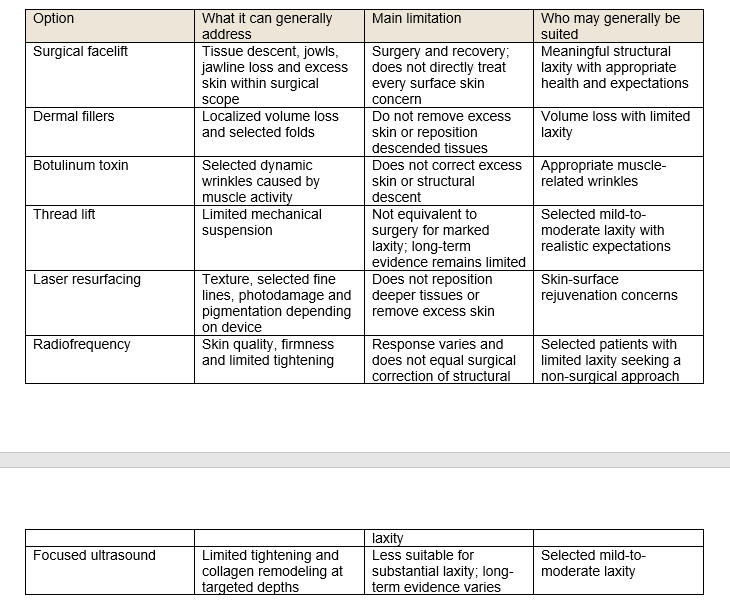
How do the main facial rejuvenation options compare?
The most useful comparison connects each treatment with the problem it was designed to address rather than ranking procedures from weakest to strongest. One patient may need volume restoration, another muscle-related wrinkle treatment or resurfacing, while structural laxity may dominate in someone else. The table summarizes typical roles and limitations without replacing individualized assessment.
How can I tell whether my concern is volume loss, laxity or a skin-surface problem?
Different aging changes can look similar in the mirror. Heaviness around the mouth may reflect tissue descent, a tired appearance may be driven by volume loss, and photodamage or fine surface lines can amplify the perception of aging. Examination separates contributions from skin, fat, muscle, ligaments and bone before matching a treatment to the actual cause.
Can I need more than one type of treatment?
Yes. Facial aging can affect multiple tissue layers at the same time, so laxity may coexist with volume loss, dynamic wrinkles or skin-surface change. Combination treatment is not automatically necessary, however. Each component should have a defined purpose and add proportionate benefit rather than becoming a routine checklist applied to every patient.
Can non-surgical treatments delay the need for a facelift?
No treatment can guarantee that facelift surgery will be delayed for a specific number of years. Non-surgical procedures can improve the concern they target, but they do not stop aging or prevent structural laxity from progressing. Facelift timing should depend on the development of a surgically correctable problem and patient goals, not on exhausting every non-surgical option first.
Do I need to try fillers or devices before considering surgery?
Not necessarily. If the main concern is substantial tissue descent, a treatment designed for volume or skin quality may not be a required step before surgical consultation. Conversely, surgery may be disproportionate when the concern is superficial or limited. The sequence should start with diagnosis and treatment matching rather than a fixed ladder from least to most invasive.
How should downtime influence the choice between surgery and non-surgical treatments?
Downtime is an important practical consideration, but it should not replace anatomical diagnosis. Non-surgical procedures are generally less invasive and often allow faster return to routine activity, while facelift surgery requires surgical recovery. A shorter recovery period does not make a limited treatment appropriate for a structural problem that it cannot adequately address.
Does shorter recovery mean a non-surgical procedure has no risks?
No. Fillers, botulinum toxin, threads, lasers and energy-based devices each have potential side effects and complications that vary by technique, treatment area and patient. Some are uncommon but important. Treatment should be performed by an appropriately qualified clinician after medical history, risks and expectations are reviewed; “non-surgical” does not mean risk-free.
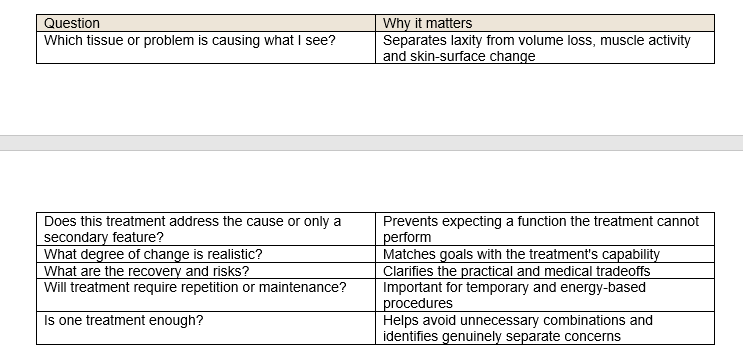
What questions help me choose between facelift surgery and non-surgical rejuvenation?
Start by defining the exact concern: laxity, volume, dynamic wrinkles, skin texture or a combination. Then ask what the proposed treatment can and cannot change, the realistic magnitude of improvement, recovery, risks, need for repeat treatment and implications for future procedures. Good decision-making matches treatment to anatomy rather than choosing a procedure name first.
Dr. Mohamed El Assal – Expertise
Dr. Mohamed El Assal’s surgical philosophy reflects a firm commitment to patient safety, long-lasting results, and natural-looking facial rejuvenation. Understanding the difference between facelift surgery and non-surgical facial rejuvenation, including their techniques, benefits, and expected results, is an important part of setting realistic expectations and helping patients make informed decisions about their facial rejuvenation journey. A facelift is a surgical procedure designed to address visible signs of aging, such as sagging skin, deep folds, and loss of facial definition, by lifting and repositioning underlying tissues and removing excess skin when necessary. In contrast, non-surgical facial rejuvenation includes treatments such as dermal fillers, Botox, laser treatments, and skin-tightening procedures, which aim to improve facial appearance without traditional surgery. While non-surgical treatments may be suitable for individuals with mild to moderate signs of aging who prefer minimal downtime, a facelift may provide more significant and longer-lasting improvements for patients experiencing advanced skin laxity and facial sagging. The choice between these approaches depends on several factors, including age, skin condition, degree of facial aging, individual aesthetic goals, and overall health. Particular importance is placed on careful patient assessment, understanding individual concerns, and selecting the most appropriate treatment approach for each patient. Dr. Mohamed El Assal’s approach emphasizes personalized treatment planning, realistic expectations, and achieving balanced, natural-looking results while prioritizing patient safety. The goal is to help patients understand the differences between surgical and non-surgical options, choose the treatment that best matches their needs, and achieve a refreshed, youthful, and harmonious facial appearance while maintaining natural facial expressions and proportions.
Frequently asked questions about facelift surgery and non-surgical rejuvenation
Can a non-surgical facelift give the same result as surgery?
“Non-surgical facelift” describes several different treatments and does not mean they reposition tissues or remove excess skin in the same way as surgery. They may improve volume, wrinkles, skin quality or limited laxity. When meaningful structural descent is present, the limitations of non-surgical options become especially important to discuss.
Fillers or facelift: how do I know what I need?
If localized volume loss is the main concern, fillers may be one option to discuss. If the problem is tissue descent, jowling or excess skin, adding volume does not perform the function of a facelift. Examination determines how much of the appearance comes from volume loss versus laxity before choosing or combining treatments.
Is a thread lift an alternative to surgical facelift?
Threads can provide limited suspension in selected patients, but they should not be treated as an equivalent substitute for surgery when laxity is substantial. Reviews differ in how they characterize efficacy and durability and repeatedly note limited long-term evidence. Expectations, risks and the degree of laxity should be discussed before treatment.
Can laser treatment tighten the face like surgery?
Laser resurfacing primarily treats skin-surface concerns such as selected fine lines, photodamage, pigmentation or texture, depending on the device. Some systems can also improve skin tightness, but they do not reposition deeper descended tissues or remove excess skin the way facelift surgery can when structural laxity is the main problem.
Are radiofrequency or focused ultrasound better than facelift surgery?
There is no universal answer because the treatment goals differ. Energy-based devices may suit selected patients seeking limited tightening or skin-quality improvement, while surgery addresses more substantial tissue descent and excess skin. Choice depends on anatomy, degree of laxity, goals, health and willingness to accept recovery rather than a fixed hierarchy.
Can a facelift be combined with non-surgical treatments?
Sometimes different treatments can address different components of facial aging; surgery may treat laxity while another procedure targets volume or skin quality. Combination and timing are not standardized for every patient. The surgeon should determine whether each additional treatment has a clear purpose and when it can be performed safely around surgery.
How does Dr. Mohamed El Assal choose between facelift surgery and non-surgical options?
Dr. Mohamed El Assal begins by identifying the source of the concern: tissue descent, volume loss, muscle activity, skin-surface change or a combination. Options are then discussed according to what they can realistically treat, their limitations, recovery and risks. The aim is to select an intervention proportionate to the anatomy rather than apply one procedure to every face.
CTA: If you are unsure whether facelift surgery or a non-surgical treatment fits your concern, schedule a consultation for an integrated assessment of laxity, volume, skin and muscle activity. Bring the specific changes that bother you rather than choosing a treatment name in advance, so the discussion can focus on what each option can and cannot achieve.
CTA: If you are unsure whether facelift surgery or a non-surgical treatment fits your concern, schedule a consultation for an integrated assessment of laxity, volume, skin and muscle activity. Bring the specific changes that bother you rather than choosing a treatment name in advance, so the discussion can focus on what each option can and cannot achieve.
Internal Links
• Face Lift — https://drmohamedelassal.com/service/face-lift/
• Thread Lifting — https://drmohamedelassal.com/service/thread-lifting/
• Face Injection — https://drmohamedelassal.com/service/face-injection/
• Thread Lifting — https://drmohamedelassal.com/service/thread-lifting/
• Face Injection — https://drmohamedelassal.com/service/face-injection/
References
Mayo Clinic. Face-lift. https://www.mayoclinic.org/tests-procedures/face-lift/about/pac-20394059
Cleveland Clinic. Nonsurgical Facelift: What It Is, Options & Benefits. https://my.clevelandclinic.org/health/treatments/24018-non-surgical-facelift
Cleveland Clinic. Facelift (Rhytidectomy): What It Is, Recovery & What to Expect. https://my.clevelandclinic.org/health/treatments/11023-facelift
American Society of Plastic Surgeons (ASPS). Facelift. https://www.plasticsurgery.org/cosmetic-procedures/facelift
American Society of Plastic Surgeons (ASPS). Dermal Fillers. https://www.plasticsurgery.org/cosmetic-procedures/dermal-fillers
American Society of Plastic Surgeons (ASPS). Botulinum Toxin. https://www.plasticsurgery.org/cosmetic-procedures/botulinum-toxin
American Society of Plastic Surgeons (ASPS). Laser Skin Resurfacing. https://www.plasticsurgery.org/cosmetic-procedures/laser-skin-resurfacing
Ling J, Zhao H. A Systematic Review and Meta-Analysis of the Clinical Efficacy and Patients' Satisfaction of Micro-focused Ultrasound Treatment for Facial Rejuvenation and Tightening. Aesthetic Plast Surg. 2023. https://pubmed.ncbi.nlm.nih.gov/37198297/
Contini M, et al. A Systematic Review of the Efficacy of Microfocused Ultrasound for Facial Skin Tightening. 2023. https://pubmed.ncbi.nlm.nih.gov/36674277/
Pham CT, et al. Safety Profile of Thread Lifts on the Face and Neck: An Evidence-Based Systematic Review. Dermatol Surg. 2021. https://pubmed.ncbi.nlm.nih.gov/34699439/
Abraham RF, et al. Percutaneous Thread Lift Facial Rejuvenation: Literature Review and Evidence-Based Analysis. Aesthetic Plast Surg. 2021. https://pubmed.ncbi.nlm.nih.gov/33471152/
Evaluating the effectiveness and safety of radiofrequency for face and neck rejuvenation: A systematic review. Lasers Med Sci. 2022. https://pubmed.ncbi.nlm.nih.gov/34923652/
Radiofrequency-Based Treatments for Facial Rejuvenation: A Systematic Review of Efficacy, Safety, and Patient-Centered Outcomes. 2025. https://pubmed.ncbi.nlm.nih.gov/41426292/
Systematic review and meta-analysis of randomized clinical trials comparing ablative and non-ablative lasers in facial and hand rejuvenation/resurfacing. 2022. https://pubmed.ncbi.nlm.nih.gov/35107665/
Dr. Mohamed El Assal. Face Lift. https://drmohamedelassal.com/service/face-lift/
Dr. Mohamed El Assal. Thread Lifting. https://drmohamedelassal.com/service/thread-lifting/
Dr. Mohamed El Assal. Face Injection. https://drmohamedelassal.com/service/face-injection/
Medically reviewed by Dr. Mohamed El Assal, Consultant Plastic Surgeon