Ear Cartilage vs. Rib Cartilage in Revision Rhinoplasty – A Decision-Making Guide
Why Do Revision Surgeries Require Cartilage Grafts?
In some revision rhinoplasty cases, remaining septal cartilage is insufficient for the required reconstruction, necessitating an external cartilage source. However, not every revision surgery requires additional cartilage — the graft source decision depends on the reconstructive requirements of each individual case.
Graft Source Priority Sequence
Specialist surgeons generally follow this order: first, septal cartilage if available in adequate volume; then auricular (conchal) cartilage for cases requiring moderate support; then costal cartilage for cases requiring major structural reconstruction.
Ear Cartilage: Advantages and Disadvantages
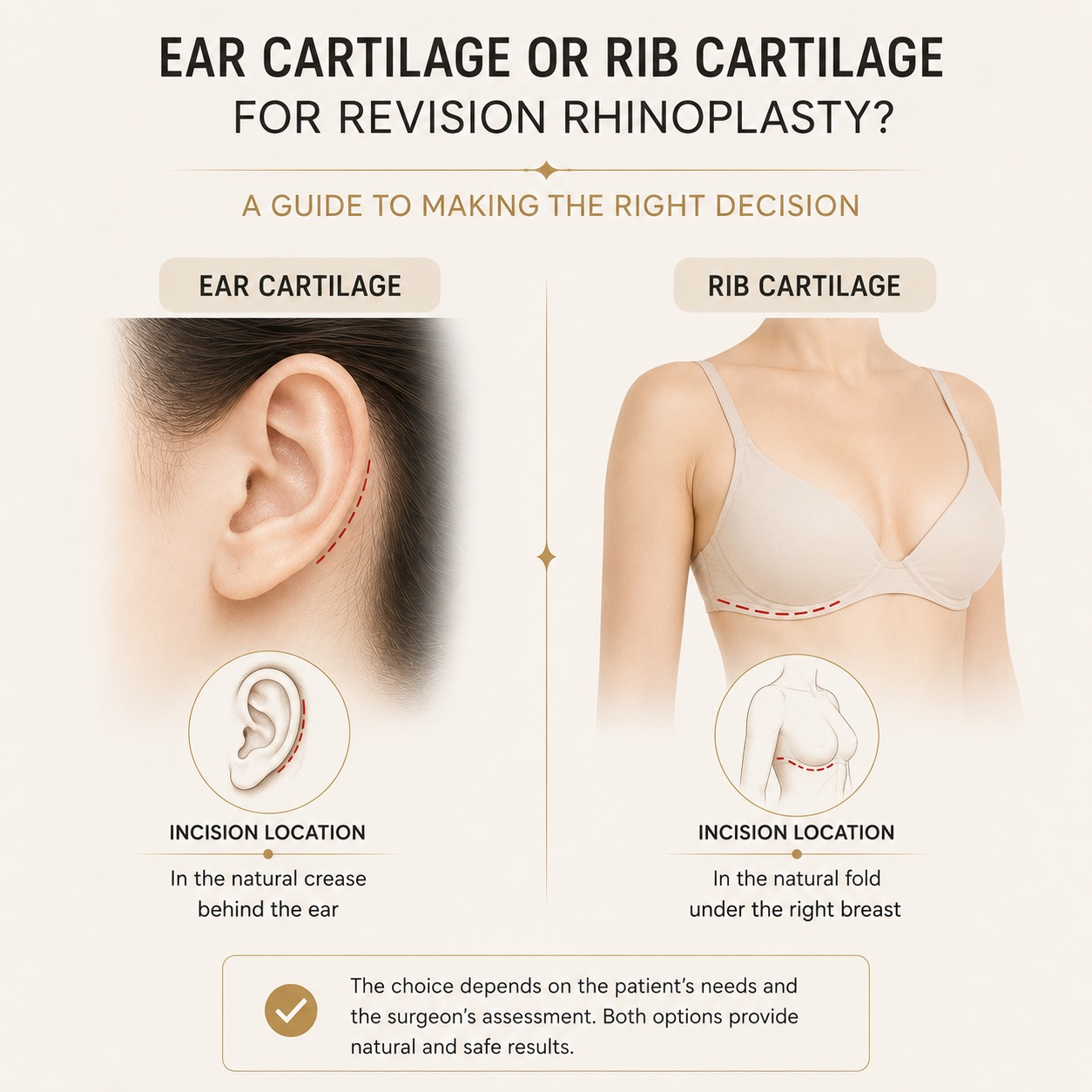
Harvested from the conchal bowl, it offers ease of harvest with a small incision, pliability suited to tip sculpting, camouflage grafts, alar batten grafts, and rim grafts. Disadvantages: limited availability and insufficient rigidity for major structural support.
Rib Cartilage: Advantages and Disadvantages
Harvested from the costal cartilages of the chest, it provides abundant volume and high structural strength, making it ideal for bridge reconstruction, saddle nose correction, and major structural rebuilding. Disadvantages: additional thoracic incision and risk of warping over time if not properly managed.
Can Multiple Cartilage Sources Be Combined?
Yes, in some cases two sources are combined — such as septum with ear, or ear with rib — each serving a different role in the surgical plan.
Techniques to Minimise Rib Cartilage Warping
Experienced surgeons use the central segment carving technique and submerge the graft in saline for 20–30 minutes before implantation to determine its warping tendency. Balanced carving techniques can also reduce long-term warping.
What to Expect in Revision Surgery
Revision surgeries are inherently more complex than primary rhinoplasty and require a longer recovery period. Patients should maintain realistic expectations: meaningful improvement, not absolute perfection. Awaiting the final result (12–18 months) is essential.
Dr. Mohamed El Assal – Expertise
Dr. Mohamed El Assal has developed specialised expertise in revision rhinoplasty through ongoing training with Dr. Hossam Fouda, widely recognised for his extensive experience in revision rhinoplasty and the use of auricular cartilage grafts in reconstructive cases. He has additionally benefited from Prof. Yves Saban's teaching on airway preservation and cartilage reconstruction. This dual training background shapes his surgical decision-making: evaluating residual cartilage first, then selecting the most appropriate graft source according to each case's individual reconstructive requirements.
Frequently Asked Questions
Does harvesting ear cartilage change the ear shape?
Generally no, as the cartilage is taken from the conchal bowl while preserving the ear framework.
Is rib cartilage harvest painful?
It may cause chest discomfort for several weeks, which gradually improves.
Which lasts longer, ear or rib cartilage?
Both are generally permanent, but rib cartilage is more prone to warping if not properly managed.
Do all revision surgeries require additional cartilage?
No. Residual septal cartilage is always evaluated first before any external source is considered.
Does rib harvest leave a scar?
Yes, a small chest incision that gradually fades over time.