A Practical Classification of Abdominal Laxity and Its Cosmetic Solutions
Why Is There No Single Solution for All Cases of Abdominal Laxity?
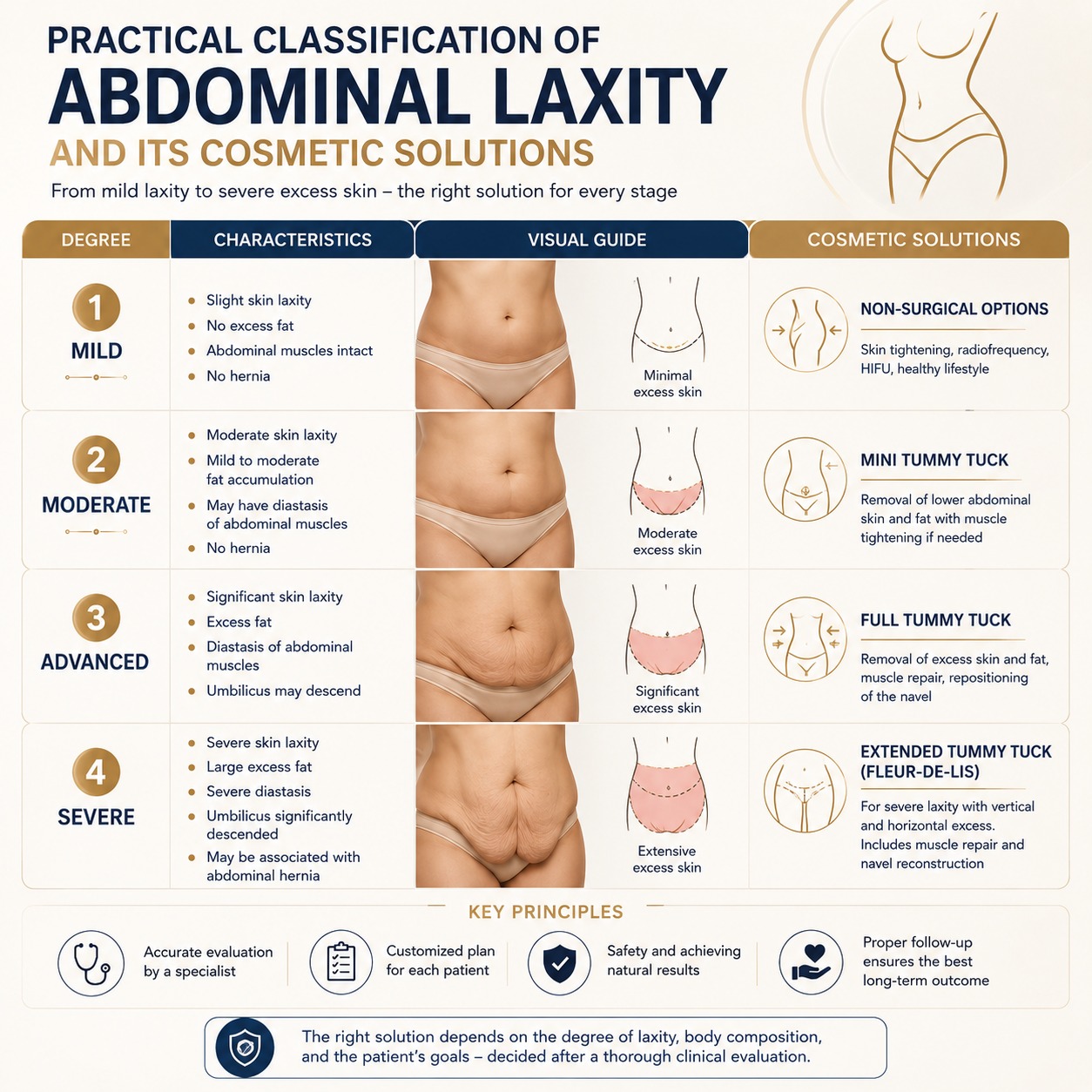
There is no universal standardised classification of abdominal laxity, and no single operation suits every patient. The surgeon's assessment is multidimensional, encompassing: volume and location of excess skin, presence of diastasis recti, fat volume and distribution, hernia (ventral or umbilical), pregnancy and weight-loss history, and the patient's individual goals. The surgical plan is designed on the basis of examination findings, not a rigid classification.
How Do I Know If My Abdomen Needs Surgery?
Signs of laxity that may warrant intervention include: loose skin following pregnancy or weight loss that does not respond to exercise and diet, symptomatic diastasis recti, and a hanging skin fold causing recurrent intertrigo. Exercise alone cannot tighten truly redundant skin.
Presentation 1 – Mild Laxity
Characterised by localised fat excess with minimal skin laxity and no muscle separation. Appropriately selected liposuction may suffice, occasionally combined with skin-tightening devices (radiofrequency or HIFU) in selected cases, alongside muscle-strengthening programmes.
Presentation 2 – Infraumbilical Laxity
Laxity extends across the infraumbilical region with notable excess skin. Options range from liposuction alone to mini abdominoplasty, selected according to skin quality, presence of muscle separation, and volume of excess skin.
Presentation 3 – Extensive Laxity Above and Below the Umbilicus
Involves widespread skin redundancy above and below the navel, commonly with diastasis recti requiring rectus plication. Full abdominoplasty with umbilical transposition is generally indicated.
Presentation 4 – Hanging Skin Fold (Abdominal Pannus)
Defined by a hanging skin apron extending beyond the inguinal crease, frequently associated with chronic intertrigo. In cases of massive weight loss, Fleur-de-Lis abdominoplasty or complete lower body lift may be required, determined by individual assessment.
Why Does the Surgeon Not Rely on Photos Alone?
Clinical examination is essential: skin elasticity, muscle separation on palpation, occult hernia, and fat thickness are all assessed. Photographs complement but do not replace examination.
Dr. Mohamed El Assal – Expertise
Dr. Mohamed El Assal has extensive experience in abdominoplasty and diastasis recti repair. His assessment is grounded in comprehensive clinical examination of each patient, accounting for skin quality, muscle separation, pregnancy and weight-loss history, and the presence of hernia before designing an individualised surgical plan to achieve the best possible outcome.
Frequently Asked Questions
Does liposuction tighten skin?
Liposuction alone does not tighten excess skin. Cases with skin redundancy require surgical excision.
Can liposuction and abdominoplasty be combined?
Yes, they are frequently combined for optimal results.
Does pregnancy affect tummy tuck results?
Yes. It is advisable to complete childbearing before undergoing abdominoplasty.
Will the laxity return after surgery?
Maintaining a stable weight after surgery is essential for long-lasting results.
What is the difference between Mini and Full Abdominoplasty?
Mini addresses only the infraumbilical zone. Full addresses the entire abdomen with umbilical transposition.