Liposuction Results Timeline: When Will You See the Final Shape?
liposuction results timeline
when do liposuction results show; final liposuction results; liposuction final shape; liposuction results 3 months; liposuction swelling and results; body contour after liposuction; skin retraction after liposuction; abdominal liposuction results
Liposuction Results Timeline: When Will You See the Final Shape?
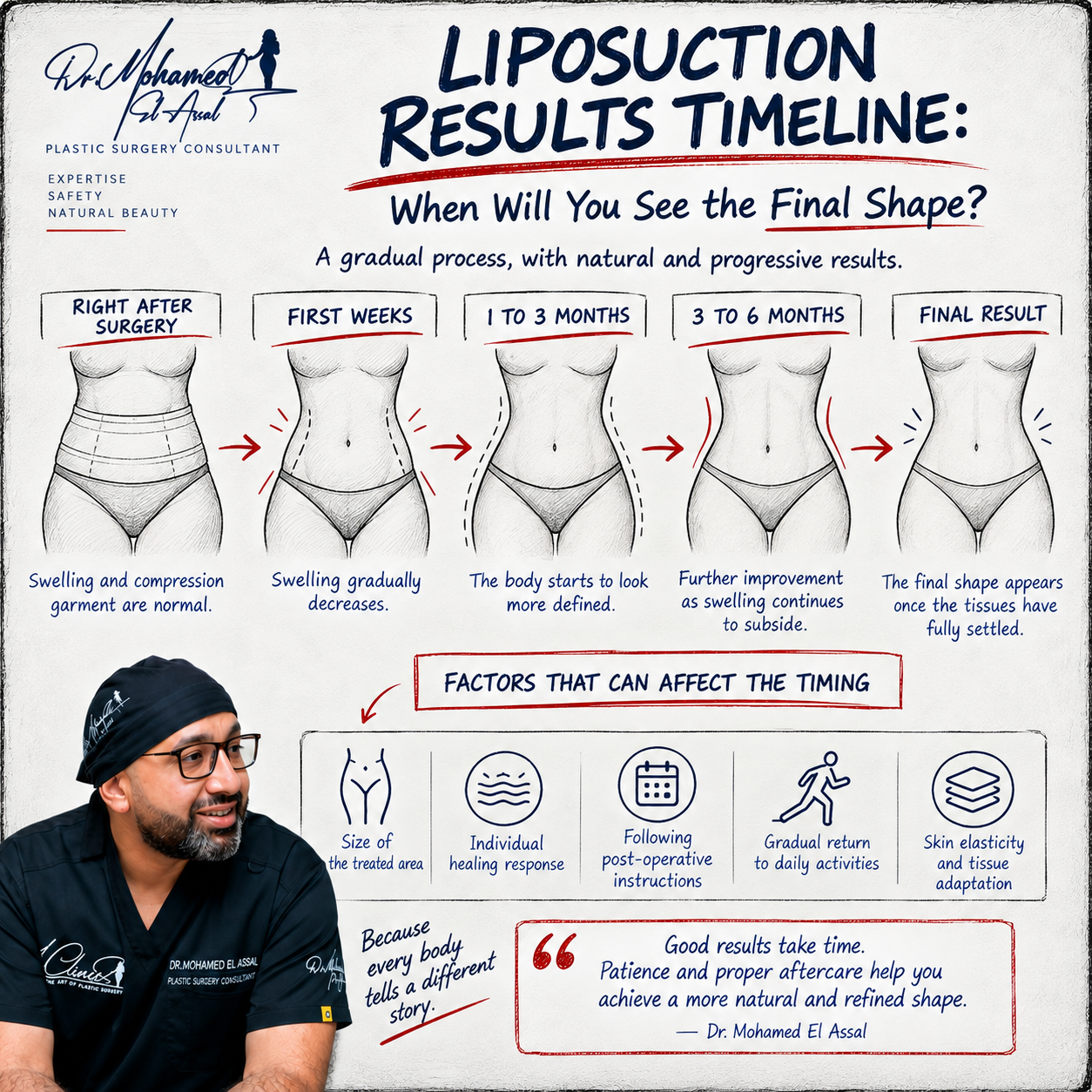
Liposuction results begin to emerge as swelling and fluid retention decrease, but the shape seen during the first days or weeks is not the stable result. Mayo Clinic and ASPS describe improvement over weeks to several months, while Cleveland Clinic places complete swelling resolution and visible results for many patients at roughly three to six months.
The timeline is not identical for every patient or body area. Treatment extent, postoperative swelling, skin quality and elasticity, tissue healing and the anatomical region all influence how quickly the contour becomes clear. It is therefore more useful to follow progressive change than to expect one calendar date when the result suddenly becomes final.
The timeline is not identical for every patient or body area. Treatment extent, postoperative swelling, skin quality and elasticity, tissue healing and the anatomical region all influence how quickly the contour becomes clear. It is therefore more useful to follow progressive change than to expect one calendar date when the result suddenly becomes final.
When do liposuction results start to show?
A change in contour may be noticeable relatively early, but swelling and retained fluid can mask much of the new shape. As they decrease, the treated area generally looks less bulky and more defined. Mayo Clinic notes that the area should look slimmer within several months, so early postoperative appearance should not be used to judge final symmetry or contour.
Why can the contour look uneven at first?
Swelling does not always resolve uniformly across both sides or every part of a treated area, and tissues need time to settle after fat removal. Temporary firmness or fullness can therefore make the contour look irregular. Early variation does not automatically predict the final shape, although worsening or concerning changes should be reviewed by the surgeon.
What are the approximate stages of liposuction results?
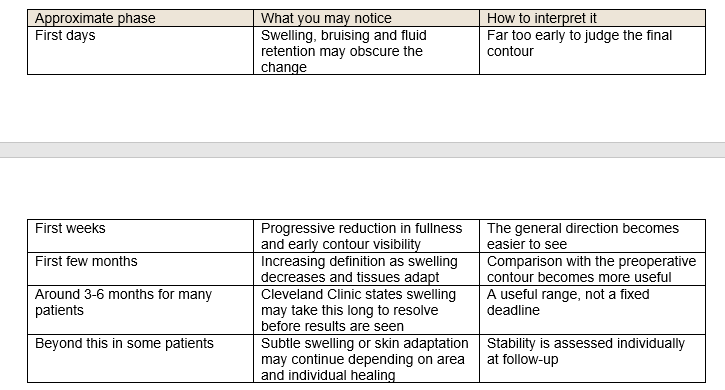
It is more accurate to think in phases than in one final-result date. Early swelling dominates first, then the new contour becomes increasingly visible as fluid decreases, and finer definition develops over the following months. Sources differ on exact timing but agree that the result evolves gradually and often requires several months for meaningful stabilization.
When are liposuction results close to the final shape?
There is no single final-result date for everyone. Mayo Clinic and ASPS use the broader description of several months as swelling resolves, while Cleveland Clinic gives an approximate three-to-six-month range for swelling to fully subside before results are seen. Subtler changes may continue beyond that in some patients depending on skin, region and recovery.
Why don't medical sources use one exact final-result date?
“Result” can refer to different endpoints: the first visible change, resolution of most swelling, or stabilization of skin and soft tissue. Treatment areas also differ in skin behavior, and swelling varies with procedure extent. Professional sources therefore give ranges rather than one day, making clinical follow-up more meaningful than the calendar alone.
How does swelling affect the liposuction results timeline?
Swelling is one of the main reasons the true contour is not immediately visible after liposuction. Postoperative fluid can temporarily make an area look fuller or less defined, and the change emerges progressively as swelling subsides. ASPS states that the improved contour continues to develop over several months as postoperative swelling and fluid retention resolve.
For related guidance, read Swelling After Liposuction: What Is Normal and When Does It Go Away?. For independent medical information, see ASPS liposuction recovery guidance.
For related guidance, read Swelling After Liposuction: What Is Normal and When Does It Go Away?. For independent medical information, see ASPS liposuction recovery guidance.
Does persistent puffiness mean the result has failed?
Not necessarily. Swelling that is gradually improving can be part of normal healing and should be interpreted according to timing, trend and accompanying symptoms. The overall direction matters more than a single day. Increasing swelling, severe pain, redness or other concerning symptoms should be discussed promptly with the surgical team rather than judged as a cosmetic result.
How does skin quality affect when the final contour appears?
Liposuction reduces subcutaneous fat but does not remove redundant skin, so the final surface contour partly depends on how the skin contracts and adapts to the reduced volume. ASPS and Mayo Clinic note that poorly elastic skin may remain looser, while clinical studies show that skin retraction varies with factors such as age, treatment site and tissue characteristics.
Does good skin elasticity make the result immediate?
No. Even when skin elasticity is favorable, swelling and tissue healing still influence the timeline. Skin quality affects how the surface adapts around the new volume rather than eliminating recovery. Retraction also differs by body region, so a patient's experience after liposuction in one area cannot precisely predict the timing in another.
Do results appear at the same speed in every body area?
Not necessarily. Fat thickness, skin characteristics, movement and treatment surface area differ between the abdomen, waist, thighs, arms and neck. Studies of skin retraction after suction lipectomy found treatment site to be an important determinant of tissue response. General timelines can guide expectations, but each region should be assessed on its own healing course.
Does the amount of fat removed affect stabilization time?
Treatment extent and the amount of tissue addressed can influence postoperative changes, but there is no simple volume-to-time formula. An older clinical study of skin retraction found age and total fat removal associated with the time needed to reach a stable result, while treatment site also had a substantial effect. These factors should therefore be interpreted together.
When is it fair to compare before-and-after liposuction photos?
Photos can document change at several stages, but early comparisons must account for unresolved swelling. Images become more representative of a stable contour after fluid decreases and skin and soft tissues have had time to adapt. Serial photographs are therefore more informative than one early postoperative image when assessing how the shape is evolving.
Why should before-and-after photos use similar conditions?
Lighting, camera angle, distance, posture and abdominal muscle tension can all change how a contour appears. Medical comparison is more useful when photographs are taken under similar conditions. The purpose is to document genuine anatomical change over time rather than create an apparent difference caused mainly by posing or photography.
Does a compression garment make final results appear faster?
Compression garments are commonly used after liposuction to support tissues and help manage swelling during recovery, but they should not be presented as a guarantee of faster final results or a better outcome for every patient. The garment type and duration vary by procedure, body area and surgeon instructions, and success is not measured by wear time alone.
Why is there no single compression-garment schedule?
Procedure extent, treatment area, skin quality, swelling and surgeon protocol differ among patients, and research does not establish one universal compression regimen for every body-contouring procedure. The prescribed fit and duration should therefore come from the operating surgeon rather than a generic timeline. Garment use is one part of recovery, not the definition of final results.
When should an uneven contour be assessed rather than simply watched?
Mild early irregularity can reflect swelling and tissue healing, but a change that worsens or is accompanied by severe pain, increasing redness, a clear fluid collection or other concerning symptoms needs assessment. Final judgment of skin laxity or contour irregularity should otherwise consider the recovery stage before any additional cosmetic treatment is planned.
Can you decide early that a revision or additional procedure is needed?
Not in every case. Some medical problems are identifiable early and require prompt evaluation, but many contour details change as swelling subsides and tissues settle. An elective decision about additional contouring should not be based only on the first postoperative weeks. The surgeon determines when the tissues are stable enough for a meaningful aesthetic assessment.
What factors can make liposuction results appear sooner or later?
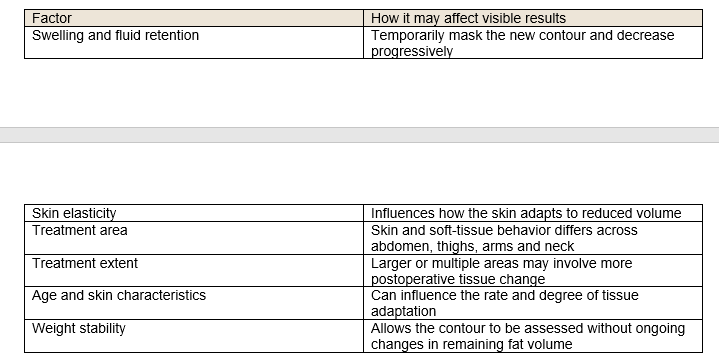
No single factor determines the timeline. Treatment area and extent, swelling, skin elasticity, age, tissue healing, weight stability and individual biology can all influence how quickly the contour becomes clear. Some cannot be modified, while following postoperative instructions and attending follow-up helps the surgeon monitor whether the shape is progressing as expected.
Dr. Mohamed El Assal – Expertise
Dr. Mohamed El Assal’s surgical philosophy reflects a firm commitment to long-lasting results, patient safety, and natural-looking body contours. Understanding the liposuction results timeline and when the final shape becomes visible is an important part of setting realistic expectations and supporting a smooth recovery after surgery. Although liposuction removes excess fat to improve body contours, the final results develop gradually as postoperative swelling subsides and the body heals. Particular importance is placed on careful patient assessment, meticulous surgical technique, and determining the most appropriate approach for each individual. His approach emphasizes personalized treatment planning, proper postoperative care, wearing compression garments as recommended, a gradual return to physical activity, and maintaining a healthy lifestyle to support recovery and long-lasting results. The goal is to achieve smoother, more defined body contours while helping patients understand the stages of recovery after liposuction, the factors that influence when results become visible, the expected timeline for swelling to resolve, and the importance of realistic expectations and long-term follow-up.
Frequently asked questions about liposuction results
When will I notice the first difference after liposuction?
You may notice a contour change relatively early, but swelling and fluid retention can hide part of the result at first. As they decrease, the difference becomes clearer. Mayo Clinic notes that the treated area becomes less bulky as swelling resolves, while the contour continues to evolve through the following weeks and months.
When will I see the final liposuction results?
There is no fixed date for everyone. Mayo Clinic and ASPS describe results becoming clearer over several months as swelling resolves, while Cleveland Clinic states that complete swelling resolution and visible results may take roughly three to six months. Subtle changes can continue beyond that depending on the treated area, skin and individual healing.
Why do I look bigger or swollen after liposuction?
Postoperative swelling and fluid retention can temporarily make a treated area look larger or less defined than expected. This should change progressively during healing. If swelling is increasing, unusually asymmetric, associated with severe pain, redness or other concerning symptoms, contact your surgeon rather than assuming it is simply part of the cosmetic result.
Can the skin keep changing after most swelling is gone?
Yes. Skin and soft tissues may continue adapting after most visible swelling has decreased. The degree of change depends on elasticity, age, treatment area and procedure extent. Clinical studies show that skin retraction is not identical across body regions, so finer contour changes can continue at different rates in different patients.
Do abdominal, arm and neck liposuction results appear at the same time?
Not necessarily. Tissue thickness, skin elasticity, movement and treatment area differ, and studies of skin retraction after liposuction identify treatment site as an important factor. General timelines are useful for orientation, but the abdomen, arms and neck should each be judged according to their own healing and tissue behavior.
When should I worry if I do not see the result I expected?
Avoid judging the final result from the early healing period because swelling and tissue adaptation can alter contour for several months. Discuss concerns at follow-up so your surgeon can distinguish normal evolution from a problem needing assessment. Severe pain, increasing redness, worsening swelling or other unusual symptoms warrant earlier contact with the surgical team.
How does Dr. Mohamed El Assal follow liposuction results over time?
Results are assessed in stages rather than from one early photograph. Dr. Mohamed El Assal reviews swelling, contour balance, skin quality and tissue stabilization over time and compares these changes with the preoperative anatomy and expected surgical limits. If a concern remains after healing, its timing is evaluated according to tissue maturity rather than the calendar alone.
For more detail about the procedure itself, read about liposuction and treatment planning.
If you have had liposuction and your current shape differs from what you expected, avoid comparing your timeline with another patient's. Surgical follow-up can determine whether the appearance reflects swelling, skin adaptation or a finding that needs further assessment, while allowing each treated area appropriate time before judging its stable contour.
Internal Links
References
- Mayo Clinic. Liposuction.
- Cleveland Clinic. Liposuction: What It Is, Surgery, Recovery & Results.
- Cleveland Clinic Cosmetic & Plastic Surgery. Liposuction.
- American Society of Plastic Surgeons (ASPS). Liposuction Results.
- The Aesthetic Society. Liposuction Results.
- Goddio AS. Cutaneous retraction. Data from liposuction and other clinical procedures. Ann Chir Plast Esthet. 1992.
- Skin retraction following suction lipectomy by treatment site: a study of 500 procedures in 458 selected subjects.
- Skin retraction after liposuction in patients over the age of 40.
- Henry F, et al. Mechanical properties of skin and liposuction. Dermatol Surg. 1996.
- Dr. Mohamed El Assal. Liposuction.