Compression Garment After Liposuction: When and for How Long?
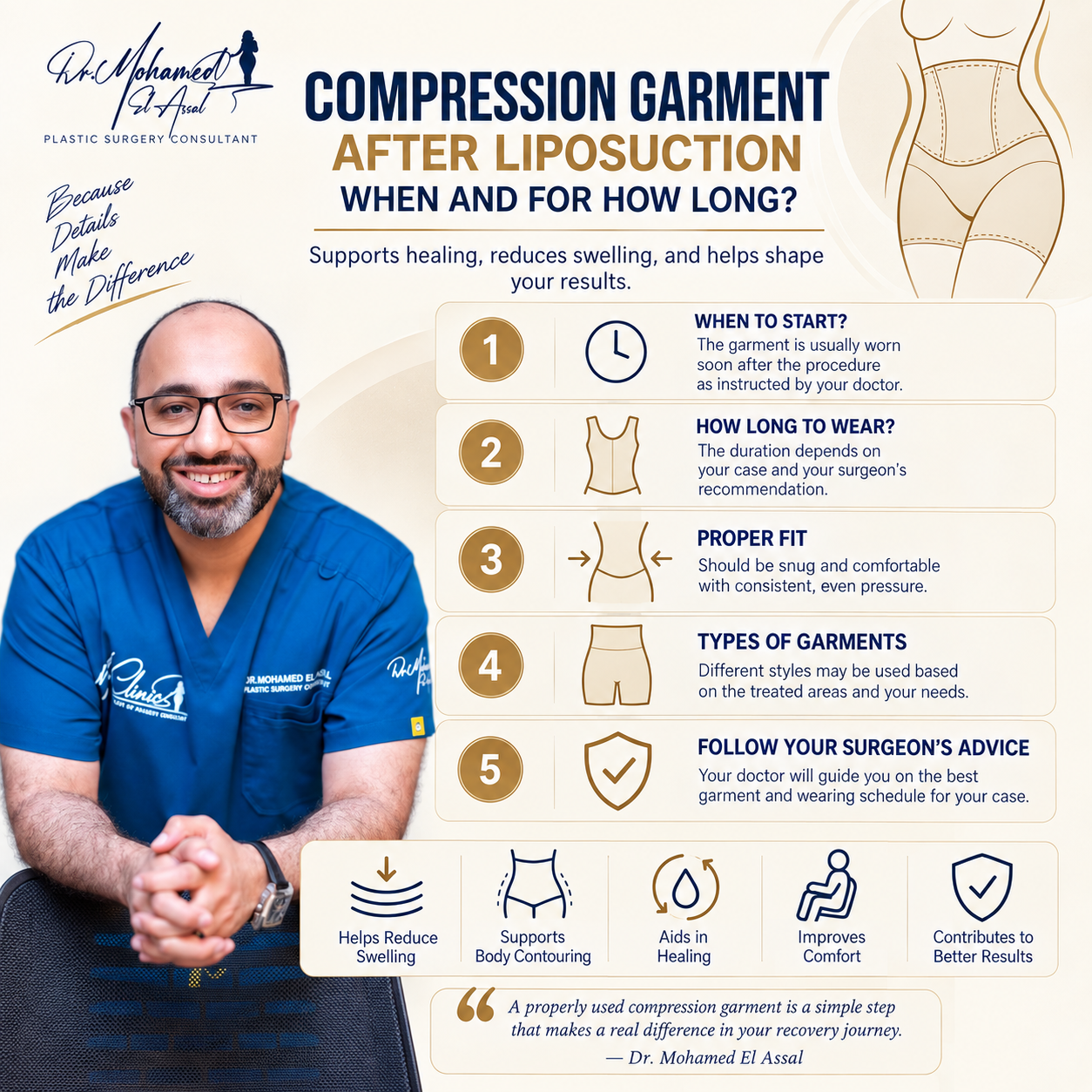
compression garment after liposuction
how long to wear compression garment after liposuction; when to wear compression garment after liposuction; liposuction compression garment; compression garment fit after lipo; tight compression garment after liposuction; post liposuction care
Compression Garment After Liposuction: When and for How Long?
A compression garment after liposuction is commonly used during recovery to support treated tissues and help control postoperative swelling. The American Society of Plastic Surgeons (ASPS) includes elastic bandages or compression garments in routine liposuction recovery guidance. However, garment type, pressure and duration should not be treated as one fixed protocol for every patient.
The plan varies with the treated region, procedure extent, skin and tissue characteristics, combined procedures and individual healing. A garment should provide the prescribed support without causing severe pain, persistent numbness, significant skin-color change or focal pressure injury. Your operating surgeon’s instructions remain the reference for when to wear it and when to reduce or stop it.
The plan varies with the treated region, procedure extent, skin and tissue characteristics, combined procedures and individual healing. A garment should provide the prescribed support without causing severe pain, persistent numbness, significant skin-color change or focal pressure injury. Your operating surgeon’s instructions remain the reference for when to wear it and when to reduce or stop it.
Why are compression garments used after liposuction?
Compression garments are primarily used to provide tissue support and help control swelling during liposuction recovery. ASPS recommends an elastic bandage, support garment or compression garment for these purposes after surgery. However, recent reviews conclude that evidence for many additional claimed benefits remains limited and inconsistent across plastic-surgery procedures, so expectations should stay realistic.
For related guidance, read Swelling After Liposuction: What Is Normal and When Does It Go Away?. For independent medical information, see ASPS liposuction recovery guidance.
For related guidance, read Swelling After Liposuction: What Is Normal and When Does It Go Away?. For independent medical information, see ASPS liposuction recovery guidance.
Does compression remove swelling by itself?
No. Compression may help manage swelling, but it is not the only factor determining how quickly edema resolves. Treatment extent, body area, inflammatory response, activity, general health and individual healing all matter. Patients should not independently increase garment tightness or wear time in an attempt to force postoperative swelling to disappear more quickly.
When should you start wearing a compression garment after liposuction?
Compression is commonly introduced during the early postoperative period, often as part of the dressings or recovery plan, but the exact timing depends on the procedure, wound care and any drains or combined surgery. ASPS includes compression in postoperative instructions, so patients should follow their own surgical plan rather than selecting a universal starting time.
Can you remove the garment during the early recovery period?
Your surgeon should specify when the garment can be removed for showering, dressing changes and incision care because this varies by treated area and surgical technique. A general schedule cannot safely replace individualized instructions. If the plan is unclear, ask the surgical team rather than leaving the garment off—or keeping it on continuously—for an unprescribed period.
How long should you wear a compression garment after liposuction?
There is no single evidence-based duration that fits every liposuction patient. Clinical protocols vary among surgeons and procedures, and a 2023 review in Plastic and Reconstructive Surgery Global Open found substantial variation and limited evidence for postoperative compression practices. Duration should therefore reflect the treated area, procedure extent, healing progress and the operating surgeon’s instructions.
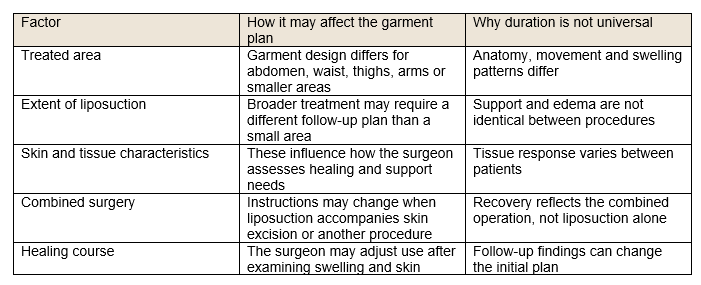
Does compression-garment duration vary by body area?
Yes. A garment designed for the abdomen and flanks differs from one used for thighs, arms or smaller regions, and movement, friction and swelling distribution also differ. This does not create one fixed schedule for each body part. The surgeon chooses garment coverage and duration according to the actual procedure and how the tissues are healing at follow-up.
What if several areas were treated in the same operation?
When multiple areas are treated, a patient may need a garment covering more than one region or a design different from that used for isolated liposuction. Pressure should remain balanced without folds or tight edges concentrating force on one spot. Garment selection follows the treatment map and any combined procedures rather than the operation name alone.
What type of compression garment is appropriate after liposuction?
An appropriate garment covers the region specified by the surgeon and provides balanced compression without severe pain, circulatory warning signs or damaging friction over incisions. No single brand or design can be called universally superior. Size, fabric, openings and closure design should match the treated anatomy, wound care needs and postoperative plan.
Does a tighter garment produce a better result?
No evidence-based rule says that tighter compression produces a better result. Excessive pressure can cause discomfort, skin problems or uneven focal compression, while scientific reviews do not support the assumption that more pressure automatically creates more benefit. The goal is the pressure prescribed for the patient, not the maximum tightness the patient can tolerate.
How do you know if a compression garment is too tight?
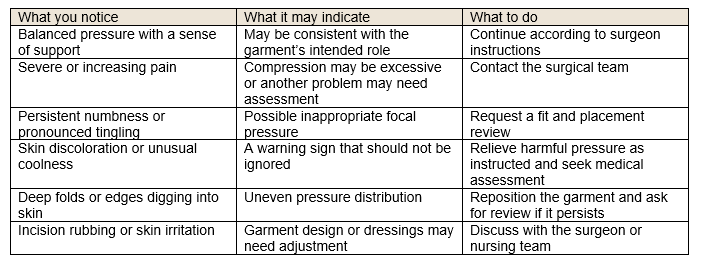
A compression garment should not cause severe pain, persistent numbness, marked skin-color change, unusual coolness or painful edges digging into one area. If these occur, or if the garment causes unusual breathing or movement difficulty, contact the surgical team to assess fit and placement rather than simply tolerating increasing pressure.
Should you buy a smaller garment as swelling decreases?
Garment size may need adjustment as swelling decreases, but moving to a smaller size should not be used simply to create more pressure. Some patients need a different size or garment later in recovery, while others do not. The surgical team should review fit, particularly when the garment becomes very loose or begins forming folds.
Do skin marks mean the garment fits incorrectly?
Compression can leave temporary impressions, but deep painful marks, persistent indentation or concentrated pressure from seams and folds deserve review. The garment should not injure skin or create neurological or vascular symptoms. If an in-person review is not immediately possible, photographs may help the treating team assess a fit problem remotely.
Do you need to wear a compression garment all day?
There is no universal number of daily hours supported for every patient because protocols vary by surgeon, procedure and recovery stage. A surgeon may prescribe near-continuous use initially and reduce it later, or use a different schedule for a specific region. Published reviews likewise show substantial variation, reinforcing the need for individualized instructions.
What about showering and washing the garment?
Time out of the garment should be coordinated with incision care and showering instructions. A spare garment can make hygiene easier when prolonged wear is prescribed, but damp or soiled fabric should not remain over healing incisions. Wound-care instructions from the operating team take priority over any general rule about compression wear.
Can compression prevent a seroma after liposuction?
Compression is traditionally used with the aim of reducing tissue space and helping control fluid, but it cannot be said to reliably prevent seroma. A 2023 practical review of postoperative compression found inconsistent evidence for seroma prevention and other outcomes, with effects varying by operation and study quality. Compression should not replace postoperative assessment.
Can a compression garment treat a seroma once it forms?
A garment should not be used as self-treatment for a suspected seroma. A new fluctuant fluid pocket or localized swelling requires surgical assessment to determine whether it is actually a seroma and whether observation, drainage or another approach is appropriate. Increasing pressure over an undiagnosed postoperative lump may not address the underlying problem.
Does compression affect the final liposuction result?
Compression is part of postoperative care, not a guarantee of a particular final contour. Published reviews indicate that evidence for long-term aesthetic benefits of compression remains limited and inconsistent across procedures. Final contour also depends on fat removal and distribution, skin quality, healing, weight stability and other patient and procedural factors.
Will leaving the garment off for a few hours ruin the result?
A short period without the garment cannot be assumed to ruin a result without knowing the surgeon’s instructions and recovery stage. Do not compensate by doubling garments or applying excessive pressure. Return to the prescribed plan and contact the team if the garment was off for a prolonged period or new swelling developed.
What are common compression-garment mistakes after liposuction?
Important mistakes include intentionally choosing a smaller size, overtightening the garment to chase faster results, ignoring pain or numbness and skin-color changes, allowing folds to concentrate pressure, or changing the prescribed schedule without advice. A compression garment is a recovery-support tool, not a device for forcibly reshaping the body or replacing clinical follow-up.
Should you add foam, boards or extra compression layers?
Do not add boards, foam, padding or extra compression layers unless the surgeon specifically recommends them for your case. These additions change pressure distribution and can create focal pressure points or skin irritation when used indiscriminately. A setup that is appropriate for one patient or body area should not automatically be copied by another.
How is the compression garment related to swelling after liposuction?
Compression is used to help manage postoperative swelling, but the course of edema, bruising and fluid collections needs separate assessment. Gradually decreasing fullness differs from sudden worsening, a new fluid pocket or escalating pain. For more detail, read about swelling after liposuction, expected recovery changes and symptoms needing assessment.
Should you tighten the garment if swelling increases?
No. Increased swelling does not automatically mean the garment should become tighter. The change may reflect activity, normal fluctuation or a problem requiring examination. If swelling increases suddenly or occurs with pain, redness or a localized lump, contact the surgeon rather than attempting to treat it by adding more compression.
Does the final-result timeline depend on how long you wear compression?
The timing of final contour cannot be linked to garment duration alone. Swelling resolution, skin quality, treatment extent, fat distribution and tissue healing all influence when the shape becomes clearer. Patients should not prolong compression independently to accelerate results. For more detail about when the final contour becomes clearer, explore the liposuction results timeline.
Dr. Mohamed El Assal – Expertise
Dr. Mohamed El Assal’s surgical philosophy reflects a firm commitment to long-lasting results, patient safety, and smooth, natural-looking body contours. Understanding the role of compression garments after liposuction, including when to start wearing them and how long to continue using them, is an important part of setting realistic expectations and supporting optimal recovery after surgery. Compression garments help provide gentle, consistent pressure to the treated areas, which may help minimize swelling, support the tissues as they heal, and improve postoperative comfort. Particular importance is placed on selecting the appropriate garment, ensuring a proper fit, and determining the most suitable duration of use for each individual patient. His approach emphasizes personalized postoperative instructions, proper garment care, regular follow-up appointments, and a gradual return to daily activities to support healing and long-lasting results. The goal is to help patients achieve smoother, more defined body contours while understanding the importance of compression garments, the expected recovery timeline, and the need to follow their surgeon’s recommendations, as the duration of garment use varies depending on the extent of liposuction, the treated areas, and each patient’s healing progress.
Frequently asked questions about compression garments after liposuction
How long should I wear a compression garment after liposuction?
There is no single evidence-based duration for every patient. Protocols vary with treated area, procedure extent, combined surgery and healing, while reviews show limited and inconsistent evidence for an optimal compression duration. Your surgeon’s postoperative instructions and follow-up examination are therefore more useful than applying one fixed number of weeks.
Should I sleep in my compression garment after liposuction?
Your surgeon may recommend sleeping in the garment during a particular stage, but this is not a universal rule. It depends on the treated area, timing, garment design and recovery plan. If it causes severe pain, persistent numbness or unusual difficulty, do not ignore the symptoms; ask the surgical team to review fit and use.
How do I know if my compression garment fits correctly?
The garment should provide balanced pressure and support without severe pain, persistent numbness, skin-color change or edges digging deeply into tissue. It should cover the prescribed area without harmful folds. If it becomes very loose as swelling falls, or painfully tight, ask the surgical team to reassess the size.
Will an extra-tight garment make swelling go away faster?
There is no evidence-based reason to increase compression indiscriminately to speed recovery. Excessive pressure can cause pain, skin irritation or focal compression symptoms, while swelling is influenced by many factors beyond the garment. Use the prescribed fit and pressure, and contact the surgeon if swelling worsens or fails to improve.
Can I skip the compression garment after liposuction?
ASPS includes compression garments in routine liposuction recovery guidance, but research does not provide one uniform protocol or quantify the benefit consistently. If your surgeon has prescribed compression, do not discontinue it independently. At the same time, patients should not assume that every operation requires exactly the same garment schedule.
Do I need a new compression garment when swelling decreases?
Some patients need a size or garment adjustment as the treated area changes, while others can continue with the same garment if it remains appropriately fitted. The goal is not automatically moving to a smaller size but maintaining balanced prescribed compression. Ask for a fit review if the garment becomes loose or folds.
How does Dr. Mohamed El Assal plan compression after liposuction?
The compression plan is based on the treated areas, procedure extent, skin quality, any combined operations and how swelling changes during follow-up. Dr. Mohamed El Assal explains the appropriate garment, how it should be worn and which symptoms require a fit adjustment or contact with the surgical team rather than relying on one universal schedule.
For more information about the procedure itself, explore liposuction and treatment planning.
Follow your surgeon’s instructions for garment type and duration, and do not independently move to a tighter size or add compression layers. If the garment causes severe pain, persistent numbness or skin-color change, or if unusual swelling develops, contact the surgical team to review both fit and recovery.
Internal Links
References
- American Society of Plastic Surgeons (ASPS). Liposuction Recovery.
- American Society of Plastic Surgeons (ASPS). Assisted Liposuction Recovery.
- Mayo Clinic. Liposuction.
- Cleveland Clinic. Liposuction: What It Is, Surgery, Recovery & Results.
- Ormseth BH, Livermore NR, Schoenbrunner AR, Janis JE. The Use of Postoperative Compression Garments in Plastic Surgery—Necessary or Not? A Practical Review. Plast Reconstr Surg Glob Open. 2023;11(9):e5293.
- Arkoubi AY. Effect of Compression Garments on Post-Abdominoplasty Outcomes: A Systematic Review of the Current Evidence. JPRAS Open. 2024;41:128-137.
- Dr. Mohamed El Assal. Liposuction.