Wide Nose Rhinoplasty: How Are the Nasal Bones and Base Narrowed?
Wide Nose Rhinoplasty: How Are the Nasal Bones and Base Narrowed?
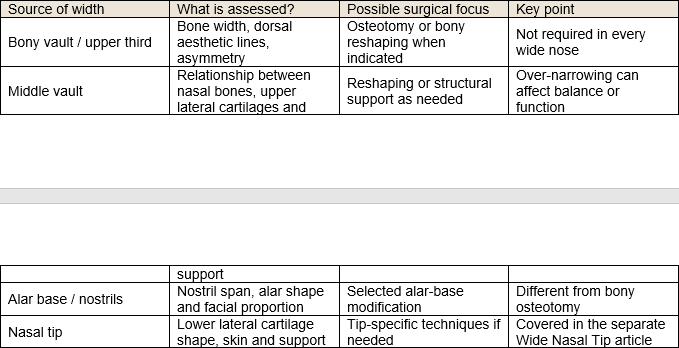
A wide nose is not one diagnosis. Width may come from the bony vault in the upper third, the middle bridge, the alar base and nostrils, or more than one level at the same time. Surgical planning therefore starts by identifying where the width originates rather than assuming that the entire nose simply needs to be made smaller.
This article focuses on the wide nose as a whole, particularly a wide bony bridge, nasal osteotomy and alar-base width. Nasal tip width is discussed only briefly because the website already has a dedicated Wide Nasal Tip Refinement article covering bulbous-tip anatomy and tip-specific techniques.
This article focuses on the wide nose as a whole, particularly a wide bony bridge, nasal osteotomy and alar-base width. Nasal tip width is discussed only briefly because the website already has a dedicated Wide Nasal Tip Refinement article covering bulbous-tip anatomy and tip-specific techniques.
Primary Keyword: wide nose rhinoplasty
Secondary Keywords: wide nasal bones rhinoplasty; narrow nasal bones; wide nasal bridge surgery; nasal osteotomy rhinoplasty; wide bony vault; alar base narrowing; wide nostrils rhinoplasty; narrowing a wide nose
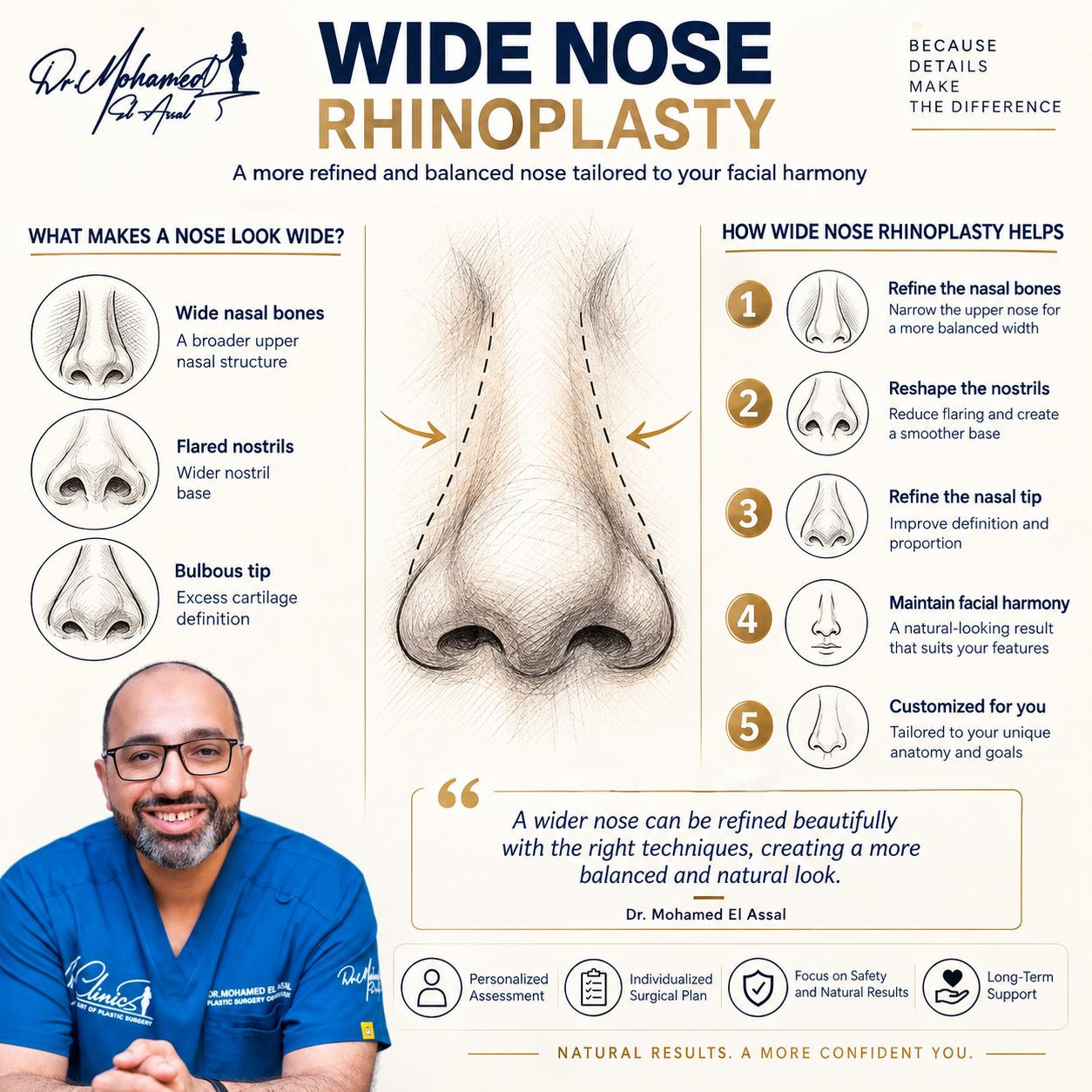
What makes a nose look wide from the front?
A nose can appear wide because the upper bony vault is broad, the middle bridge is wide, the nostril base is spread, the tip is broad, or several of these features coexist. Frontal, basal and oblique assessment helps separate these components because narrowing nasal bones, modifying the alar base and refining the tip are different surgical decisions.
Why is a frontal photograph not enough?
A frontal image shows dorsal aesthetic lines and overall width, but it cannot fully define nostril-base anatomy, cartilage support or nasal airflow. Standardized views and physical examination help the surgeon assess the septum, middle vault, nasal valves and the relationship between bony and soft-tissue width before selecting a procedure.
How does a surgeon tell whether the width comes from bone, cartilage or the alar base?
The nose is assessed by anatomical level: bone forms much of the upper framework, cartilage contributes to the middle and lower nose, and the alar base determines much of nostril width. Examination identifies where widening begins, whether the dorsum itself is broad, whether asymmetry exists and whether narrowing could affect nasal support or breathing.
What is a nasal osteotomy in wide nose rhinoplasty?
A nasal osteotomy is a controlled surgical cut in bone that allows the nasal bones to be mobilized and repositioned when indicated. Osteotomies may be used for a wide bony vault, bony asymmetry or closure of an open roof after hump reduction. The pattern and instrumentation are selected for the anatomy rather than applied routinely to every rhinoplasty.
What are lateral and medial osteotomies?
The Photographic Atlas of Rhinoplasty describes lateral osteotomy as a maneuver that mobilizes the lateral bony wall and bony base, while medial osteotomy can be incorporated when a broad bony dorsum requires narrowing. Transverse or intermediate lines may be added in selected patterns. These are surgical planning options, not a standard checklist for every patient.
Does osteotomy mean the nose is simply “broken”?
The everyday phrase “breaking the nose” oversimplifies the procedure. Surgical osteotomy creates planned bone lines with dedicated instruments so the bony framework can be repositioned in a controlled way. Surgeons may use traditional osteotomes, powered instruments or ultrasonic devices depending on the case, technique and their experience.
Does every wide nose need the nasal bones broken or narrowed?
No. A nose that looks wide does not automatically require bony osteotomy. If the width comes mainly from the nostril base, lower soft tissues or tip, while the bony vault is already proportionate, a different plan may be appropriate. Even during rhinoplasty, osteotomy is selected according to bony anatomy and the effects of other surgical steps.
When is bony narrowing more likely to be considered?
Bony work is more relevant when the upper third or bony base is genuinely broad, when the bony pyramid is asymmetric, or when dorsal hump reduction creates an open roof that requires closure. The final decision still depends on the complete nasal plan, facial proportions and preservation of structural and airway function
How is a wide nasal bridge narrowed without over-narrowing the nose?
The objective is proportional narrowing, not the smallest possible bridge. The Photographic Atlas distinguishes a wide bony base with a normal, narrow or wide dorsum, and each relationship changes the osteotomy strategy. The surgeon must consider the middle vault and dorsal aesthetic lines so that bony narrowing does not create a new imbalance or compromise support.
What if the bony base is wide but the middle vault is already narrow?
This pattern requires particular caution because narrowing the bony base without addressing an already narrow middle vault can worsen disproportion. The atlas describes selected cases in which the bony base is narrowed while the middle vault is supported or widened, including the use of spreader grafts when appropriate for anatomy and function.
What if both the bony base and dorsum are wide?
When widening exists at more than one bony level, the osteotomy design may need to address both the base and dorsum. The atlas describes lateral and transverse osteotomies for bony-base narrowing and medial osteotomy in selected broad-dorsum patterns. The exact combination is individualized rather than dictated by the label “wide nose.”
How are wide nostrils or a broad alar base narrowed?
If the main width is at the alar base or nostrils, the problem may not be the nasal bones. In selected patients, alar-base surgery can use carefully placed incisions near natural nostril creases to remove or redistribute a measured amount of tissue. ASPS notes that additional incisions may be used to alter nostril size during rhinoplasty.
Is alar-base narrowing the same as osteotomy?
No. Osteotomy changes the bony framework, while alar-base modification changes soft tissue around the nostrils. A patient may need one, both or neither. This distinction also prevents confusion between the “bony base” described in osteotomy planning and the visible alar base at the lower end of the nose.
How much does the nasal tip contribute to a wide-looking nose?
A broad or bulbous nasal tip can contribute to overall nasal width, but it is anatomically different from a wide bony bridge or broad alar base. Tip assessment considers lower lateral cartilage shape, support and skin thickness. Because the website already has a dedicated Wide Nasal Tip Refinement article, this page intentionally avoids duplicating that search intent.
Internal Link Context: Read “Wide Nasal Tip Refinement – Modern Surgical and Cosmetic Solutions” for detailed bulbous-tip anatomy and tip-specific treatment: https://drmohamedelassal.com/wide-nasal-tip-refinement/
Internal Link Context: Read “Wide Nasal Tip Refinement – Modern Surgical and Cosmetic Solutions” for detailed bulbous-tip anatomy and tip-specific treatment: https://drmohamedelassal.com/wide-nasal-tip-refinement/
Can a wide nose be narrowed while protecting nasal breathing?
Surgical planning should balance external width with airway function. Narrowing the bony or cartilaginous framework without considering internal support can affect the functional space in some patients. Assessment therefore includes the septum, middle vault and nasal valves, and selected cases may require cartilage support or reconstruction rather than reduction alone.
Why would cartilage grafts be used in a narrowing operation?
External narrowing does not mean internal support should simply be removed. In selected anatomy, the middle vault may need to be preserved or reconstructed after bony changes. ASPS and Mayo Clinic describe rhinoplasty as a procedure that can remove, rearrange or add cartilage and bone depending on the structural and functional needs of the patient.
Why is wide nose rhinoplasty different for every patient?
The operative plan depends on bony-vault width, middle-vault shape, nostril-base width, skin thickness, cartilage strength, previous trauma or surgery, asymmetry and breathing function. Appropriate nasal width is also judged in relation to the individual face rather than a universal measurement. Two patients with the same complaint may therefore require very different procedures.
Do ethnic and anatomical differences change the plan?
Skin thickness, cartilage strength, dorsal projection and bony width vary considerably among individuals and populations. The goal is not to impose one narrow nasal shape, but to select changes that respect facial identity, structural support and breathing. Patients seeking more detail on these patterns can be directed to the Ethnic & African Rhinoplasty service page.
What risks and limitations should be understood before narrowing a wide nose?
Rhinoplasty is complex and a specific cosmetic result cannot be guaranteed. General considerations include bleeding, infection, breathing changes, asymmetry, possible revision and anesthesia-related risks. When the nasal bones are reshaped, careful anatomical planning, controlled technique, follow-up and adherence to postoperative instructions are important parts of reducing avoidable risk and protecting function.
Does a narrower nose automatically mean a better result?
No. Excessive narrowing can create disproportion or reduce structural support. The aim is a width that fits the face and nasal anatomy while maintaining breathing, not the narrowest possible bridge or nostril base. Realistic goals and anatomical limits should therefore be discussed before surgery rather than defined by a single idealized measurement.
Dr. Mohamed El Assal – Expertise
Dr. Mohamed El Assal's surgical philosophy reflects a firm commitment to natural, harmonious outcomes. Every intervention is designed according to the individual patient's anatomy and realistic goals, with paramount importance placed on preserving function and natural facial expression. His international training in Preservation Rhinoplasty and Deep Plane Facelift techniques supports the achievement of stable, natural long-term results — free from generic templates and one-size-fits-all solutions.
Frequently asked questions about wide nose rhinoplasty
Does a wide nose always require osteotomy?
No. Osteotomy is used when the bony framework itself needs to be mobilized or narrowed, such as selected wide bony vaults, asymmetry or an open roof after hump reduction. If width is mainly at the alar base or lower nose, another approach may be more appropriate. Examination determines the source of width
What is the difference between narrowing nasal bones and reducing wide nostrils?
Nasal-bone narrowing changes the bony pyramid with reshaping or osteotomy when indicated. Nostril reduction addresses the alar base and surrounding soft tissue through carefully planned incisions in selected patients. Some noses need one component, some need both, and others need neither, depending on anatomy and facial proportion.
Can the nasal bridge be narrowed without changing the tip?
Yes, in selected patients whose main concern is a wide bridge or bony vault and whose tip is already proportionate. However, the nose is assessed as a whole because changing bridge width alters its visual relationship with the tip. The surgeon decides whether leaving the tip unchanged preserves overall balance.
Can narrowing a wide nose affect breathing?
Any change to the bony or cartilaginous framework should account for the airway. Inappropriate narrowing can reduce internal support, while thoughtful planning may preserve or reconstruct the middle vault and address septal problems when present. Functional assessment is therefore part of rhinoplasty planning rather than separate from cosmetic analysis.
Can preservation rhinoplasty be used for a wide nose?
Preservation principles may suit selected wide-nose cases, but preservation rhinoplasty is not synonymous with narrowing and is not appropriate for every bony pattern. Suitability depends on the dorsum, nasal bones, septum and surgical goals. Patients interested in that technique should review the dedicated Preservation Rhinoplasty service page.
How can I tell whether my nose is wide because of bone or the tip?
Standardized photographs from several views and physical examination help separate the components. Upper-third width is more closely related to the bony vault, while tip width is influenced by lower lateral cartilages and soft-tissue thickness. Both can coexist. This article focuses on the bony bridge and base; the tip has a separate page.
How does Dr. Mohamed El Assal plan rhinoplasty for a wide nose?
Planning begins by locating the source of width rather than choosing a technique in advance: bony vault, middle bridge, alar base, nasal tip or several levels together. Breathing, septal alignment, skin, cartilage strength and facial proportions are then assessed before deciding whether osteotomy, alar-base modification, structural support or another maneuver is appropriate.
CTA: If your nose appears wide from the front and you want to understand which anatomical component creates that width, schedule a consultation with Dr. Mohamed El Assal, Consultant Plastic Surgeon, for structural and functional assessment and a discussion of options tailored to your anatomy rather than a one-technique-fits-all plan.
CTA: If your nose appears wide from the front and you want to understand which anatomical component creates that width, schedule a consultation with Dr. Mohamed El Assal, Consultant Plastic Surgeon, for structural and functional assessment and a discussion of options tailored to your anatomy rather than a one-technique-fits-all plan.
References
Mayo Clinic. Rhinoplasty. https://www.mayoclinic.org/tests-procedures/rhinoplasty/about/pac-20384532
American Society of Plastic Surgeons (ASPS). Rhinoplasty Procedure Steps. https://www.plasticsurgery.org/cosmetic-procedures/rhinoplasty/procedure
Cleveland Clinic. Rhinoplasty (Nose Job): Surgery, Recovery, Before & After. https://my.clevelandclinic.org/health/treatments/11011-rhinoplasty
Cleveland Clinic. Cosmetic Nose Surgery: Rhinoplasty. https://my.clevelandclinic.org/cosmetic-plastic-surgery/procedures/rhinoplasty-nose-surgery
NHS. Nose reshaping (rhinoplasty). https://www.nhs.uk/tests-and-treatments/cosmetic-procedures/cosmetic-surgery/nose-reshaping-rhinoplasty/
Frimley Health NHS Foundation Trust. Rhinoplasty - With or without septoplasty. https://www.fhft.nhs.uk/patients-and-visitors/patient-information-library/rhinoplasty-or-without-septoplasty
Locketz GD, Lozada KN, Becker DG. Osteotomies - When, Why, and How? Facial Plast Surg. 2020. https://pubmed.ncbi.nlm.nih.gov/32191960/
Şeneldir S. Photographic Atlas of Rhinoplasty. Springer; 2021. Chapter 7: Dorsum: Osteotomy. https://doi.org/10.1007/978-3-030-44325-2_7
Dr. Mohamed El Assal. Wide Nasal Tip Refinement - Modern Surgical and Cosmetic Solutions. https://drmohamedelassal.com/wide-nasal-tip-refinement/
Medically reviewed by Dr. Mohamed El Assal, Consultant Plastic Surgeon
American Society of Plastic Surgeons (ASPS). Rhinoplasty Procedure Steps. https://www.plasticsurgery.org/cosmetic-procedures/rhinoplasty/procedure
Cleveland Clinic. Rhinoplasty (Nose Job): Surgery, Recovery, Before & After. https://my.clevelandclinic.org/health/treatments/11011-rhinoplasty
Cleveland Clinic. Cosmetic Nose Surgery: Rhinoplasty. https://my.clevelandclinic.org/cosmetic-plastic-surgery/procedures/rhinoplasty-nose-surgery
NHS. Nose reshaping (rhinoplasty). https://www.nhs.uk/tests-and-treatments/cosmetic-procedures/cosmetic-surgery/nose-reshaping-rhinoplasty/
Frimley Health NHS Foundation Trust. Rhinoplasty - With or without septoplasty. https://www.fhft.nhs.uk/patients-and-visitors/patient-information-library/rhinoplasty-or-without-septoplasty
Locketz GD, Lozada KN, Becker DG. Osteotomies - When, Why, and How? Facial Plast Surg. 2020. https://pubmed.ncbi.nlm.nih.gov/32191960/
Şeneldir S. Photographic Atlas of Rhinoplasty. Springer; 2021. Chapter 7: Dorsum: Osteotomy. https://doi.org/10.1007/978-3-030-44325-2_7
Dr. Mohamed El Assal. Wide Nasal Tip Refinement - Modern Surgical and Cosmetic Solutions. https://drmohamedelassal.com/wide-nasal-tip-refinement/
Medically reviewed by Dr. Mohamed El Assal, Consultant Plastic Surgeon