Preservation Rhinoplasty vs Traditional Rhinoplasty: What Is the Difference?
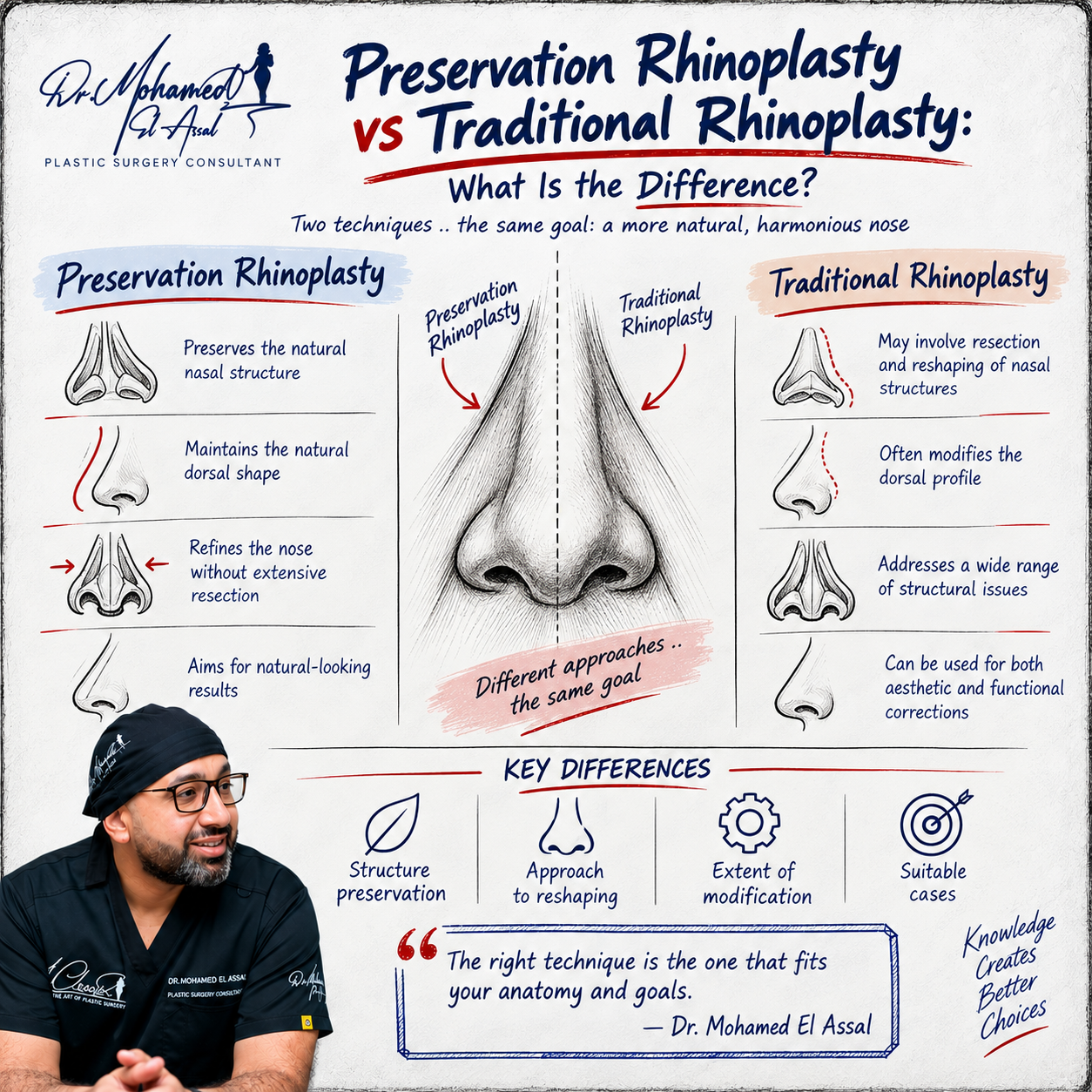
preservation rhinoplasty vs traditional rhinoplasty
preservation rhinoplasty vs structural rhinoplasty; dorsal preservation vs hump reduction; traditional rhinoplasty; structural rhinoplasty; dorsal preservation rhinoplasty; push down rhinoplasty; let down rhinoplasty; preservation rhinoplasty recovery
Preservation Rhinoplasty vs Traditional Rhinoplasty: What Is the Difference?
Preservation rhinoplasty and traditional or structural rhinoplasty are not quality grades; they are surgical philosophies that can overlap. Preservation aims to retain more native nasal anatomy when that anatomy can safely serve the surgical goal. Structural techniques allow targeted resection, reshaping and reconstruction when the existing framework needs a more direct or extensive change.
The choice starts with anatomy rather than a technique label: dorsal shape, septal alignment, cartilage strength, nasal valves, skin thickness, breathing and the degree of change required. One patient may suit dorsal preservation, another may need structural reconstruction, and a third may benefit from a hybrid plan that combines preservation and structural principles.
The choice starts with anatomy rather than a technique label: dorsal shape, septal alignment, cartilage strength, nasal valves, skin thickness, breathing and the degree of change required. One patient may suit dorsal preservation, another may need structural reconstruction, and a third may benefit from a hybrid plan that combines preservation and structural principles.
What is the main difference between preservation and traditional rhinoplasty?
The central difference is how native structures, especially the nasal dorsum, are handled. Dorsal preservation lowers or reshapes the bridge while maintaining its natural roof in selected anatomy. Traditional structural hump reduction removes the prominent dorsal components and then reshapes or reconstructs the roof and middle vault as required for form, stability and airway function.
Does “traditional rhinoplasty” mean an outdated operation?
No. Structural reduction and reconstruction remain core modern rhinoplasty tools. “Traditional” in this comparison describes techniques that directly resect and rebuild parts of the framework rather than preserving the dorsal roof as a unit. These methods can be particularly useful when a deformity requires changes that preservation alone cannot reliably accomplish.
How does each approach treat the nasal bridge differently?
Dorsal preservation seeks to retain the native dorsal surface and aesthetic lines while reducing bridge height from beneath or through maneuvers that mobilize the dorsum as a unit. Conventional hump reduction removes prominent bone and cartilage from above, after which the surgeon may narrow, reconstruct or support the middle vault to create the intended contour.
Does preservation rhinoplasty leave the dorsal hump in place?
No. The hump can be lowered rather than simply left untouched. Foundation techniques include push-down and let-down concepts, with variations selected according to dorsal shape, bony width, septal anatomy and the amount of lowering required. The exact method cannot be chosen from a profile photograph alone because internal anatomy and structural behavior also matter.
How do preservation and traditional rhinoplasty compare in practice?
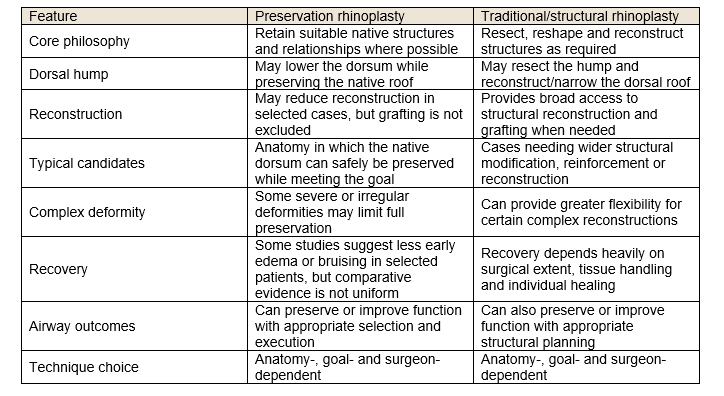
A useful comparison goes beyond incision size or recovery claims. It asks what anatomy is preserved, how much reconstruction is required, what deformity is being treated and how the airway is protected. Both approaches have strengths and limitations, and contemporary surgeons may combine them. The table summarizes broad differences rather than ranking one technique above the other.
Who may be a good candidate for preservation rhinoplasty?
Preservation is most relevant when the native framework is worth retaining and the desired change can be achieved without dismantling the dorsum extensively. Hump shape, radix position, bony width, septal anatomy, cartilage strength and deviation all influence candidacy. Reviews consistently emphasize patient selection because preservation techniques are not interchangeable across every nasal deformity.
Is everyone with a dorsal hump a preservation candidate?
No. Hump presence alone is not enough. A wide or irregular dorsum, certain deviations, weak cartilage or the need for major structural change can make structural or hybrid techniques more appropriate. Examination considers frontal, profile and basal views together with septal alignment, airway function, bone shape and soft-tissue characteristics.
When may structural rhinoplasty be more appropriate?
Structural rhinoplasty may be more appropriate when the nose needs substantial reconstruction or when the native framework itself is part of the problem and should not simply be preserved. This can include selected severe deformities, support deficiencies and complex revisions. The goal is not greater tissue removal; it is sufficient freedom to rebuild what the anatomy requires.
Can preservation and structural techniques be combined?
Yes. Modern rhinoplasty is not always a binary choice. A surgeon may preserve a suitable dorsal segment or ligament system while using structural grafts or reconstruction elsewhere. Hybrid rhinoplasty reflects this anatomy-based approach: preserve what is useful and stable, modify or rebuild what is necessary for the aesthetic and functional objective.
Is recovery faster after preservation rhinoplasty?
Some comparative studies report less early swelling, bruising or a smoother early recovery with certain preservation techniques, but the evidence is not consistent enough to promise faster recovery for every patient. Osteotomies, septal work, surgical exposure, skin thickness and individual healing can substantially influence recovery regardless of whether the operation is labeled preservation or structural.
Does preservation mean a smaller operation with no bone work?
No. Dorsal preservation may require controlled osteotomies, septal strip work and mobilization of the bony-cartilaginous framework so the dorsum can be lowered predictably. “Preservation” describes what the surgeon tries to retain and how the framework is managed; it does not mean the operation is minor, superficial or free of bone surgery.
Are breathing outcomes different between preservation and structural rhinoplasty?
Current comparative evidence does not establish a consistent functional winner. Recent systematic reviews and meta-analyses report broadly comparable validated breathing outcomes when preservation and structural techniques are appropriately performed. Airway success depends on recognizing and treating septal deviation, nasal valve problems and support requirements rather than assuming one dorsal philosophy automatically produces better breathing.
Why are the septum and nasal valves still important in both techniques?
Because dorsal shape alone does not determine nasal airflow. Septal deviation, internal or external valve narrowing and turbinate factors can coexist with a cosmetic hump. These structures must be assessed and treated when indicated whether the dorsum is preserved or reconstructed. A successful aesthetic plan should not substitute for a functional airway assessment.
Does preservation rhinoplasty look more natural?
Preserving native dorsal lines can help maintain familiar anatomical relationships in well-selected patients, but a natural appearance is not guaranteed by a technique name. Structural rhinoplasty can also produce natural-looking results when changes are proportionate and well planned. Naturalness depends on facial harmony, tissue behavior and appropriate technique selection rather than preservation alone.
What does preserving nasal identity actually mean?
It means avoiding unnecessary change to features that already suit the face while correcting the features that matter to the patient. That goal can be achieved with preservation, structural or hybrid methods. The surgeon’s task is to decide which relationships should remain and which require modification rather than applying the same nasal template to every patient.
What are the limitations of preservation rhinoplasty?
Preservation is not ideal for every dorsal shape, deviation or support problem. Published reviews stress careful selection and describe cases in which additional structural techniques are needed. Preservation also has technique-specific concerns, including residual or recurrent dorsal prominence in some patients. These limitations should be discussed alongside structural alternatives before surgery.
Is preservation rhinoplasty suitable for most revision cases?
Not generally. Previous surgery may have altered or removed native structures and created scar tissue or cartilage deficiency, making reconstruction more important. Preservation principles can still be useful in selected limited revisions, but complex secondary rhinoplasty often requires structural techniques. For more detail, read: Revision Rhinoplasty. [Internal Link → Revision Rhinoplasty]
How does a surgeon choose between preservation and traditional rhinoplasty?
Selection begins with a structural and functional examination: hump and radix shape, dorsal straightness, bony width, cartilage strength, septum, nasal valves, skin thickness, breathing and the patient’s goals. The surgeon then decides what can safely remain and what needs modification or support. The final plan may be preservation, structural or deliberately hybrid.
Can the technique be selected from photographs alone?
Photographs are important for proportions, symmetry and external contour, but they cannot fully show cartilage strength, septal anatomy, valve function or how the framework behaves during surgery. Images can support preliminary discussion, while the final technique is selected after direct examination and a clear understanding of both aesthetic and functional goals.
Is one rhinoplasty technique better for everyone?
No single technique is appropriate for every nose. Recent systematic reviews report favorable outcomes with both dorsal preservation and structural reduction in properly selected patients, while study methods, preservation variants and follow-up remain heterogeneous. The useful clinical question is therefore not which label is universally superior, but which approach fits a particular anatomy and surgical objective.
Dr. Mohamed El Assal – Expertise
Dr. Mohamed El Assal’s surgical philosophy reflects a strong commitment to patient safety, long-lasting results, and natural-looking facial harmony. Understanding the difference between preservation rhinoplasty and traditional rhinoplasty is essential for setting realistic expectations and choosing the right surgical approach. Preservation rhinoplasty aims to maintain the natural nasal structure while reshaping the nose, whereas traditional rhinoplasty involves modifying bone and cartilage to achieve the desired results. The choice between these techniques depends on nasal anatomy, individual concerns, breathing function, and aesthetic goals. Dr. Mohamed El Assal’s approach emphasizes personalized treatment planning, preserving nasal function, and achieving balanced, natural-looking results while prioritizing patient safety.
Frequently asked questions about preservation vs traditional rhinoplasty
Is preservation rhinoplasty better than traditional rhinoplasty?
No technique is better for every patient. Preservation can be useful when the native framework can safely achieve the goal, while structural rhinoplasty provides greater reconstructive freedom when substantial change or support is needed. Comparative reviews show favorable outcomes with both approaches, and the evidence still varies in technique, follow-up and outcome measurement.
Does preservation rhinoplasty mean the hump is not removed?
No. Dorsal preservation lowers the bridge using techniques designed to retain its native surface rather than resecting the hump from above and rebuilding the roof. Push-down, let-down and other variations may be used depending on anatomy. The amount and method of lowering are selected from examination, not the hump’s profile appearance alone.
Is there less swelling after preservation rhinoplasty?
Some studies report less early edema or bruising with selected preservation techniques, but systematic reviews do not support promising this for every patient. Swelling is also influenced by the extent of bone and septal work, surgical exposure, skin thickness and individual healing. Recovery expectations should therefore be personalized rather than based only on technique name.
Can preservation rhinoplasty be used with a deviated septum?
Some septal deviations can be corrected within a preservation plan, while more complex deviations may require broader structural reconstruction. The location and severity of the deviation, its relationship to the dorsum and its effect on airflow all matter. A deviated septum by itself neither confirms nor excludes preservation rhinoplasty.
Can a surgeon combine preservation and structural rhinoplasty?
Yes. A hybrid operation may preserve suitable dorsal or ligamentous structures while using grafts, sutures or structural reconstruction in areas that need more support. This reflects contemporary anatomy-based planning rather than a strict either-or choice. The combination depends on what each region of the nose requires for form and function.
How do I know which rhinoplasty technique suits my nose?
The decision requires assessment of the hump, radix, nasal bones, septum, cartilage strength, nasal valves, skin and breathing together with the amount of change you want. Photographs help analyze external proportions but cannot answer every structural question. Direct examination allows the surgeon to discuss preservation, structural or hybrid options responsibly.
How does Dr. Mohamed El Assal choose the rhinoplasty approach?
Dr. Mohamed El Assal begins with nasal anatomy, airway function and the intended change before naming a technique. When healthy native structures can be retained while meeting the goal, preservation principles may be used. When broader support or reconstruction is required, structural or hybrid techniques can be selected. The plan follows the nose rather than a trend or technique label.
CTA: If you are considering rhinoplasty and want to understand whether dorsal preservation fits your anatomy or whether a structural or hybrid approach is more appropriate, schedule a consultation with Dr. Mohamed El Assal, Consultant Plastic Surgeon, for examination of nasal form, airway function and realistic surgical goals.
CTA: If you are considering rhinoplasty and want to understand whether dorsal preservation fits your anatomy or whether a structural or hybrid approach is more appropriate, schedule a consultation with Dr. Mohamed El Assal, Consultant Plastic Surgeon, for examination of nasal form, airway function and realistic surgical goals.
Internal Links
• Preservation Rhinoplasty — https://drmohamedelassal.com/service/preservation-rhino/
• Rhinoplasty — https://drmohamedelassal.com/service/rhinoplasty/
• Revision Rhinoplasty — https://drmohamedelassal.com/service/revision-rhino/
• Wide Nasal Tip Refinement — https://drmohamedelassal.com/wide-nasal-tip-refinement/
• Rhinoplasty — https://drmohamedelassal.com/service/rhinoplasty/
• Revision Rhinoplasty — https://drmohamedelassal.com/service/revision-rhino/
• Wide Nasal Tip Refinement — https://drmohamedelassal.com/wide-nasal-tip-refinement/
References
DeSisto NG, Okland TS, Patel PN, Most SP. State of the Evidence for Preservation Rhinoplasty: A Systematic Review. Facial Plast Surg. 2023. https://pubmed.ncbi.nlm.nih.gov/37160159/
Wells MW, et al. Exploring the Resurgence of the Preservation Rhinoplasty: A Systematic Literature Review. Aesthetic Plast Surg. 2023. https://pubmed.ncbi.nlm.nih.gov/37130993/
Ferraz MBJ, Sella GCP. Indications for Preservation Rhinoplasty: Avoiding Complications. Facial Plast Surg. 2021. https://pubmed.ncbi.nlm.nih.gov/33715148/
Shim SR, et al. Preservation Rhinoplasty Versus Structural Rhinoplasty in Dorsal Hump Reduction: A Systematic Review and Meta-Analysis of Randomized Controlled Studies. Facial Plast Surg Aesthet Med. 2025. https://pubmed.ncbi.nlm.nih.gov/40227917/
Barnawi AB, et al. Comparison of preservation rhinoplasty versus conventional rhinoplasty techniques: a systematic review of aesthetic and functional outcomes. Front Surg. 2026. https://pubmed.ncbi.nlm.nih.gov/42523890/
Zaki Zadeh A, et al. Preservation rhinoplasty versus conventional structural reduction: a systematic review of aesthetic, functional, and patient-reported outcomes. Oral Maxillofac Surg. 2026. https://pubmed.ncbi.nlm.nih.gov/42067692/
Functional Outcomes of Dorsal Preservation Rhinoplasty: A Systematic Review and Meta-analysis. 2026. https://pubmed.ncbi.nlm.nih.gov/42532128/
Şeneldir S. Photographic Atlas of Rhinoplasty. Springer; 2021. https://doi.org/10.1007/978-3-030-44325-2
Dr. Mohamed El Assal. Preservation Rhinoplasty. https://drmohamedelassal.com/service/preservation-rhino/
Dr. Mohamed El Assal. Rhinoplasty. https://drmohamedelassal.com/service/rhinoplasty/
Medically reviewed by Dr. Mohamed El Assal, Consultant Plastic Surgeon