Facelift Scars: Where Are They and How Do They Heal?
facelift scars
facelift scar location; facelift incisions; scars after facelift; facelift scar healing; incision around ear facelift; facelift scar care; facelift scar maturation; neck lift incision scar; post facelift scars
Facelift Scars: Where Are They and How Do They Heal?
Facelift scars are a normal consequence of healing surgical incisions, and no operation can promise that a scar will disappear completely. Incisions are generally planned around natural contours near the ear and may extend into hair-bearing areas depending on the procedure. The scar then changes in color, firmness and visibility as wound healing and remodeling progress.
Final scar appearance depends on more than incision location. Wound tension, smoking or nicotine exposure, medical conditions, sun exposure, infection or delayed healing, and an individual tendency toward raised scars can all matter. Scar management therefore begins with surgical planning and careful closure and continues with postoperative wound care directed by the surgeon.
Final scar appearance depends on more than incision location. Wound tension, smoking or nicotine exposure, medical conditions, sun exposure, infection or delayed healing, and an individual tendency toward raised scars can all matter. Scar management therefore begins with surgical planning and careful closure and continues with postoperative wound care directed by the surgeon.
Where are facelift scars usually located?
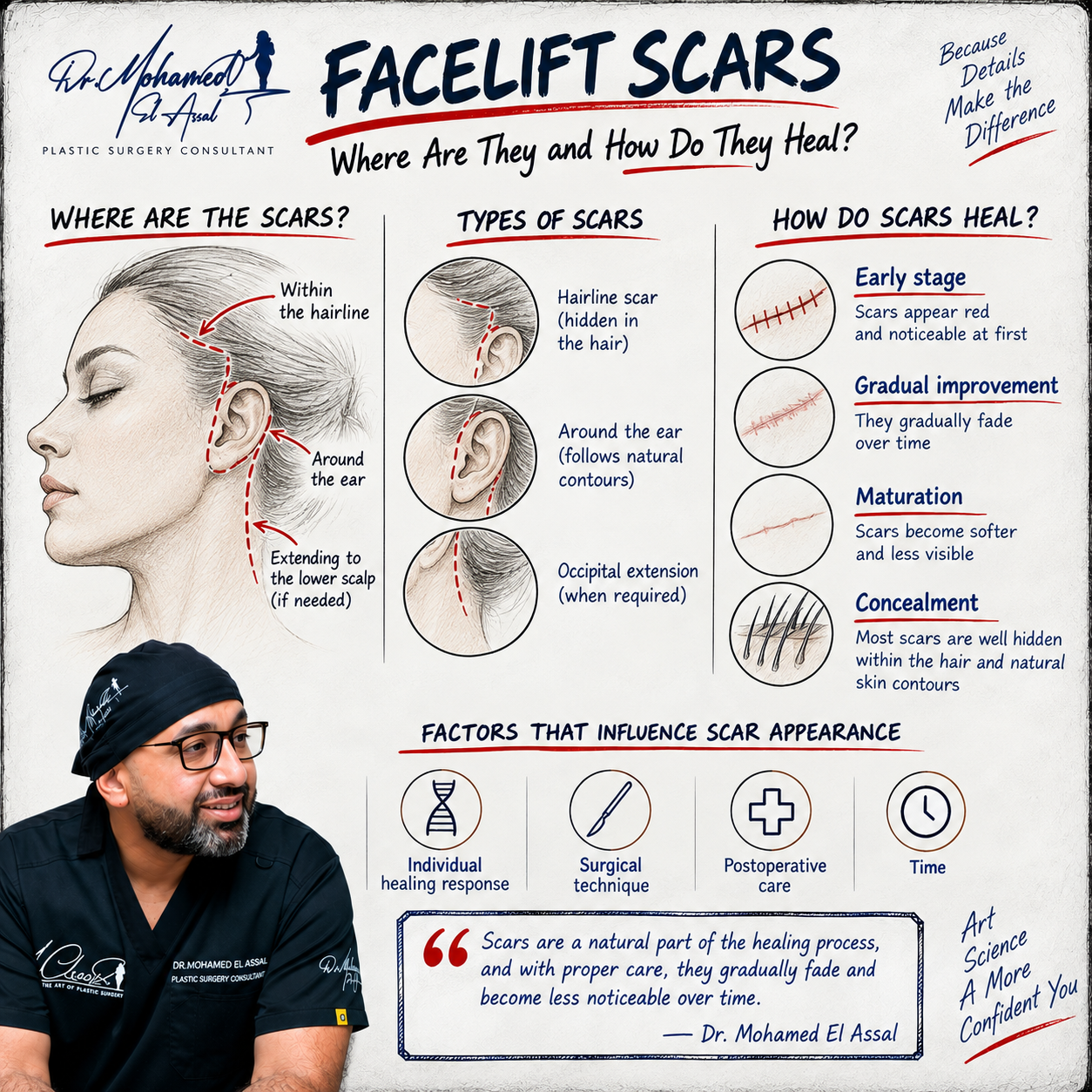
Incision patterns vary with facelift type and whether the neck is treated, but they commonly travel around the ear and within or along the hairline, sometimes extending behind the ear into posterior scalp. Some plans use an additional incision beneath the chin for neck work. The surgeon selects the route according to anatomy and required surgical access.
Why are facelift incisions placed around the ear and hairline?
These boundaries can provide surgical access while using natural contours and transitions to make a mature incision line less conspicuous. Concealment, however, does not mean that the scar vanishes. Its visibility also depends on wound tension, closure, skin characteristics, healing behavior and individual scar biology.
Does every facelift use the same incision?
No. Cleveland Clinic and ASPS describe incision length and location as technique-dependent. Limited approaches may use shorter incisions near the temples and ear, while traditional patterns extend around the ear and into the hairline. Neck treatment can also add a submental incision. The expected incision map should therefore be discussed before surgery.
Do facelift scars disappear completely over time?
No surgical scar disappears biologically. A scar is the tissue left after an incision heals. What usually changes is its color, firmness, thickness and prominence as it matures. Mayo Clinic specifically notes that facelift incision scars do not go away, although the hairline and natural contours of the face and ears often help conceal them.
What does scar maturation mean?
Scar maturation is the transition from a newly healed wound to more stable scar tissue. During the remodeling phase, collagen is reorganized and the scar may gradually soften, flatten and change color. The pace and degree of these changes vary among individuals, so an early postoperative scar should not be treated as its final appearance.
How does a facelift scar change during healing?
Scars progress through inflammatory, proliferative and remodeling phases, so the appearance during the first weeks does not represent the mature scar. A new incision can look pinker, firmer or more noticeable before gradually softening and fading. Remodeling continues for months, and visible scar change may continue longer in some patients depending on individual healing.

How long does a facelift scar take to mature?
There is no single timeline for every patient. Plastic-surgery sources often describe active scar maturation over many months, while NHS guidance notes that scars can continue fading for up to two years or longer. These statements are not necessarily contradictory: remodeling and visible fading can continue at different rates, so improvement should be viewed as a gradual process.
Why do sources give different scar-healing timelines?
Sources may use different endpoints. Some describe the more active remodeling period, while others describe how long visible fading can continue. Scar location, tension, skin characteristics, health and sun exposure also affect the course. For that reason, a single number should not be used as a promise for when a facelift scar will reach its final appearance.
What factors affect how facelift scars heal?
Scar healing reflects patient, wound and surgical factors. Individual scar tendency, skin characteristics, some medical conditions, smoking, infection or delayed healing, incision location and tension across the closure can all influence appearance. Evidence reviews also emphasize incision planning, careful closure and postoperative care as important modifiable elements in reducing the risk of unfavorable facial scarring.
Why does smoking matter for facelift wound healing?
Smoking and nicotine can impair blood flow and oxygen delivery to healing tissue, increasing concern for wound-healing problems. Maintaining skin perfusion is especially important in facial surgery where tissue has been elevated and repositioned. Patients should disclose all nicotine use and follow their surgeon’s stop-and-restart instructions rather than choosing a timeline independently.
Does a history of raised scars matter?
Yes. A personal or family history of hypertrophic scars or keloids can be relevant when assessing scar risk, along with skin type, scar location and other factors. It does not guarantee the same response after a facelift, but it is useful information for preoperative counseling and for planning how scars will be monitored after surgery.
How should I care for facelift scars after surgery?
Scar care starts with the surgeon’s instructions for the incision, sutures and dressings, without adding products to an open wound on your own. Once the surface has fully healed, selected patients may use silicone, moisturization or massage, together with sun protection. The surgeon should determine when each step is safe because an open incision is not a mature scar.
Is silicone useful for every facelift scar?
Silicone gel or sheets are widely used for postsurgical scar management after the wound surface has healed, and multiple reviews support their role in appropriate cases. Application method and duration vary with the product and patient. Silicone should not be placed on an unhealed incision without medical direction, and it cannot guarantee that a scar will disappear.
When can I massage a facelift scar?
Massage is generally discussed only after the wound is closed and stable, not while there are open areas, unstable crusts or signs of infection. NHS guidance includes massage among measures that may help some healed scars, but timing around facelift incisions should come from the operating surgeon because tissues around the ear and hairline have been surgically repositioned.
Why should facelift scars be protected from the sun?
New scar tissue is more vulnerable to ultraviolet exposure, which can contribute to persistent color change. NHS and ASPS guidance therefore recommends protecting healing scars from direct sun using appropriate covering and sunscreen once the skin is healed enough for topical products. The exact duration and product choice should follow the surgeon’s advice and the condition of the incision.
Is sunscreen alone enough for a healing facelift scar?
Sunscreen is one part of protection rather than the only measure. Limiting direct exposure, using a hat or physical covering, and applying sunscreen to healed skin can be combined. Sources differ somewhat on the recommended duration and specific protection level, so the practical plan should follow surgeon guidance and avoid topical products on an unclosed wound.
When does a facelift scar need medical review?
Contact your surgeon if an incision opens, develops drainage, increasing redness, worsening pain or other signs of infection, or if a scar becomes persistently thick, raised, itchy or otherwise troublesome. Early assessment can distinguish expected healing changes from a problem that needs treatment. Self-diagnosing a scar or starting injections, lasers or other therapies independently is not recommended.
What is the difference between a hypertrophic scar and a keloid?
A hypertrophic scar is raised and thickened but generally remains within the boundaries of the original wound, whereas a keloid can extend beyond the original injury. Diagnosis depends on examination and history. Early redness or thickness alone is not enough to label a scar abnormal because normal scars can look more active during the maturation process.
What can be done if a facelift scar remains noticeable after healing?
If a scar remains troublesome after its stage of maturation is assessed, options can be selected according to scar type and location. These may include silicone, tension-reduction strategies, selected injections, laser-based treatments or surgical scar revision in appropriate cases. No single treatment has proven superior for every scar, so management should begin with diagnosis rather than a product.
Does scar treatment start only after a scar becomes obvious?
No. Prevention begins before and during surgery through incision planning, tension reduction and careful closure, then continues with postoperative wound care. Treatments aimed at an established raised, widened or discolored scar are selected later according to diagnosis. Timing matters because a scar naturally changes during remodeling, and an early scar may improve without aggressive intervention.
Dr. Mohamed El Assal – Expertise
Dr. Mohamed El Assal’s surgical philosophy reflects a firm commitment to patient safety, long-lasting results, and natural-looking facial rejuvenation. Understanding facelift scars, including where they are typically located and how they heal over time, is an important part of setting realistic expectations and helping patients make informed decisions about their facelift journey. Facelift scars are usually carefully placed around the ears, along the hairline, and sometimes beneath the chin, depending on the surgical technique and the extent of the procedure. Although scars are an inevitable part of any surgical incision, they are generally positioned in discreet areas to make them less noticeable. Their appearance and healing process can vary depending on the surgical approach, skin type, individual healing response, and postoperative care. In most cases, scars appear more noticeable during the early stages of recovery and gradually fade over the following months, although complete scar maturation may take up to a year or longer. Particular importance is placed on careful patient assessment, precise incision placement, meticulous surgical technique, and appropriate postoperative care tailored to each individual. His approach emphasizes following recovery instructions, keeping incision sites clean, protecting healing scars from sun exposure, avoiding unnecessary tension on the incisions, and attending scheduled follow-up appointments to monitor healing and support optimal results. The goal is to achieve a refreshed, youthful, and natural-looking facial appearance while minimizing visible scarring and helping patients understand the normal stages of scar healing, recognize potential warning signs, and maintain realistic expectations throughout the recovery process.
Frequently asked questions about facelift scars
Does a facelift leave a scar?
Yes. Every surgical incision heals with a scar, and facelift surgery is no exception. Surgeons usually place incisions along natural contours around the ear and hairline to make them less conspicuous. Mayo Clinic notes that the scars do not disappear completely. Final appearance varies with technique, skin characteristics, wound healing and individual scar biology.
Are facelift scars in front of the ear or behind it?
They may pass in front of or around the ear and extend behind it and into the hairline, depending on the facelift and whether the neck is treated. Some techniques use shorter patterns, and selected neck procedures add a submental incision. There is therefore no single incision map that applies to every facelift patient.
Is it normal for a facelift scar to look red at first?
A new scar can appear pink or relatively red and may feel firmer or look more noticeable during early healing before gradually changing with collagen remodeling. Color and timing vary. Increasing redness accompanied by worsening pain, drainage, fever or other concerning symptoms should be reported to the surgeon because it may indicate a wound problem rather than normal maturation.
When can I start silicone on a facelift scar?
Silicone is generally used after the skin surface is fully closed and healed rather than on an open incision, but your surgeon should decide the starting point after examining the wound. Products and schedules vary, and silicone cannot guarantee scar disappearance. Follow the prescribed plan instead of adding gel or sheets independently during early healing.
Can sunlight make a facelift scar darker?
Ultraviolet exposure can contribute to color change in immature scars, which is why NHS and ASPS guidance emphasizes sun protection during scar maturation. Protection can include covering and sunscreen on healed skin as directed. Avoid applying products directly to an incision that has not fully closed unless your surgical team specifically advises it.
Can a thick or raised facelift scar be improved?
Some thick or raised scars can be improved, but treatment depends on the diagnosis, scar maturity, location and medical history. Options may include silicone, injections, laser-based treatment or other approaches, and occasionally surgical revision. There is no single treatment appropriate for every scar, so examination should come before selecting a scar procedure.
How does Dr. Mohamed El Assal approach incision placement and scar care?
Planning starts by defining the facelift required and selecting an incision route that provides surgical access while respecting ear contours, hairline position and skin tension as much as possible. After surgery, wounds and scars are reviewed through healing, with cleaning, sun protection and any additional scar-care measures individualized according to how each patient’s incisions are progressing.
For more detail about the operation itself, read: Face Lift. [Internal Link → Face Lift]
CTA: If scarring is one of your main concerns before facelift surgery, discuss the expected incision map, your previous scar history, smoking or nicotine use, and postoperative scar-care plan during consultation. Understanding where the incisions are likely to sit and how scars mature supports realistic expectations without promising that they will disappear.
Internal Links
• Face Lift — https://drmohamedelassal.com/service/face-lift/
References
Mayo Clinic. Face-lift. https://www.mayoclinic.org/tests-procedures/face-lift/about/pac-20394059
Cleveland Clinic. Facelift (Rhytidectomy): What Is It, Recovery & What to Expect. https://my.clevelandclinic.org/health/treatments/11023-facelift
Cleveland Clinic Cosmetic & Plastic Surgery. Facelift (Rhytidectomy). https://my.clevelandclinic.org/cosmetic-plastic-surgery/procedures/facelift
American Society of Plastic Surgeons (ASPS). Facelift Procedure Steps. https://www.plasticsurgery.org/cosmetic-procedures/facelift/procedure
American Society of Plastic Surgeons (ASPS). What to expect as a scar heals following plastic surgery. https://www.plasticsurgery.org/news/articles/what-to-expect-as-a-scar-heals-following-plastic-surgery
American Society of Plastic Surgeons (ASPS). Fun in the sun: Protecting your plastic surgery scars. https://www.plasticsurgery.org/news/articles/fun-in-the-sun-protecting-your-plastic-surgery-scars
NHS. Scars. https://www.nhs.uk/conditions/scars/
Son D, Harijan A. Overview of surgical scar prevention and management. J Korean Med Sci. 2014. https://pubmed.ncbi.nlm.nih.gov/24932073/
Kridel RWH, et al. Techniques for Creating Inconspicuous Facelift Scars: An Update. Facial Plast Surg Aesthet Med. 2025. https://pubmed.ncbi.nlm.nih.gov/36749164/
Hom DB, Bernstein JD. Reducing Risks of Facial Scarring. Facial Plast Surg Clin North Am. 2023. https://pubmed.ncbi.nlm.nih.gov/37001923/
Marshall CD, et al. Strategies to Minimize Surgical Scarring. Adv Wound Care. 2022. https://pubmed.ncbi.nlm.nih.gov/34416825/
Commander SJ, et al. Update on Postsurgical Scar Management. Semin Plast Surg. 2016. https://pubmed.ncbi.nlm.nih.gov/27478420/
Ho E, Latif J, Meller C. Improving facial scar outcomes: an evidence-based update. Curr Opin Otolaryngol Head Neck Surg. 2026. https://pubmed.ncbi.nlm.nih.gov/42267491/
Dr. Mohamed El Assal. Face Lift. https://drmohamedelassal.com/service/face-lift/
Medically reviewed by Dr. Mohamed El Assal, Consultant Plastic Surgeon