Breathing Problems After Rhinoplasty: What Is Normal and When Should You Worry?
breathing problems after rhinoplasty
nasal obstruction after rhinoplasty; blocked nose after rhinoplasty; difficulty breathing after nose job; nasal valve collapse after rhinoplasty; deviated septum after rhinoplasty; nasal adhesions after surgery; turbinate hypertrophy rhinoplasty; septal hematoma after rhinoplasty; revision rhinoplasty breathing
Breathing Problems After Rhinoplasty: What Is Normal and When Should You Worry?
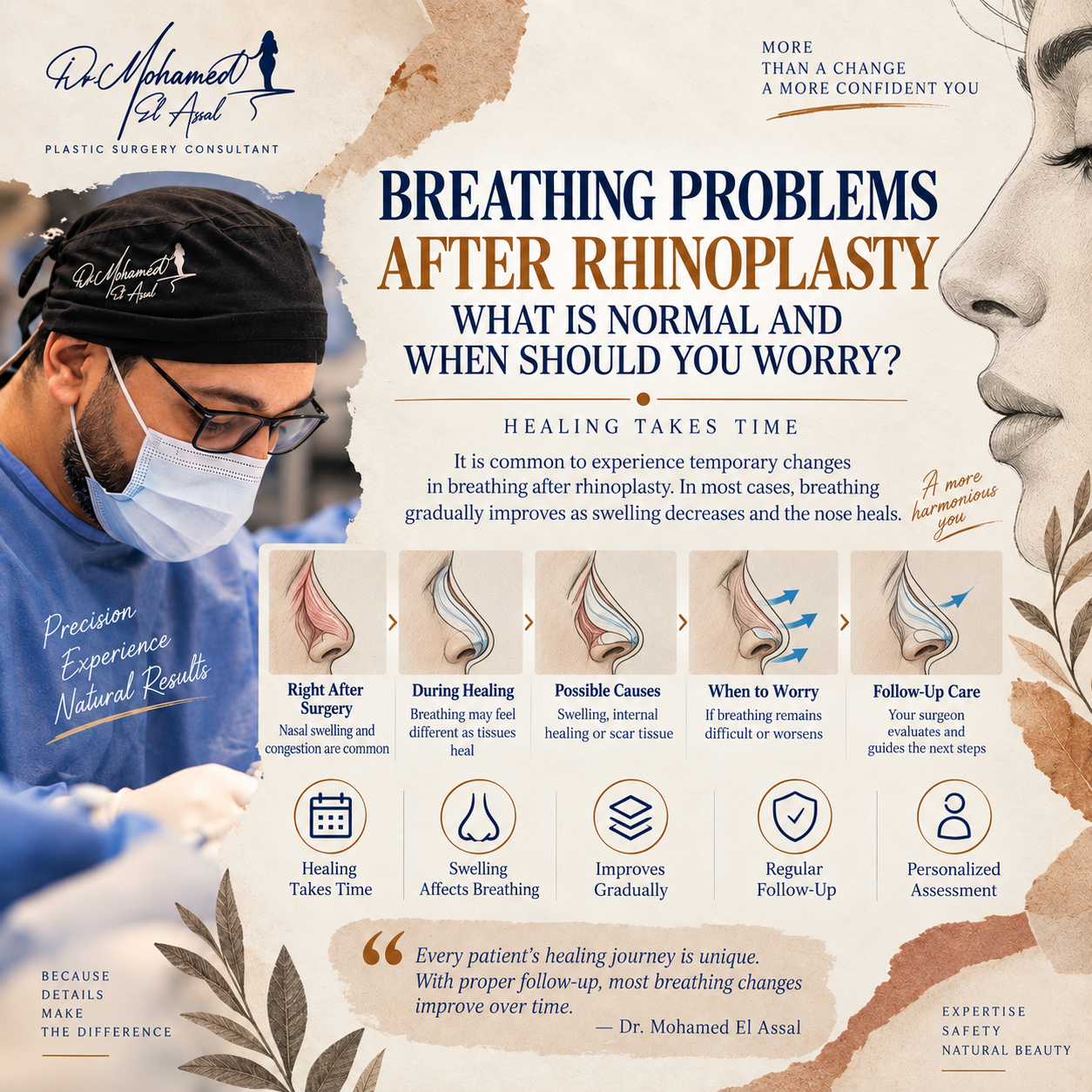
Breathing can feel temporarily restricted after rhinoplasty because swelling, internal splints or packing, crusting and secretions narrow the nasal passages. Persistent, severe or worsening obstruction deserves assessment because septal deviation, nasal valve dysfunction, turbinate enlargement, adhesions or structural support problems can also restrict airflow. Symptoms alone cannot reliably identify which structure is responsible.
This guide focuses on why breathing difficulty may persist or appear after rhinoplasty, how surgeons evaluate the airway, which warning signs need prompt contact, and when revision treatment may be considered. For a broader week-by-week discussion of early congestion and routine recovery, read: Rhinoplasty Recovery Timeline. [Internal Link → Rhinoplasty Recovery Timeline]
This guide focuses on why breathing difficulty may persist or appear after rhinoplasty, how surgeons evaluate the airway, which warning signs need prompt contact, and when revision treatment may be considered. For a broader week-by-week discussion of early congestion and routine recovery, read: Rhinoplasty Recovery Timeline. [Internal Link → Rhinoplasty Recovery Timeline]
Is difficulty breathing after rhinoplasty normal?
Temporary nasal blockage is common early after rhinoplasty because mucosal swelling, splints or packing when used, crusting and secretions can narrow the airway. The overall trend should be toward improvement as healing progresses. Severe obstruction, symptoms that worsen rather than improve, or persistent blockage after early healing should be assessed instead of automatically attributed to normal recovery.
How is early congestion different from persistent obstruction?
Early congestion is usually linked to temporary postoperative swelling and internal healing changes and should gradually improve. Persistent obstruction, or blockage that appears after a period of better breathing, raises a different question: whether septal deviation, nasal valve narrowing, turbinate hypertrophy, scar adhesions or loss of structural support is contributing to the airway problem.
What can cause persistent breathing problems after rhinoplasty?
Post-rhinoplasty obstruction can have more than one cause. Possibilities include ongoing mucosal swelling, residual or new septal deviation, internal or external nasal valve narrowing, intranasal adhesions, inferior turbinate hypertrophy and changes in structural support. In the early postoperative period, a suspected septal hematoma is an important complication that requires prompt direct examination.
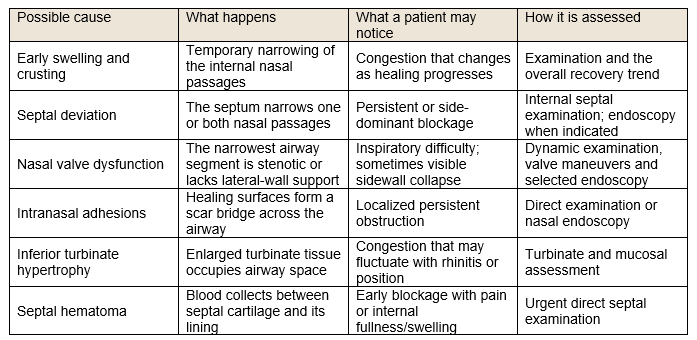
How can a deviated septum cause breathing problems after rhinoplasty?
The nasal septum divides the nose into two air passages, and a residual, recurrent or previously unaddressed deviation can narrow airflow after rhinoplasty. Caudal and other strategically located deviations may be especially important functionally. The septum must be examined internally because external appearance alone cannot show the exact site or functional significance of a deviation.
Does every septal deviation need another operation?
No. Treatment depends on symptom severity, the location of the deviation, its effect on daily breathing and whether other causes coexist. Turbinate enlargement, mucosal disease or nasal valve dysfunction may contribute alongside the septum. Identifying the dominant obstructive site is important before considering any corrective procedure rather than treating an anatomical finding in isolation.
What is the nasal valve and how can it cause obstruction after rhinoplasty?
The nasal valve is the narrowest functional segment of the nasal airway. It can become stenotic or lose lateral-wall support because of native anatomy, trauma or previous nasal surgery. When support is insufficient, the sidewall may narrow further during inspiration. Internal and external valve problems are distinct, and collapse is not always obvious from appearance alone.
How does a surgeon evaluate the nasal valve?
The surgeon watches the nostrils and lateral nasal walls during breathing and may use the Cottle maneuver or a modified maneuver to support a specific region and assess airflow change. Nasal endoscopy can help inspect internal structures and exclude competing causes. A positive maneuver by itself is not a self-diagnosis or a prescription for a specific operation.
Can scar adhesions inside the nose cause breathing difficulty?
Yes. Intranasal adhesions, also called synechiae, can form when opposing mucosal surfaces heal together after nasal surgery. If a scar bridge crosses a functionally important part of the airway, it can create localized obstruction. Diagnosis is generally made by direct examination or nasal endoscopy, and management depends on the adhesion’s location, extent and surrounding anatomy.
Does all internal scar tissue mean I have an adhesion?
No. Normal healing produces internal tissue changes and scarring that do not necessarily obstruct airflow. A clinically important synechia is an abnormal bridge between surfaces that narrows the nasal passage. Because the sensation of blockage cannot distinguish ordinary healing from an adhesion, the area needs to be visualized before attributing symptoms to scar tissue.
How can enlarged turbinates affect breathing after rhinoplasty?
The inferior turbinates are normal structures that warm, humidify and regulate inspired air, but enlargement can contribute to nasal obstruction. Hypertrophy may be related to rhinitis, mucosal inflammation or compensatory changes associated with septal deviation. Turbinates should therefore be assessed together with the septum and nasal valve rather than assuming all postoperative blockage comes from rhinoplasty shape changes.
Does turbinate enlargement always require surgery?
No. Inferior turbinate hypertrophy is heterogeneous, and management depends on its cause, symptom burden and response to appropriate treatment. Reviews compare medical and surgical approaches while emphasizing preservation of mucosal function. A specific medication or procedure should not be selected from symptoms alone; the treatment plan follows examination and identification of contributing factors.
What is a septal hematoma and why does it need prompt assessment?
A septal hematoma is a collection of blood between septal cartilage and its lining that can cause early nasal obstruction, pain and internal swelling or fullness. Because an untreated collection can compromise the cartilage’s blood supply and lead to serious structural complications, suspected septal hematoma requires urgent medical examination rather than waiting for a routine postoperative appointment.
Which symptoms should prompt immediate contact with the surgeon?
Contact the surgeon promptly or seek urgent medical assessment for rapidly worsening or severe obstruction, especially with increasing pain, concerning septal swelling, bleeding that does not settle, fever, suspicious discharge or severe breathing difficulty. These features do not prove a particular diagnosis, but they warrant direct assessment rather than self-treatment or watchful waiting.
How does a surgeon evaluate persistent nasal obstruction after rhinoplasty?
Evaluation starts with the symptom history: whether obstruction existed before surgery, when it began, whether one or both sides are affected, and whether allergy, sleep or inspiration changes it. Examination then assesses the septum, turbinates, nasal valves and external support. Nasal endoscopy and selected additional tests or imaging may be used when clinically indicated.
Does everyone with postoperative obstruction need a CT scan?
No. Many structural causes can be evaluated with history, internal examination and nasal endoscopy. CT imaging can be useful in selected situations, such as suspected sinus disease or complex internal anatomy, but it is not automatically required for every patient with breathing difficulty after rhinoplasty. Testing should answer a specific clinical question.
When is breathing difficulty after rhinoplasty an urgent warning sign?
Urgent review is appropriate when breathing difficulty is severe or rapidly worsening, or when it occurs with persistent bleeding, unusually increasing pain, concerning internal septal swelling, fever, signs of infection or general deterioration. Early congestion that is steadily improving is different and is usually followed according to the operating surgeon’s postoperative instructions and scheduled examinations.
Should I wait for my next appointment if the blockage is getting worse?
Do not simply wait for a routine appointment when there is clear deterioration or a warning sign. Contact the operating surgeon or an urgent medical service according to symptom severity. Avoid inserting instruments, removing splints or packing yourself, or starting unprescribed treatment because the cause may require direct examination and time-sensitive management.
When is treatment or revision surgery considered for breathing problems?
Treatment is based on the cause rather than symptom duration alone. Urgent complications are managed when identified, while nonurgent structural problems are reassessed as healing makes anatomy clearer. If persistent obstruction results from septal deformity, nasal valve dysfunction, support loss or adhesions, targeted treatment or revision rhinoplasty may be discussed after a complete functional evaluation.
Does every patient need to wait a full year for revision?
There is no single timing rule for every problem. Elective revision rhinoplasty is commonly delayed until tissues have matured enough for reliable assessment, with about a year often used as a practical benchmark. An urgent complication or significant functional problem may require earlier treatment, however. Timing should follow the diagnosis, healing stage and surgeon’s judgment.
If persistent breathing difficulty is linked to structural changes from a previous operation, read: Revision Rhinoplasty. [Internal Link → Revision Rhinoplasty]
If persistent breathing difficulty is linked to structural changes from a previous operation, read: Revision Rhinoplasty. [Internal Link → Revision Rhinoplasty]
How can I avoid self-diagnosing nasal obstruction after rhinoplasty?
The sensation of blockage does not reliably identify the obstructed structure. Swelling, septal deviation, turbinate enlargement, nasal valve dysfunction and adhesions can produce overlapping symptoms. Avoid forceful self-testing, inserting objects or judging internal anatomy from photographs. Note the timing, side, triggers and associated symptoms, then bring that information to the surgeon for direct examination.
Dr. Mohamed El Assal – Expertise
Dr. Mohamed El Assal's surgical philosophy in addressing breathing problems after rhinoplasty reflects a firm commitment to restoring nasal function while preserving natural aesthetics. Every treatment plan is tailored to the patient's individual nasal anatomy, airway condition, septal structure, and cartilage support, with particular emphasis on identifying the underlying cause of breathing difficulties. His approach prioritises a comprehensive clinical assessment and an individualised surgical strategy aimed at improving airflow, maintaining structural stability, and preserving the natural appearance of the nose — achieving a balance between functional improvement and aesthetic harmony, without generic templates or one-size-fits-all solutions.
Frequently asked questions about breathing problems after rhinoplasty
How long is difficulty breathing normal after rhinoplasty?
Nasal breathing can be more difficult early on because of swelling, splints or packing when used, crusting and secretions, and it should gradually improve as healing progresses. There is no single duration for everyone because procedures and tissues differ. Worsening obstruction or a lack of progressive improvement should be discussed with the surgeon.
Is blockage on only one side normal after rhinoplasty?
Temporary side-to-side differences can occur from swelling or crusting, but persistent unilateral blockage may also reflect septal deviation, turbinate enlargement, a localized adhesion or valve narrowing. Symptoms alone cannot distinguish these possibilities. If one-sided obstruction persists, becomes severe or worsens, an internal examination is more useful than self-testing.
How can I tell if the problem is nasal valve collapse?
Nasal valve dysfunction may cause inspiratory difficulty or visible inward movement of the lateral wall, but it cannot be reliably diagnosed at home. A clinician examines the nose during breathing and may use Cottle or modified valve maneuvers and nasal endoscopy to localize narrowing and rule out septal or turbinate causes.
Can adhesions cause nasal blockage after surgery?
Yes. Opposing mucosal surfaces can heal together and form an intranasal adhesion that narrows part of the airway. However, the feeling of obstruction does not prove an adhesion is present. Direct examination or nasal endoscopy can show whether a scar bridge exists, whether it affects airflow and what management is appropriate.
Does breathing difficulty mean I need revision rhinoplasty?
No. Early obstruction is often temporary, and some persistent causes can be managed without a full revision operation. Revision rhinoplasty is considered when evaluation identifies a structural problem that requires reconstruction or correction. The decision depends on the cause, severity, healing stage, nasal function and anatomy rather than the symptom alone.
When should I call my surgeon urgently?
Contact your surgeon promptly for severe or rapidly worsening breathing difficulty, bleeding that does not settle, unusually increasing pain, concerning septal swelling, fever, suspicious discharge or general deterioration. These symptoms do not establish a diagnosis, but they justify direct assessment rather than waiting, manipulating the nose or starting treatment on your own.
How does Dr. Mohamed El Assal evaluate breathing problems after rhinoplasty?
The assessment first distinguishes temporary healing-related obstruction from a structural airway problem. It considers the septum, nasal valves, turbinates, intranasal adhesions and cartilage support, together with the previous operation and current breathing function. If correction is needed, planning targets the identified cause while considering nasal form and function as parts of the same reconstruction.
CTA: If breathing difficulty persists after rhinoplasty or appears after an initial period of improvement, schedule an assessment with Dr. Mohamed El Assal, Consultant Plastic Surgeon, to evaluate the nasal airway and discuss cause-specific options. If symptoms are severe or worsening rapidly, contact the operating surgeon or an urgent medical service rather than waiting for a routine visit.
CTA: If breathing difficulty persists after rhinoplasty or appears after an initial period of improvement, schedule an assessment with Dr. Mohamed El Assal, Consultant Plastic Surgeon, to evaluate the nasal airway and discuss cause-specific options. If symptoms are severe or worsening rapidly, contact the operating surgeon or an urgent medical service rather than waiting for a routine visit.
Internal Links
References
Mayo Clinic. Rhinoplasty. https://www.mayoclinic.org/tests-procedures/rhinoplasty/about/pac-20384532
Mayo Clinic. Evaluation and decision-making in functional rhinoplasty for persistent nasal obstruction. https://www.mayoclinic.org/medical-professionals/otolaryngology/news/evaluation-and-decision-making-in-functional-rhinoplasty-for-persistent-nasal-obstruction/mac-20608806
Cleveland Clinic. Rhinoplasty (Nose Job): Surgery, Recovery, Before & After. https://my.clevelandclinic.org/health/treatments/11011-rhinoplasty
Cleveland Clinic. Nasal Valve Collapse: Symptoms, Causes, Test & Treatment. https://my.clevelandclinic.org/health/diseases/24977-nasal-valve-collapse
Cleveland Clinic. Septoplasty: Procedure & Recovery. https://my.clevelandclinic.org/health/treatments/17779-septoplasty
Joe SA. The assessment and treatment of nasal obstruction after rhinoplasty. Facial Plast Surg Clin North Am. 2004. https://pubmed.ncbi.nlm.nih.gov/15337113/
Friedman O, et al. Nasal Obstruction and Rhinoplasty: A Focused Literature Review. 2020. https://pubmed.ncbi.nlm.nih.gov/32328743/
Stępiński MJ, Banaszewski J. Intranasal Synechiae as Complications of Rhinosurgical Treatment—A Review of Current Knowledge. 2023. https://pubmed.ncbi.nlm.nih.gov/37959296/
Downs BW. The Inferior Turbinate in Rhinoplasty. Facial Plast Surg Clin North Am. 2017. https://pubmed.ncbi.nlm.nih.gov/28340648/
Winkler A, Sokoya M. Causes and Prevention of Secondary Obstruction. Facial Plast Surg. 2016. https://pubmed.ncbi.nlm.nih.gov/26862967/
Şeneldir S. Photographic Atlas of Rhinoplasty. Springer; 2021. Chapters addressing septum, airway-supporting structures and revision rhinoplasty. https://doi.org/10.1007/978-3-030-44325-2
Dr. Mohamed El Assal. Rhinoplasty. https://drmohamedelassal.com/service/rhinoplasty/
Dr. Mohamed El Assal. Revision Rhinoplasty. https://drmohamedelassal.com/service/revision-rhino/
Dr. Mohamed El Assal. Revision Rhinoplasty — Arabic. https://drmohamedelassal.com/ar/service/revision-rhino/
Medically reviewed by Dr. Mohamed El Assal, Consultant Plastic Surgeon